
Why Carney, Macron met in St. Pierre and Miquelon
Advertisement
Read this article for free:
or
Already have an account? Log in here »
We need your support!
Local journalism needs your support!
As we navigate through unprecedented times, our journalists are working harder than ever to bring you the latest local updates to keep you safe and informed.
Now, more than ever, we need your support.
Starting at $15.99 plus taxes every four weeks you can access your Brandon Sun online and full access to all content as it appears on our website.
Subscribe Nowor call circulation directly at (204) 727-0527.
Your pledge helps to ensure we provide the news that matters most to your community!
To continue reading, please subscribe:
Add Brandon Sun access to your Free Press subscription for only an additional
$1 for the first 4 weeks*
- Enjoy unlimited reading on brandonsun.com
- Read the Brandon Sun E-Edition, our digital replica newspaper
*Your next Free Press subscription payment will increase by $1.00 and you will be charged $20.95 plus GST for four weeks. After four weeks, your payment will increase to $24.95 plus GST every four weeks.
Read unlimited articles for free today:
or
Already have an account? Log in here »
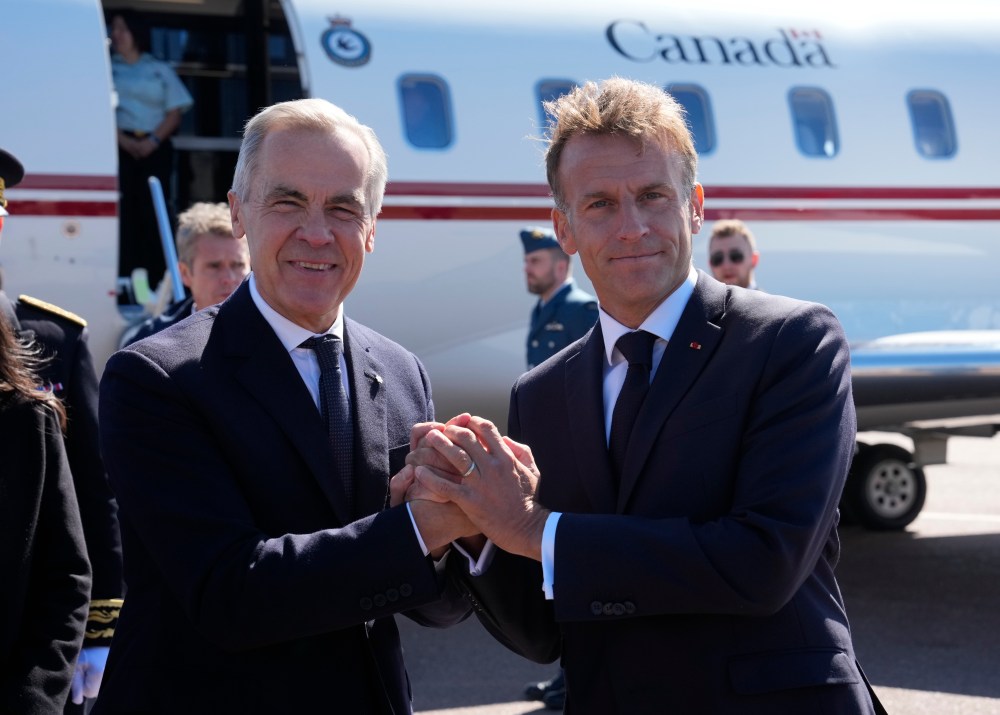
Canadian Prime Minister Mark Carney did not need to cross the Atlantic to meet Emmanuel Macron on French soil over the weekend. Instead, he joined the French president in St. Pierre and Miquelon, just 25 kilometres off Newfoundland.
It was the first official visit to the archipelago by a Canadian prime minister.
The visit brought together a contentious shared history, Canada’s rapprochement with Europe and St. Pierre and Miquelon’s search for new development opportunities.
Covering 242 square kilometres and home to around 6,000 people, the archipelago rarely attracts international attention.
Yet its location gave the weekend meeting particular significance as France and Canada seek closer ties amid growing tensions with the United States.
After repeatedly threatening to make Canada a 51st state, U.S. President Donald Trump recently posted a map depicting an expanded U.S. encompassing Canada, Greenland and St. Pierre and Miquelon.
From fishing disputes to common ground
Evidence of Indigenous presence in St. Pierre and Miquelon dates back nearly 5,000 years. It later attracted European explorers, including Frenchman Jacques Cartier in 1536.
Fiercely contested by France and Great Britain, the islands changed hands repeatedly before returning permanently to French control in 1816.
Fishing drove their strategic value. Even as France lost most of its North American possessions, international treaties preserved French fishing rights off Newfoundland, with St. Pierre and Miquelon serving as a fishing outpost. These privileges later fuelled Franco-Canadian disputes over access to the Grand Banks and quotas.
Tensions peaked in 1988, with vessel seizures and diplomatic retaliation.
The relationship shifted in 1992. Canada’s cod moratorium devastated St. Pierre and Miquelon’s fishing economy, while international arbitration recognized a limited French maritime zone around the islands, including a narrow corridor south of the archipelago (nicknamed French Baguette).
Disputes nevertheless persisted. In 2014, France sought to extend its continental shelf, but Canada was opposed. St. Pierre and Miquelon therefore remains both a bridge between the two countries and a legacy of a longtime maritime rivalry.
Trump’s shadow
Located roughly 1,300 kilometres from Boston, St. Pierre and Miquelon has long attracted American attention.
In the early 20th century, U.S. Sen. Henry Cabot Lodge advocated bringing the islands under American control.
In 1941, the Franklin D. Roosevelt administration strongly opposed Gen. Charles de Gaulle’s decision to seize the territory from the Vichy regime, triggering a Franco-American diplomatic crisis.
In April 2025, Trump’s tariff announcement assigned St. Pierre and Miquelon a 50 per cent rate, among the highest listed worldwide. His latest map reinforces the uncertainty facing small territories near American power.
Canadian-European rapprochement
By meeting on French soil just off Canada’s coast, Carney and Macron reaffirmed that proximity to the U.S. does not diminish a neighbour’s sovereignty.
For Carney, the visit fits a broader effort to reduce Canada’s vulnerability to American pressure. After months of tariff disputes, the Canadian government has accelerated its search for alternatives to an increasingly unpredictable former ally.
In his high-profile Davos speech in January, Carney described a “rupture” in the international order and argued that middle powers must co-operate to reduce their exposure to economic coercion by stronger nations. His recent address to the European Parliament, as well as his visit to St. Pierre and Miquelon, is now giving that argument practical form.
At the European Parliament, Carney welcomed moves to deepen Canada-EU ties following a proposal for Canada to become an EU “associate member.”
The concept remains undefined, but discussions already span defence, energy, critical minerals and technology.
St. Pierre and Miquelon gives this broader rapprochement a concrete geography.
Although associated with the EU as an overseas country and territory, St. Pierre and Miquelon’s location gives France a territorial foothold beside Canada that could support closer European co-operation.
French outpost to Euro-Canadian corridor?
St. Pierre and Miquelon’s economy has been profoundly affected by the decline of the cod fishery, alongside a high cost of living, dependence on public transfers and imports, demographic decline and the climate threat that has already forced Miquelon to begin relocating its village.
Diversification is therefore not a distant policy goal, but an immediate local concern.
Canada could play a central role in several of these development prospects.
The archipelago lies near the Atlantic Ocean’s approach to the St. Lawrence River–Great Lakes corridor, suggesting a potential role in port services.
France also envisions St. Pierre and Miquelon as a logistical base for Arctic co-operation involving Canada, Denmark and Greenland, linking the region’s security to broader European interests — a connection made more important by the recently announced U.S.-Denmark agreement.
Energy offers a further point of convergence.
In his recent address to the European Parliament, Carney proposed supplying Europe with Canadian liquefied natural gas and hydrogen, supported by new port infrastructure on Canada’s East Coast and in the High North.
St. Pierre and Miquelon could seek a supporting logistical role, subject to investment and commercial demand.
Space and digital infrastructure add another dimension: St. Pierre and Miquelon already hosts a ground-based satellite station for the European Galileo navigation system, and new submarine cable connections could position it as a transatlantic relay. Together, these prospects could give the archipelago a more active role in the growing partnership between Canada and Europe.
Trump has given France and Canada another reason to close ranks. For St. Pierre and Miquelon, the test is whether this new diplomatic attention produces lasting investment and development opportunities for its residents.
» Paco Milhiet is an associate researcher in international relations at the Institut Catholique de Paris.
» This column was originally published at The Conversation Canada: theconversation.com/ca