
It’s time that Manitoba Hydro had 21st-century leadership
Advertisement
Read this article for free:
or
Already have an account? Log in here »
We need your support!
Local journalism needs your support!
As we navigate through unprecedented times, our journalists are working harder than ever to bring you the latest local updates to keep you safe and informed.
Now, more than ever, we need your support.
Starting at $15.99 plus taxes every four weeks you can access your Brandon Sun online and full access to all content as it appears on our website.
Subscribe Nowor call circulation directly at (204) 727-0527.
Your pledge helps to ensure we provide the news that matters most to your community!
To continue reading, please subscribe:
Add Brandon Sun access to your Free Press subscription for only an additional
$1 for the first 4 weeks*
- Enjoy unlimited reading on brandonsun.com
- Read the Brandon Sun E-Edition, our digital replica newspaper
*Your next Free Press subscription payment will increase by $1.00 and you will be charged $20.95 plus GST for four weeks. After four weeks, your payment will increase to $24.95 plus GST every four weeks.
Read unlimited articles for free today:
or
Already have an account? Log in here »
With the recent resignation of its CEO Alan Danroth, Manitoba Hydro now has a chance for an overdue course correction. The propaganda spouted by its PR flaks notwithstanding, our Crown corporation has set a backward path to the era of fossil fuels, largely ignoring the rapid clean (and cheap) energy transition taking place around the globe.
Manitoba Hydro has argued that spending $3 billion on new methane (aka natural) gas generating stations is the best way to meet rising peak-load power demands, and oh, by the way, don’t worry about rising carbon emissions because we’ll hardly ever use them. Just stop and think about that. We’re going to spend (at minimum) $3 billion for something we don’t intend to use very much.
That borders on absurdity.
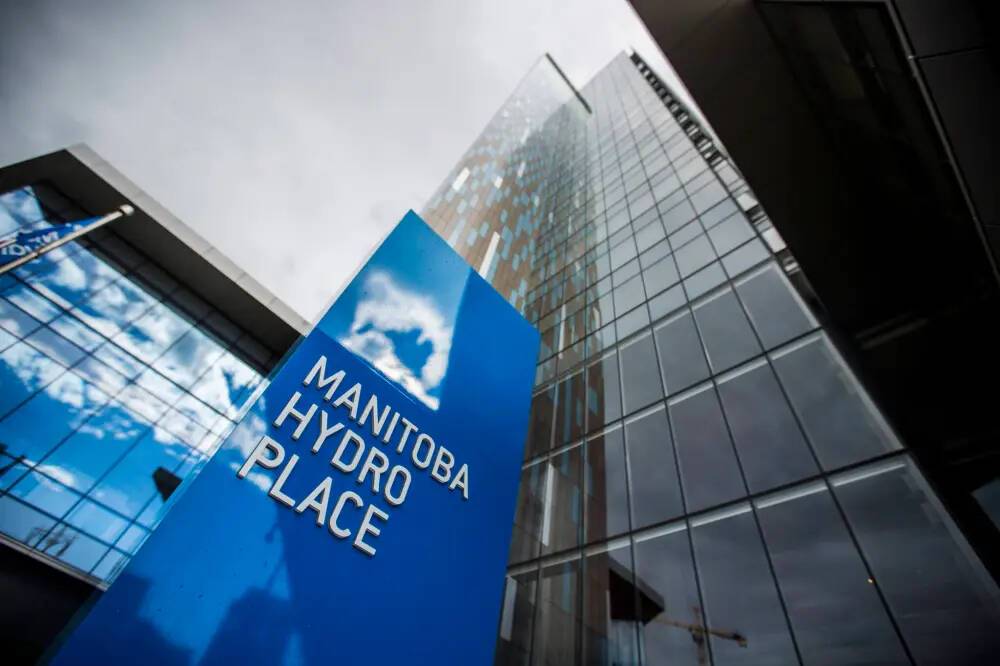
Scott Forbes writes that the recent resignation of Manitoba Hydro CEO Alan Danroth gives the Crown corporation an opportunity to make an “overdue course correction” toward a 21st-century approach. (Mikaela MacKenzie/Winnipeg Free Press files)
The much more likely scenario is that as the inevitable electrification of the economy proceeds, in tandem with rising grid demands, those methane-gas power plants will be called into service more and more.
Hydro argues that there’s nothing to worry about as our electricity grid is largely based on clean hydro power. A bit of fossil fuel burning won’t mean much in the big picture.
But the reality is this: more than 70 per cent of Manitoba’s energy use is still fossil-fuel based, mainly from using gas and diesel for transportation and methane gas for home and industrial heating. Electrification means replacing fossil fuels with clean energy, largely from the electricity grid. If that electricity is generated more and more from fossil fuels, well, the problem becomes obvious.
To find examples of a 21st-century approach, we need only compare Manitoba Hydro to its counterparts in Quebec and British Columbia. Both Hydro Quebec and BC Hydro are moving aggressively to add wind power to the grid. That allows their reservoir system to act as an effective battery, by substituting wind power for hydro when there’s a surplus. Water held behind the dams can be saved for later peak loads.
Quebec Hydro is far out in front with wind generation: 4,000 MW built, another 10,000 MW scheduled to come online by 2035. BC Hydro is also moving rapidly in that direction: 700 MW built, another 1,500 MW by 2032-33. Manitoba Hydro, by comparison, has barely dipped its toes in the water: 258 MW built, another 600 MW planned for 2035. Quebec and B.C. are also moving to add grid-scale batteries to firm intermittent wind and solar power into reliable base-load power. Without this, the utilities only count roughly 15 per cent of wind power toward base load. With batteries in place, that rises to more than 40 per cent.
The clean energy transition is based chiefly on growing wind and solar energy, and to some extent, geothermal power. Any utility that does not recognize this global change lives in the past. And that is where our Crown corporation finds itself.
Manitoba Hydro lags far behind its counterparts in B.C. and Quebec in promoting the energy transition.
Just one example is EV charging infrastructure. BC Hydro has already built 917 charging stations at 190 sites, and will expand that to 3,500 charging ports by 2035. B.C. has completed its electric highway with charging stations 150 kilometres apart on every major highway and travel corridor.
Quebec Hydro? Even better. It has already built more than 8,000 charging ports at 3,500 charging stations and Quebec’s Green Economy plan expands that to more than 100,000 charging ports by 2030.
And Manitoba Hydro? It has not yet finished any charging stations.
It has plans for six charging sites on Highway 6 by next year. If Manitoba wants a 21st-century economy, it needs a 21st-century power utility.
Our next Hydro CEO should come not from the fossil fuel sector, but from firms specializing in the burgeoning clean energy. Capital Power, where Danroth was an executive before his brief stint with Hydro (among other jobs he held), came from the fossil fuel side. While Capital Power produces a bit of renewable energy, 85 to 90 per cent of its power comes from methane gas. It even boasts on its website that “the natural gas expansion era has arrived.” Little surprise then that Manitoba Hydro chose that wrong-headed direction.
Any new Manitoba Hydro CEO should be tasked with building a robust wind, solar, geothermal and storage division. A 21st-century Manitoba Hydro needs to move aggressively to acquire the expertise in-house to build out new sources of renewable energy, including staffing up an environmental stewardship division to minimize adverse impacts — e.g., bird and bat mortality at wind turbines. Cheap, clean, reliable renewable energy is not the future but the present.
The 21st century is now more than a quarter over. It’s waiting for Manitoba to join it.
» Scott Forbes is an ecologist at the University of Winnipeg. This column also appeared in the Winnipeg Free Press.