
4 steps Canada must take before an EU associate membership
Advertisement
Read this article for free:
or
Already have an account? Log in here »
We need your support!
Local journalism needs your support!
As we navigate through unprecedented times, our journalists are working harder than ever to bring you the latest local updates to keep you safe and informed.
Now, more than ever, we need your support.
Starting at $15.99 plus taxes every four weeks you can access your Brandon Sun online and full access to all content as it appears on our website.
Subscribe Nowor call circulation directly at (204) 727-0527.
Your pledge helps to ensure we provide the news that matters most to your community!
To continue reading, please subscribe:
Add Brandon Sun access to your Free Press subscription for only an additional
$1 for the first 4 weeks*
- Enjoy unlimited reading on brandonsun.com
- Read the Brandon Sun E-Edition, our digital replica newspaper
*Your next Free Press subscription payment will increase by $1.00 and you will be charged $20.95 plus GST for four weeks. After four weeks, your payment will increase to $24.95 plus GST every four weeks.
Read unlimited articles for free today:
or
Already have an account? Log in here »
European Commission President Ursula von der Leyen has expressed hope that Canada could become the European Union’s first “associate member.” Canadian Prime Minister Mark Carney, more realistically, has called for a strong, unique alliance.
Whatever form these strengthened relations take, it’s clear the EU and Canada each have high ambitions for the other. But Europe is being courted from all sides. Competition to capture market share and attract investors there is fierce.
Canadians need to work better with Europeans, but also work better among themselves to succeed in Europe. They must develop effective work habits and organize themselves better, in a methodical and planned way, so that Canada can achieve its ambitions in Europe.
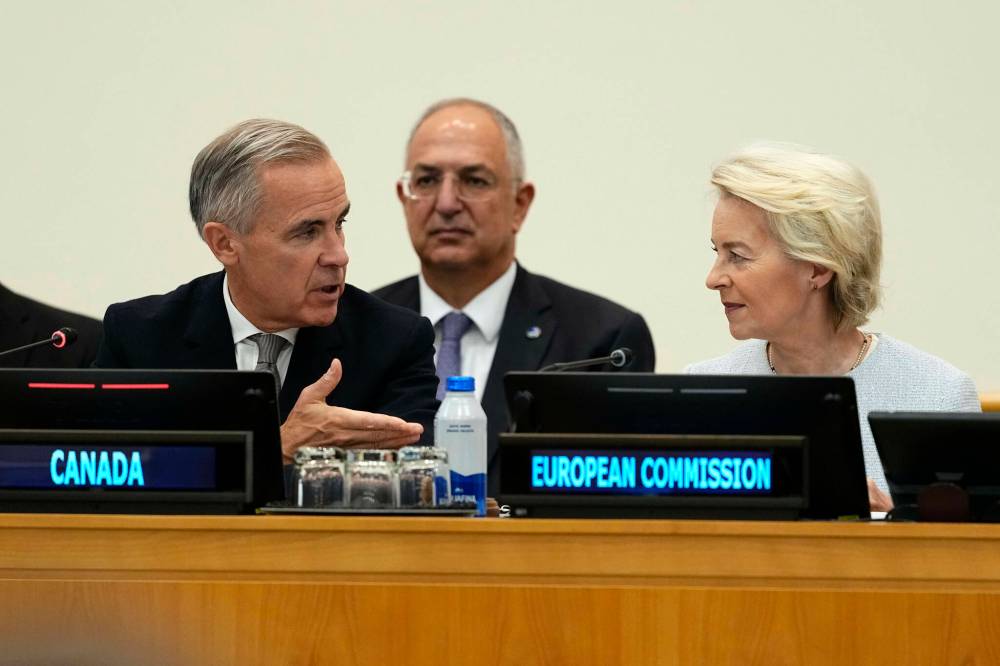
Prime Minister Mark Carney and European Commission President Ursula von der Leyen attend a high-level pledging event for the OceanEye International Alliance in support of the Global Ocean Observing System (GOOS), on Wednesday. (The Canadian Press files)
Currently a diplomat-in-residence at the Université de Montréal’s Faculty of Arts and Sciences, I served as Canada’s ambassador to Germany from 2017 to 2022, then to France until December 2025. Throughout those eight years, I also served as the Special Envoy of the Prime Minister of Canada to the European Union and Europe.
Drawing on that experience, here are four suggestions for how the Canadian government should organize itself internally to help Canada better succeed in Europe:
1. CLEAR ACCOUNTABILITY
The prime minister should systematically and officially appoint, for every agreement signed with the EU or European countries, a senior Canadian official who, together with a European counterpart, will be held accountable for its implementation. This requires clear deadlines and specific goals attached to each agreement.
This is what Carney did in the case of the Strategic Partnership with the EU signed in June 2025. He appointed his personal representative to the European Union, John Hannaford, to implement the agreement, along with Hannaford’s European counterpart.
The next Canada-EU Summit, on Oct. 29-30, must be an opportunity to take stock of what’s actually been achieved over the past year across all priority areas, to build on this momentum and take the relationship to the next level — a genuinely unique alliance.
2. ADOPT A TRUE ‘TEAM CANADA’ APPROACH
A team-based approach would be valuable for Canada’s ambitions around the world, but it’s especially needed in the European context.
Europe is the only truly integrated continent, thanks to the EU and the appeal it holds for every country that wants to join it. That’s why there’s an undeniable need for a “Team Canada” approach.
High hopes are riding on the Strategic Export Office the prime minister has just created.
But the initiative will only prove useful if its work is co-ordinated — not only with government ministries, but also with all the organizations that already exist: Export Development Canada, which provides trade financing; the Canadian Commercial Corporation, which helps Canadian companies sell to foreign governments; the Trade Commissioner Service, which builds connections on the ground; Invest in Canada, with its mission is to attract investment from everywhere, including Europe; and the new Defence Investment Agency.
If each of these bodies pulls in its own direction and becomes a state unto itself, Canada will fail.
3. MAINTAIN DIPLOMATIC RESOURCES IN EUROPE
You have to be on the ground to win. As Canada sharply increases its military spending, it must not neglect its diplomatic resources on the ground either. They are underdeveloped for a G7 country, and even by comparison with smaller, less influential countries.
Global Affairs Canada is being required to make cuts to help the government reduce its deficit. These savings must be made within the department in Ottawa, while sparing the geographic branch and Canada’s presence in the field. The number of Global Affairs staff based in Ottawa is disproportionate compared with Canadian deployment abroad, particularly when measured against what Canada’s allies do.
Above all, the Trade Commissioner Service must not be weakened, especially since it’s important to encourage Canadian companies to take greater interest in the European market. Trade commissioners guide these companies from start to finish and show them how to approach the German, French, Italian, Polish and other markets.
Canada also needs to make full use of its trade agreement with the EU — the Canada-European Union Comprehensive Economic and Trade Agreement, known as CETA — which, until recently, was only at 60 per cent of its potential, according to Global Affairs Canada’s chief economist.
4. MAKE BETTER USE OF AMBASSADORS
During my eight years as special envoy to Europe, I only ever met competent, dedicated heads of mission. At the same time, I saw how often they and their teams were kept out of essential information, because the Canadian government’s operations are too often siloed.
I propose the government adopt a four-rule protocol stating that: During bilateral meetings held on the occasion of official visits, the ambassador is always present; if there is silent monitoring of a phone call between heads of government or ministers, the ambassador is, of course, always part of the group listening in; the briefing books prepared for official visits are always reviewed by the ambassador, who has a chance to make suggestions; no matter where in the world bilateral meetings take place, the report is sent to the ambassador.
Following these four rules wouldn’t cost the government a cent, but it would make Canadian diplomacy far more effective at doing its job. Putting them into practice would leave Canada better placed to truly strengthen ties with Europe.
» Stéphane Dion is a diplomat-in-residence at the Université de Montréal’s Faculty of Arts and Sciences. This column was originally published at The Conversation Canada: theconversation.com/ca.