
Respectful separation: an obvious oxymoron
Advertisement
Read this article for free:
or
Already have an account? Log in here »
We need your support!
Local journalism needs your support!
As we navigate through unprecedented times, our journalists are working harder than ever to bring you the latest local updates to keep you safe and informed.
Now, more than ever, we need your support.
Starting at $15.99 plus taxes every four weeks you can access your Brandon Sun online and full access to all content as it appears on our website.
Subscribe Nowor call circulation directly at (204) 727-0527.
Your pledge helps to ensure we provide the news that matters most to your community!
To continue reading, please subscribe:
Add Brandon Sun access to your Free Press subscription for only an additional
$1 for the first 4 weeks*
- Enjoy unlimited reading on brandonsun.com
- Read the Brandon Sun E-Edition, our digital replica newspaper
*Your next Free Press subscription payment will increase by $1.00 and you will be charged $20.95 plus GST for four weeks. After four weeks, your payment will increase to $24.95 plus GST every four weeks.
Read unlimited articles for free today:
or
Already have an account? Log in here »
“We want a fair and respectful relationship with Canada,” Alberta separatist leader Keith Wilson told the CBC commentator. He paused. Briefly. “On our terms.”
He followed up with a poorly-veiled threat. Trade goods moving east or west across Canada, especially to and from Vancouver, must pass through Alberta, he mused, so…
Wilson and his ilk are blackmailing Canada. If they win this referendum vote, he intends — with Alberta Premier Danielle Smith’s acquiescence — to pull the pin on a genuine separation referendum grenade. The separatists’ transition plan has been largely anonymously authored — much like Trump’s blueprint Project 2025.
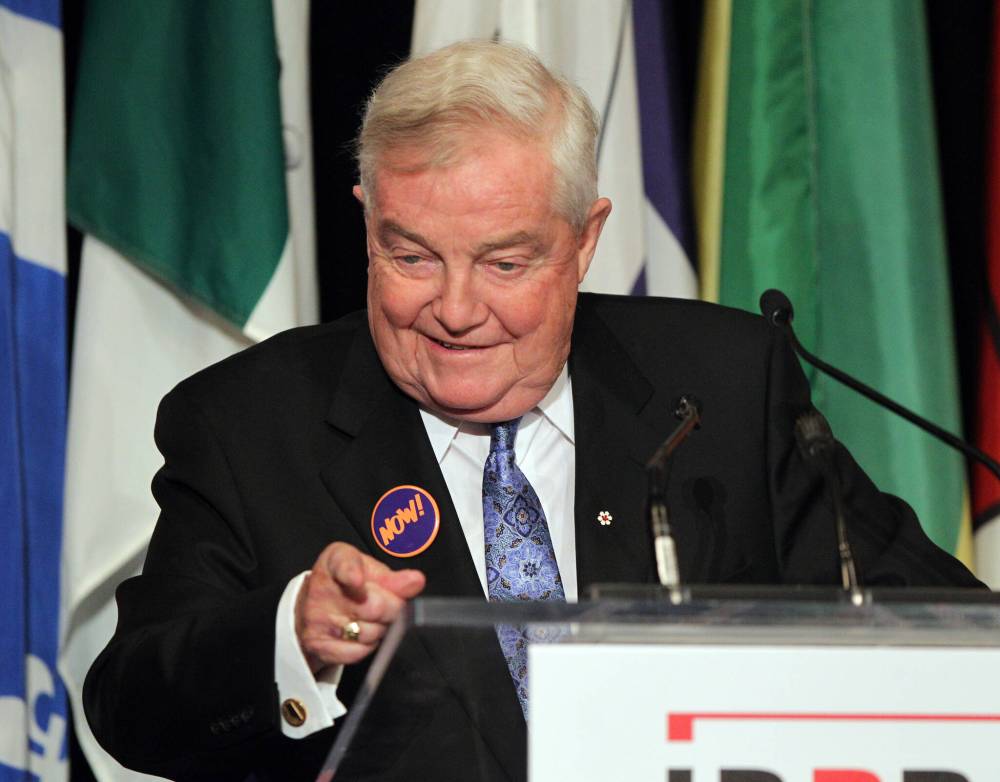
Former Alberta Premier Peter Lougheed speaking after being named the best Canadian premier of the past 40 years in 2012, as chosen in a landslide by a panel of 30 eminent historians, political scientists, economists, journalists and policy advisers from across Canada. One can only wonder what Lougheed would think about current Alberta separation. (Calgary Herald files)
Smith claims Albertans will vote against separation. She’s bluffing. Her precarious personal political survival tightrope as she tries to balance atop the UCP could easily carry Canada down a potentially disastrous road. All it will take is for separatists to turn out en masse (about 25 per cent of Albertans, if you believe the polls) and those supporting Canada to stay home because they think it’s in the bag for them.
That’s how Brexit came about, and Britain still regrets the mess that made of their economy.
Smith chose to move forward with the referendum idea. She can blame questionably-staged petitions all she wants.
The fact is, she is willing to sacrifice a whole country to try and secure her own political future. That hypocrisy has its roots in the birth of the United Conservative Party in the province, hatched in 2017 by merging the wildly right-wing, prevailingly-separatist Wildrose party and the Conservative party, neither of which could win power on their own. The party remains riven by two factions, and Smith is trying to make them both happy to save her political skin.
And if the separatists lose, they won’t go away quietly. She’ll still have to cope with them — somehow.
As the date in Alberta draws closer, pundits have repeatedly observed that Alberta’s grievances are “real.”
Are they?
Alberta’s grievances are threefold.
First, lengthy spats over federal oil and gas revenue taxation structures emerged in the 1970s. Alberta’s premier, Conservative Peter Lougheed, was outraged, but he did not threaten to take his province’s piggy bank and leave. He negotiated changes.
Second, there was the infamous National Energy Program instituted by Pierre Trudeau in 1980. It slapped federal price controls and taxes on Western Canadian oil. It was dramatically revised just a year later by the Liberal government — changes spearheaded by Lougheed. The NEP was dismantled completely by the Mulroney government within five years of its inception. Apparently the federal government, when it’s your party in power, does listen to a province.
Third, there’s the federal equalization payment system Alberta so loathes, intended to ensure all Canadians receive roughly similar social safety net programs. Under it, the feds siphon individual and corporate tax revenue out of “have” provinces (Alberta, Saskatchewan and British Columbia) and pass it on to the “have-not” provinces.
The provinces themselves do not put money directly into equalization; it has never worked that way, despite Smith’s claims. The corporations head-officed in Alberta have not left because of these taxes. They remain, and prosper there.
Saskatchewan and B.C. also have both suffered through all these federally-inflicted indignities — two of them redressed through Lougheed’s staunch statesmanship, the third of which still rankles in Alberta — and neither have at any point threatened to leave Confederation.
That’s it. That’s the essence of the boiling resentment some Albertans still nurse furiously (I have a 75-year-old friend in Calgary who still won’t shut up about it). “Western alienation” became a media byword. And Preston Manning and his new Reform party would ride that hobbyhorse (briefly) all the way to Ottawa.
Threatening to separate has worked (in astoundingly sloppy fashion) in Quebec, where angst has run far higher with far more justification, for some 70 years. The 1970 FLQ Crisis, kidnapping of British high commissioner James Cross, and murder of Quebec cabinet minister Pierre Laporte sparked Pierre Trudeau’s infamous declaration of martial law. Two referendums happened (the second painfully close; just 50.58 per cent voted no). The torpedoed Meech Lake Accord, then the Charlottetown Accord, failed to give Quebec its coveted “special status” as a “distinct society.” In 2021, the House of Commons finally passed a half-baked version of it, in a bill by the Bloc Quebecois — which is still muttering about yet another separation referendum.
Keith Wilson concedes Alberta needed Confederation from its inception in 1905 until the late 1950s. But when Alberta discovered its oil riches, that need evaporated. The Alberta separatism movement position can be summarized simply: Thanks for the help for the first five decades, now buzz off.
With Quebec, the need to preserve cultural distinction is as obvious as le nez sur ton visage.
With Alberta? History shows just as clearly that Alberta’s “grievances” have been, for the most part, resolved by discussion and negotiation, and Peter Lougheed never levelled a separation gun to the federal head. As for equalization, it’s still getting pushed around the table, and maybe that’s how it should be; Canadians talk, and compromise, and consider each other’s changing needs. Saskatchewan was once a “have-not.” Ontario was once a “have.”
No, this is not about self-determination, though many Alberta separatists cherish that deluded belief.
It’s about nursing long-held “grievances” and a desperate premier using that resentment to hang onto power. It’s about her inability to work with the federal government without throwing tantrums. It’s about money.
It’s being egged on by MAGAts in the U.S., and Russian (and possibly Chinese) trolls, fuelling the Maple MAGA contingent here, with the next logical step annexation into the U.S.
Those are lousy reasons to shred a country. Peter Lougheed would be rolling in his grave.
» A journalist since the era of Pierre Trudeau, Judy Waytiuk writes from Winnipeg. This column was originally published in the Winnipeg Free Press.