
Education alone can’t combat residential school denialism
Advertisement
Read this article for free:
or
Already have an account? Log in here »
We need your support!
Local journalism needs your support!
As we navigate through unprecedented times, our journalists are working harder than ever to bring you the latest local updates to keep you safe and informed.
Now, more than ever, we need your support.
Starting at $15.99 plus taxes every four weeks you can access your Brandon Sun online and full access to all content as it appears on our website.
Subscribe Nowor call circulation directly at (204) 727-0527.
Your pledge helps to ensure we provide the news that matters most to your community!
To continue reading, please subscribe:
Add Brandon Sun access to your Free Press subscription for only an additional
$1 for the first 4 weeks*
- Enjoy unlimited reading on brandonsun.com
- Read the Brandon Sun E-Edition, our digital replica newspaper
*Your next Free Press subscription payment will increase by $1.00 and you will be charged $20.95 plus GST for four weeks. After four weeks, your payment will increase to $24.95 plus GST every four weeks.
Read unlimited articles for free today:
or
Already have an account? Log in here »
Premier Wab Kinew has triggered a lot of attention after stating that residential school denialism should not be criminalized.
His comments were made in response to a question about Winnipeg NDP MP Leah Gazan’s private member’s bill, which aims to make condoning, denying or minimizing the residential school system a crime under the Criminal Code.
First Nations leaders, residential school survivors, and organizations such as the Manitoba Teachers’ Society have endorsed the bill, but Kinew disagrees with it.
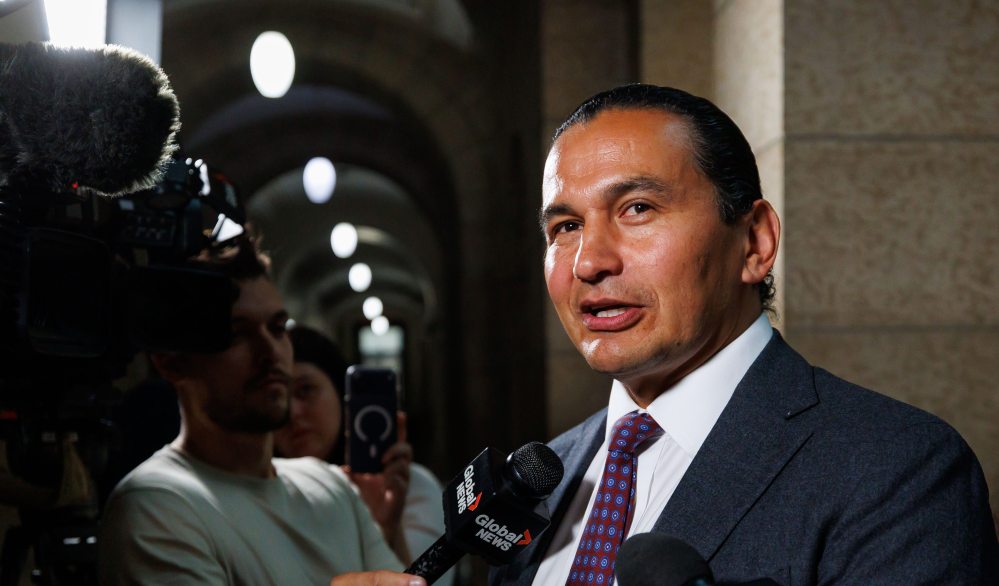
“I have a lot of respect for MP Gazan, but I don’t think we can criminalize this. I think we have to just do the continued work of educating people and trying to combat misinformation,” Kinew said.
Kinew’s words have been criticized by nearly every chiefs organization in Manitoba and many advocates, survivors and organizations such as the National Family and Survivors Circle.
“When people deliberately deny, mock or distort that truth, the harm is real,” Manitoba Keewatinowi Okimakanak Grand Chief Garrison Settee said in a news release.
“There comes a point when governments must decide whether reconciliation is simply something they speak about or something they are prepared to defend … We respectfully but firmly call upon (Kinew) and the government of Manitoba to reconsider this position and lead a national conversation with First Nations and survivors about meaningful legislative protections against residential school denialism.”
The odd thing is that Kinew didn’t need to take a stand on Gazan’s bill. The private member’s bill isn’t supported by federal Indigenous Services Minister Mandy Gull-Masty, and it isn’t expected to pass.
He could have pointed out there are many ways — indeed, some forcible — to stand up for truth and reconciliation, such as the time in 2021 that he publicly confronted then-Tory Indigenous reconciliation minister Alan Lagimodiere on his factually incorrect comments about residential schools.
Instead, the premier went out of his way to say residential school denialism should be left to the work of “education.”
The problem is that education alone cannot change society.
This lesson was learned by Germany.
Following the Second World War and the worldwide shock at the discovery of the Holocaust, elected German leaders came to the realization that the country must take collective responsibility for its past, a concept known as Vergangenheitsbewaltigung, or the “struggle to overcome the past.”
This involved a set of actions that provided restitution to those harmed by the country’s actions, the creation of memorials and commemorations, and a nationwide commitment to education about the Holocaust.
There was also the accompanying realization that a democratic state must protect itself against extremists who had used their rights under the law to institutionalize hate, destroy democracy, and justify a genocide.
The result was the creation of Section 130 of the German Criminal Code (often called Volksverhetzung, or “incitement of the masses”) that explicitly banned public denial, approval or “gross trivialization” of genocidal acts committed under the Nazi regime.
This and other related laws — such as Section 86 (the prohibition of the “public display, distribution, or production of Nazi symbols”) or Section 189 (acts that “insult the memory or dignity of Holocaust victims”) — made clear to German society that Holocaust denialism was not a protected opinion but a method used to foster extremism, promote hate and facilitate antisemitic violence.
These laws were complicated to prove and did not stop Holocaust denialism but taught citizens there are moral, responsible and ethical guidelines in a civil society and individuals must uphold certain standards of dignity and respect during interactions.
This resulted in a society-wide commitment to confronting hate that has influenced the world. Following Germany’s lead, 18 countries have criminalized Holocaust denialism.
One of them is Canada, whose legislators in June 2022 passed legislation to criminalize instances when individuals wilfully promote antisemitism by condoning, denying or downplaying the Holocaust through public statements. Guilty offenders can be imprisoned for up to two years.
The law has been as complicated as German laws (and has only been employed a few times) but has signalled to Canada’s Jewish community that antisemitism is an issue rightfully taken seriously.
While Canada’s 2022 decision to criminalize Holocaust denialism hasn’t stopped it, it has reduced acts of antisemitism to the fringe of society and forced governments, workplaces and schools to join in a collective, interdependent struggle.
Germany — and subsequently Canada — learned that confronting hate, misinformation and those who wish to profit off of the denial of truth requires a collective response.
In other words; no institution or set of individuals can do it alone.
Not schools, not Canadians or Indigenous peoples, not even the law, alone.
» Niigaan Sinclair is Anishinaabe from Peguis First Nation, a professor in the department of Indigenous studies at the University of Manitoba and a columnist for the Winnipeg Free Press.