
NDP policy shifts leave opponents in the dust
Advertisement
Read this article for free:
or
Already have an account? Log in here »
We need your support!
Local journalism needs your support!
As we navigate through unprecedented times, our journalists are working harder than ever to bring you the latest local updates to keep you safe and informed.
Now, more than ever, we need your support.
Starting at $15.99 plus taxes every four weeks you can access your Brandon Sun online and full access to all content as it appears on our website.
Subscribe Nowor call circulation directly at (204) 727-0527.
Your pledge helps to ensure we provide the news that matters most to your community!
To continue reading, please subscribe:
Add Brandon Sun access to your Free Press subscription for only an additional
$1 for the first 4 weeks*
- Enjoy unlimited reading on brandonsun.com
- Read the Brandon Sun E-Edition, our digital replica newspaper
*Your next Free Press subscription payment will increase by $1.00 and you will be charged $20.95 plus GST for four weeks. After four weeks, your payment will increase to $24.95 plus GST every four weeks.
Read unlimited articles for free today:
or
Already have an account? Log in here »
Last week, Finance Minister Adrien Sala made two announcements that showed why the NDP will remain the party to beat in the next provincial election.
The first was confirmation the province had created a special levy to be charged on electricity-guzzling crypto miners and data centres to fund an estimated $50 per household rebate on Manitoba Hydro bills.
The second was a bit of bookkeeping involving the Workers Compensation Board that, in the short term, could help Premier Wab Kinew get within striking distance of balancing the provincial budget next year — about six months before the presumed October 2027 election.
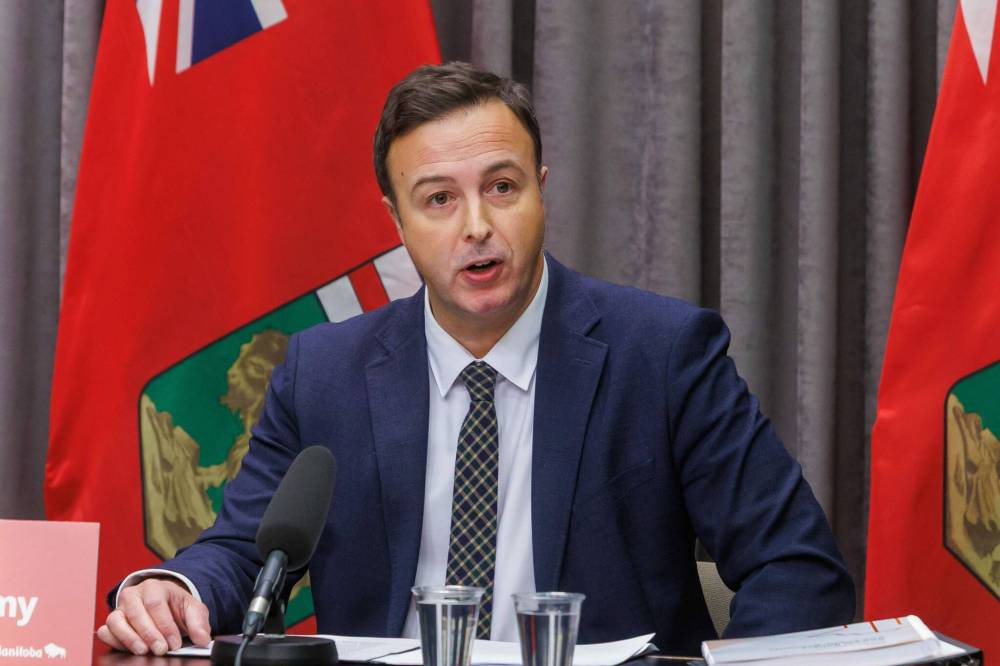
Finance Minister Adrien Sala, the minister responsible for Manitoba Hydro, said the electricity surcharge revenue on crypto and data operations will be paid directly to households. (Mike Deal/Winnipeg Free Press files)
First, the crypto/data centre levy, a gesture that is, at first glance, a bit difficult to fathom.
Manitoba’s electricity rates are regulated by the Public Utilities Board. When Hydro revenue increases — either from higher-than-expected export sales or (in this case) from a levy on energy-intensive crypto and data operations — it lowers bills either by producing a reduction or mitigating approved rate increases.
Sala, the minister responsible for Hydro, said the revenue from a surcharge on crypto and data operations using more than five megawatts of electricity — an estimated $20 million — will not flow through Hydro’s balance sheet. Instead, it will be paid directly to households.
Why go through the trouble of bypassing Hydro accounting? Governments create special rebates or tax credits when they want the electorate to know who is helping them and by how much.
It’s not unethical, but it is decidedly political.
There are a lot of ‘ifs’ in this equation. If there are enough crypto mining entities and if they don’t flee the province with their hair on fire, then Sala will get the revenue and Manitobans will get a rebate.
The political value for the NDP comes from the fact that Manitoba will have established itself as hostile to crypto miners and data centres. Given the broad unpopularity of businesses that use enormous amounts of electricity and water but return very little in direct economic benefits, this is destined to be a winner with voters.
Which brings us to the Workers Compensation Board move.
Sala announced that starting in the 2026-27 fiscal year, the balance sheet of the WCB will be, once again, included in the province’s summary financial statements. This is the comprehensive accounting of all financial assets and liabilities used to determine whether the government is in deficit or surplus.
Sala is actually reversing a decision made by the previous Progressive Conservative government in 2018 to remove the WCB from the summary budget. It was a highly ideological move on the part of former premier Brian Pallister, who claimed the money belonged to workers and employers and should not be used by the government.
The auditor general of the day disagreed vehemently and offered only a “qualified opinion” of the PC government’s books. In accounting terms, this is the equivalent of waving a pretty big red flag over the integrity of financial reporting.
The prevailing theory was that Pallister removed the WCB from the summary budget to keep the deficit artificially higher, which helped him justify a radical policy to freeze public sector wages.
Is the NDP’s decision to reverse that decision and roll WCB finances into the summary budget driven by ideology or political pragmatism?
The smart money is on the latter.
Although there are no guarantees about the future, the WCB is currently awash in surplus cash thanks to record bull market returns on its investments.
The WCB must keep a reserve equal to 130 per cent of current and future benefit liabilities. Over the past five years, the board has exceeded its reserve requirements by hundreds of millions of dollars.
That has triggered windfalls for employers, which receive rebates based on any surplus funds above that 130 per cent reserve threshold. In 2024, $122 million was returned to employers; last year, it was $90 million.
Which is all to say — the WCB is a very valuable public asset, and returning it to the summary budget could shrink the bottom line deficit depending on how its investments perform.
Of course, just as is the case with other Crown entities, like Manitoba Hydro and Manitoba Public Insurance, poor financial performance at WCB could add to a deficit.
For the opposition Tories, a party struggling to find its voice without a permanent leader, and the moribund Liberal Party, none of this is particularly good news.
The NDP won’t win re-election just on these two gestures. And to be fair, the Kinew government has made lots of mistakes.
It has given away hundreds of millions of dollars on foolish tax cuts. Meanwhile, progress in fixing health care and homelessness has been slow to the point of disappointing.
As we fast approach the next election, the NDP government finds itself with the most popular premier in the country, improving finances (thanks to some crafty bookkeeping) and an enemy of crypto and data centres.
It doesn’t get any better for the NDP, or any worse for opposition parties.
» Dan Lett is a Winnipeg Free Press columnist.