
A vote for public education
Advertisement
Read this article for free:
or
Already have an account? Log in here »
We need your support!
Local journalism needs your support!
As we navigate through unprecedented times, our journalists are working harder than ever to bring you the latest local updates to keep you safe and informed.
Now, more than ever, we need your support.
Starting at $15.99 plus taxes every four weeks you can access your Brandon Sun online and full access to all content as it appears on our website.
Subscribe Nowor call circulation directly at (204) 727-0527.
Your pledge helps to ensure we provide the news that matters most to your community!
To continue reading, please subscribe:
Add Brandon Sun access to your Free Press subscription for only an additional
$1 for the first 4 weeks*
- Enjoy unlimited reading on brandonsun.com
- Read the Brandon Sun E-Edition, our digital replica newspaper
*Your next Free Press subscription payment will increase by $1.00 and you will be charged $20.95 plus GST for four weeks. After four weeks, your payment will increase to $24.95 plus GST every four weeks.
Read unlimited articles for free today:
or
Already have an account? Log in here »
On Oct. 28, Manitobans will head to the polls for municipal elections. Alongside their choices for mayors, reeves and councillors, voters will also have an opportunity to elect their school trustees.
In 2021, people across Manitoba rejected the government’s attempts to eradicate locally elected school boards and to centralize school governance. By defeating Bill 64, Manitobans demonstrated their commitment to maintaining locally elected school boards and to the ideals of public education.
School trustees are locally elected representatives who help govern their public school divisions. They make decisions about the direction and priorities of their school divisions, oversee budgets and help establish policies and programs that shape students’ educational experiences. Trustees also help determine how resources are allocated, advocate for the needs of students and communities and provide a link between local residents and the provincial government. They can raise — and address — concerns about class sizes, staffing, student supports, accessibility, school facilities and the resources educators need to do their jobs.
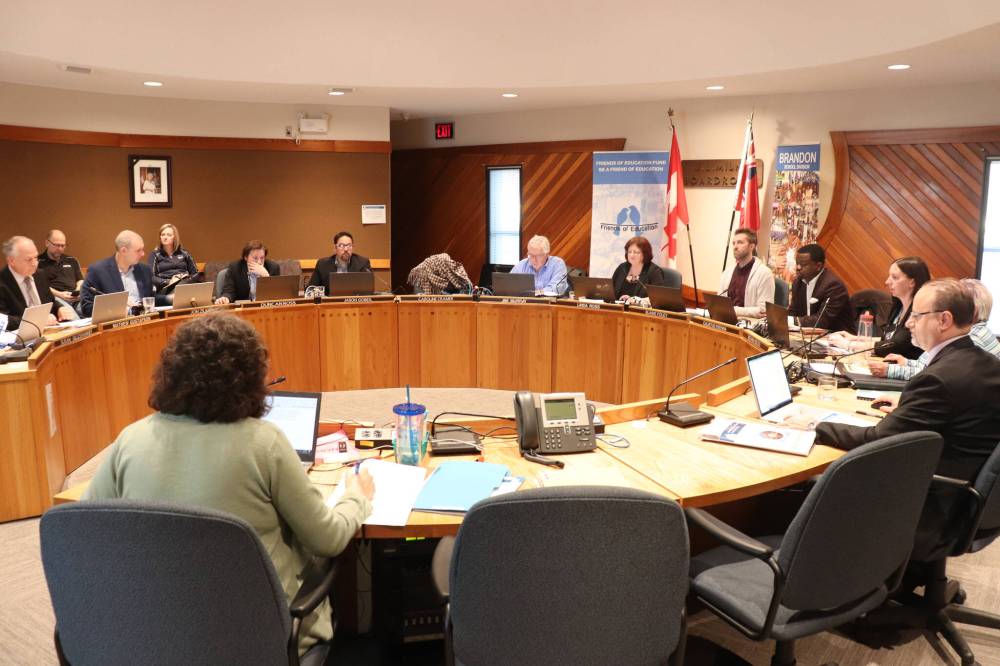
The Brandon School Division board of trustees is shown during a regular meeting in April 2023. Shannon D.M. Moore and Melanie Janzen encourage voters to learn more about trustee candidates in their school division and ward before filling out a ballot. (The Brandon Sun files)
Despite the important role trustees play in communities across the country, school board elections in Canada have historically received little public or media attention. Low voter turnout for municipal elections (25 to 35 per cent), combined with ballot drop-off for the section on school trustees, single-digit turnouts for standalone school board elections and the number of trustees who run unopposed are all emblematic of the perception that school board elections are low stakes.
However, locally elected school trustees are a crucial pillar of the public school ideal. To be considered truly public, schools need to provide universal access, offer equal opportunity, create conditions in which all students can benefit, serve the common good and be publicly governed in public. Undermining any one of these pillars weakens this ideal. Who you elect to take on the responsibility of this position matters.
When trustee-driven agendas crowd out the public’s priorities, school boards lose sight of what matters most — the concerns of students, parents and educators, from inadequate resources and crumbling infrastructure to overcrowded classrooms. A candidate who campaigns on a single divisive issue may have little to say about these practical responsibilities. Voters should ask whether that candidate is prepared to support the governance of a school division or primarily interested in turning the board table into an ideological platform for their views.
For example, some school trustees do not believe in the project of public education. Calls to “fund students, not systems,” for example, may sound appealing, but voters should ask what they mean in practice.
The same scrutiny should apply to appeals to “parental rights.” Parents undeniably deserve a voice in their children’s education, but the beliefs of some parents should not be used to undermine human rights, negate children’s rights or narrow and censor curriculum in public schools. The rights of some parents should not become a pretext for excluding or harming others.
That is why it is important that we elect school trustees who are invested in all elements of the public school ideal and who recognize that their role is to represent their constituents rather than drive their own agendas.
Before casting your ballot, take a few minutes to learn about the trustee candidates in your school division and ward. Make your vote count. Read candidate statements, review public endorsements and examine candidates’ public social media activity.
People for Public Education has posted candidates’ responses to a questionnaire about their commitments and priorities. Look beyond candidates’ slogans to their stated priorities and past conduct. Where do candidates stand on public school funding, privatization and funding for non-public alternatives? How will they support diversity, equity, inclusion and the safety of LGBTTQ+ students? Do they respect transparent decision-making, democratic procedures and the responsibility to serve all students?
School boards are not perfect. They can be improved, and trustees must be held accountable for their decisions and conduct. The upcoming election is an opportunity to protect and strengthen public education by choosing trustees who understand their responsibility to the whole community.
After all, a vote for a trustee is a vote for public schools, reflecting our commitment to the public good.
» Shannon D.M. Moore and Melanie Janzen are both researchers in the faculty of education at the University of Manitoba and founding members of People for Public Education. This column also appeared in the Winnipeg Free Press.