
Post-secondary education also a national emergency
Advertisement
Read this article for free:
or
Already have an account? Log in here »
We need your support!
Local journalism needs your support!
As we navigate through unprecedented times, our journalists are working harder than ever to bring you the latest local updates to keep you safe and informed.
Now, more than ever, we need your support.
Starting at $15.99 plus taxes every four weeks you can access your Brandon Sun online and full access to all content as it appears on our website.
Subscribe Nowor call circulation directly at (204) 727-0527.
Your pledge helps to ensure we provide the news that matters most to your community!
To continue reading, please subscribe:
Add Brandon Sun access to your Free Press subscription for only an additional
$1 for the first 4 weeks*
- Enjoy unlimited reading on brandonsun.com
- Read the Brandon Sun E-Edition, our digital replica newspaper
*Your next Free Press subscription payment will increase by $1.00 and you will be charged $20.95 plus GST for four weeks. After four weeks, your payment will increase to $24.95 plus GST every four weeks.
Read unlimited articles for free today:
or
Already have an account? Log in here »
The federal government is set to deliver its fall budget with a promised focus on building a strong Canada while positioning the country for long-term prosperity.
Among the major nation-building projects being championed are fighter jets and nuclear submarines, high-speed rail, ice-breakers, ports, mines, roads, pipelines and more.
One critical sector is conspicuously under-represented: post-secondary education. Once regarded as deserving of federal funding and a key player in our national interest, support has slowly dwindled.
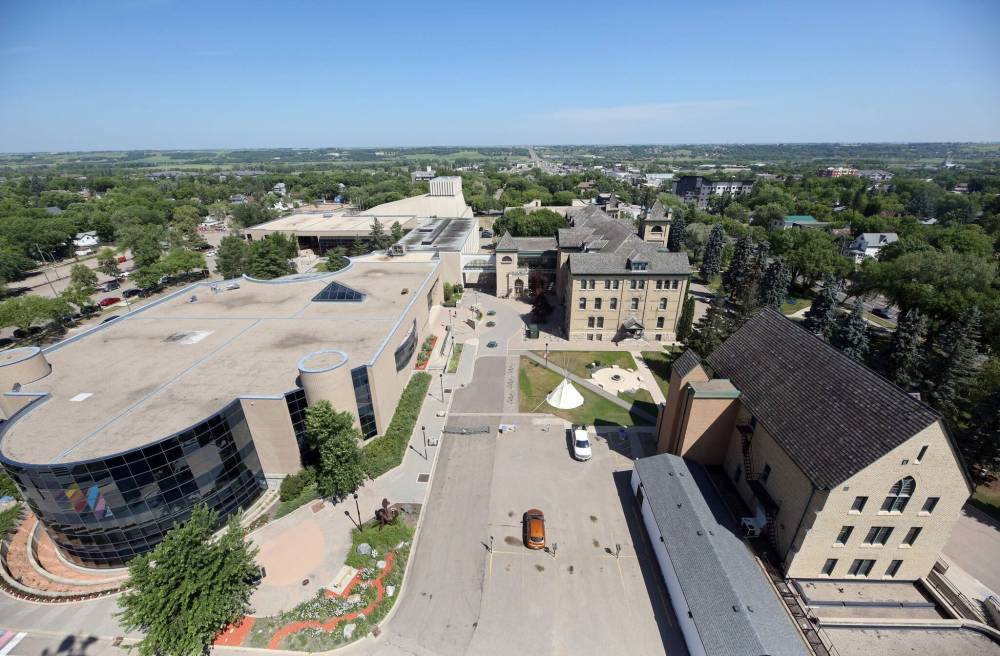
The Brandon University campus, as seen from the top of the Brodie Science Building. (Matt Goerzen/The Brandon Sun files)
However, Canada’s nation-building vision must include a focus on nurturing the current and next generation of thinkers, workers, innovators and dreamers.
A new collection of essays we’ve edited, “Knowledge Under Siege: Charting a Future for Universities,” examines the purpose of universities and how they can best seek truth, make discoveries and pass on work skills, knowledge and wisdom — as well as fulfil their unique responsibility of asking difficult questions of governments, other power structures and society itself.
This critical function, we note, distinguishes our universities from their counterparts in illiberal states.
Universities across the globe, including in Canada, are increasingly under threat, partly due to a growing and volatile anti-intellectual and authoritarian climate.
DROP IN SPENDING
The Canadian Centre for Policy Alternatives (CCPA) notes that in the early 1970s, funding for post-secondary education represented more than 3.5 per cent of all federal government spending. By 2024, it had fallen to just 1.9 per cent.
Students have been carrying a growing funding burden since, with average student-funded revenue growing from $3,140 in 1990 to a whopping $12,890 by 2024. CCPA also reports the total expenses required for a year of undergraduate study have nearly doubled from $13,500 in 2004-05 to $22,200 in 2022-23.
It’s no exaggeration to say this creates an inter-generational theft of opportunity. Students graduate with significant debt related to post-secondary studies, doing real harm to their ability to pursue their goals and dreams and to participate in the economy and society.
UNIVERSITIES, COLLEGES MISSING AS PRIORITY
As Prime Minister Mark Carney furthers the Canada Strong strategy, the federal government has offered only minimal and limited investments targeting the post-secondary sector, such as the Eddie Goldenberg Research Chairs program. This was formerly the Canada Impact+ Research Chairs program, a recruiting initiative aimed at attracting top researchers and scholars from around the world.
Research chair funding is welcome, although it should be noted there’s plenty of talent in Canada — including current international researchers now facing precarity in the country — that needs to be supported.
We have a national problem that demands immediate attention. Every major sector in Canada, regardless of political stance, including administrators, financial officers, bankers, unions and consultants, agrees that Canada’s post-secondary sector has been chronically underfunded, is experiencing further defunding and is headed toward crisis.
Such a cautionary chorus should be a wake-up call to governments of every level.
LOSING KEY AREAS OF STUDY
Due to cuts and a drastic drop in revenue from international student fees, Canada is losing key areas of study and research in the social sciences, humanities and arts disciplines that are best positioned to help us understand ourselves and others. These model how to peacefully co-exist with one another.
A Universities Canada/Canadian Association of University Business Officers report recently recognized Canada’s universities as:
“… foundational institutions within the country’s economic and social fabric. They develop highly skilled workers, generate research breakthroughs, support regional economies and provide important community services.”
MASSEY COMMISSION SERVES AS INSPIRATION
It’s time for a bold strategy. Our deep dive into the history of Canada’s university sector and its role in Canada’s democracy, sovereignty and national identity points toward perhaps a surprising source of inspiration.
From almost 80 years ago, the Massey Commission recommendations provide us with a useful guide for effectively managing today’s threats to universities.
In 1949, the Massey Commission, formally known as the Royal Commission on National Development in the Arts, Letters and Sciences, was a federal inquiry appointed by Prime Minister Louis St-Laurent to investigate the state of Canadian culture as Canada emerged from the post-Second World War period.
Chaired by Vincent Massey (who later became Canada’s first Canadian-born governor general), the commission published its landmark findings, known as the Massey Report, on June 1, 1951.
It warned that Canadian identity was overwhelmed by an influx of American media, that Canadian arts and culture were “anemic” and that Canada needed to adopt strong public policy to support a distinct national culture.
The Massey Commission viewed universities as essential guardians of Canada’s intellectual freedom, local talent, national identity and cultural sovereignty. The federal government agreed and began making federal transfers tied directly to the costs of post-secondary education institutions, providing provinces 50 cents for each dollar spent on approved operating expenditures.
This also led to the creation of the Canada Council for the Arts, followed by the Social Sciences and Humanities Research Council. Our time desperately calls for a return to a similar ethos and support.
ENGAGED CITIZENRY, THE PUBLIC GOOD
Current populist arguments that a degree isn’t worth it, along with calls for student tuition to rise, find favour with those who frame education as simply a monetary return on an investment benefiting individuals.
Granted, the public face of a university may look like job preparation, particularly in the professions. However, professional training together with a deeper educational mandate framed in broader humanistic terms contributes to the public good. That’s because it encourages an active and engaged citizenry and supports other democratic pillars including a free press, fair courts and the rule of law.
What the Massey Report referred to as the “Arts and Letters tradition,” is now commonly called the liberal arts and sciences.
Universities are critical to resisting tyranny and ensuring the rights of individuals to be free of fear and oppression. They’re essential for preparing students to think deeply, rationally and creatively and to contribute to a society that is just, prosperous and environmentally sustainable.
“Elbows up” might work for hockey, but what Canada desperately needs is to retain and expand its capacity to be an independent, democratic nation capable of nurturing the current and next generation — while also contributing to the betterment of the future of the planet and all its inhabitants.
» Marc Spooner is a professor in the faculty of education at the University of Regina. R. James McNinch is an emeritus professor and dean of education at the University of Regina.
» This column was originally published at The Conversation Canada: theconversation.com/ca