
David Eby’s early election call backfires badly
Advertisement
Read this article for free:
or
Already have an account? Log in here »
We need your support!
Local journalism needs your support!
As we navigate through unprecedented times, our journalists are working harder than ever to bring you the latest local updates to keep you safe and informed.
Now, more than ever, we need your support.
Starting at $15.99 plus taxes every four weeks you can access your Brandon Sun online and full access to all content as it appears on our website.
Subscribe Nowor call circulation directly at (204) 727-0527.
Your pledge helps to ensure we provide the news that matters most to your community!
To continue reading, please subscribe:
Add Brandon Sun access to your Free Press subscription for only an additional
$1 for the first 4 weeks*
- Enjoy unlimited reading on brandonsun.com
- Read the Brandon Sun E-Edition, our digital replica newspaper
*Your next Free Press subscription payment will increase by $1.00 and you will be charged $20.95 plus GST for four weeks. After four weeks, your payment will increase to $24.95 plus GST every four weeks.
Read unlimited articles for free today:
or
Already have an account? Log in here »
Conservative Lorne Doerkson, a man who hadn’t even campaigned to be leader of his own party, will be British Columbia’s next premier after his party won an election that didn’t need to be held against an opponent who largely defeated himself.
Even in a province long accustomed to unprecedented developments in its politics, this was a remarkable turn of events. Just two years since B.C.’s last provincial election, in the middle of the province’s regularly scheduled municipal election campaign, Eby sent B.C. voters back to the polls early.
Throughout the election, Eby struggled to justify the call. The initial explanation, offered at the start of the campaign, centred on the need for the province to draw a line in the sand against United States President Donald Trump.
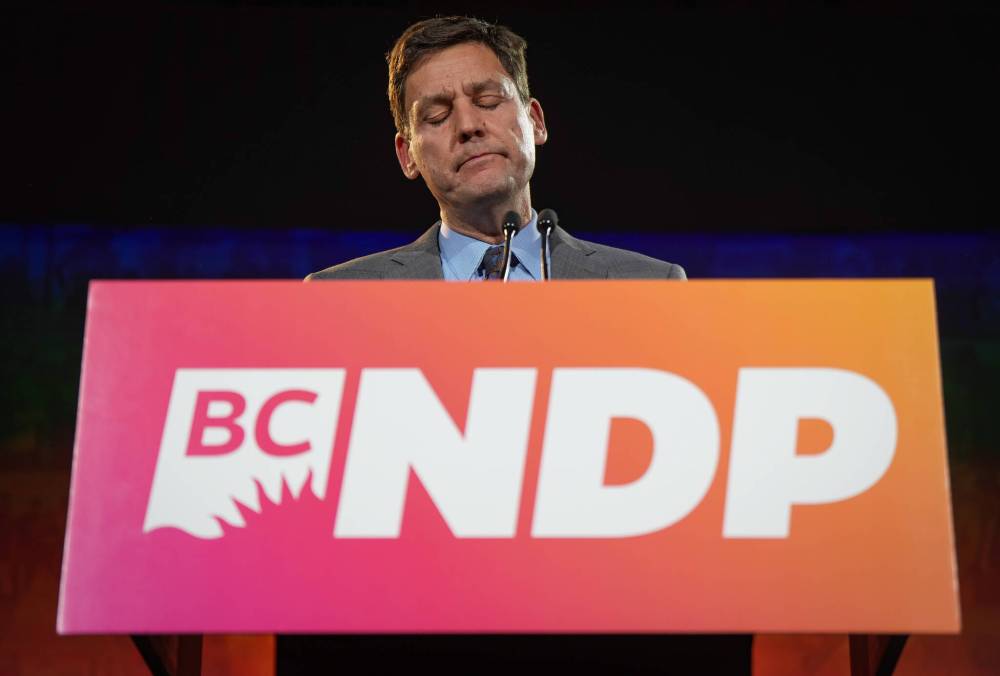
B.C. NDP Leader David Eby resigns in a speech to supporters on election night, in Vancouver, on Saturday. (The Canadian Press)
Later, during the leaders’ debate, Eby tried a new line.
He focused instead on the thinness of his one-seat majority — which was nonetheless still a majority — and the challenges that came with its management amid MLA sickness and the untimely passing of long-time NDP MLA Joan Philip.
AFFORDABILITY, HEALTH CARE TOP CONCERNS
Neither of these justifications made much sense, however. There was nothing new in late September 2026 on the Trump front that required a provincial reset. And as much as British Columbians agree that Trump is a problem, they evidently are looking to the federal government, rather than the provincial, to lead the country’s response.
Polls consistently showed provincial concerns were closer to home, related to affordability and access to core government services, particularly health care.
As for the unmanageability of the legislature, a thin majority is still a majority. This explanation therefore seemed opportunistic given that other governments, including previous iterations of the NDP, have done much with less.
These explanations rang all the more hollow given the obvious political motives behind the election call. The NDP had climbed back to a small lead in polls over the summer, and was facing a B.C. Conservative opposition in disarray.
The new Conservative party leader at the time, Kerry-Lynne Findlay, had made a number of controversial organizational moves, alienating much of her own party in the process.
By the weekend before the Sept. 22 election call, more than a dozen MLAs had either left or been expelled from the Conservative Party. Eight former Conservatives joined the nascent CentreBC party to create an alternative right-of-centre political vehicle.
Simply put, the simplest explanation seemed to be that Eby saw his chance to carve out a larger majority against a weakened opposition, and took it — consequences be damned. It was in fact a transparently obvious and particularly brazen bit of political opportunism, and voters saw it as such.
HOISTED ON HIS OWN ELECTION
Once underway, the campaign proved demoralizing for voters and participants alike. The NDP’s initial script for the campaign focused not just on the need to stand up to Trump, but also on the elements of conservativism in the province that bore hallmarks of MAGA politics. Eby called out what he described as Conservative parties cozying up to Trump.
These tactics might have worked when Findlay was still the Conservative leader. Hers was a particularly chaotic brand of populist politics; she had even hired political staff with ties to the Alberta separatist movement.
Unfortunately for Eby, the threat of an imminent election accomplished what nothing else seemingly could — a reconciliation among Conservatives. Amid steadily increasing internal pressure, Findlay stepped down the Sunday before the election call. Following the hasty selection of Doerkson as interim leader, most Conservatives in exile returned to the party.
Doerkson was also nearly a perfect foil for not only Eby but his Conservative predecessor, Findlay. A member of the more moderate wing of conservativism in the province, Doerkson was as comfortable as Eby talking about his dislike of Trump and his politics. He proved a folksy, relatable politician as well, someone who exuded openness.
Contrary to Eby’s claims, he seemed an unlikely Trojan horse for radical populist conservatism. The NDP’s script was no longer working. The situation had changed and Eby had failed to adapt accordingly, ultimately handing the Conservatives a historic majority.
LOW VOTER TURNOUT
Rather than dent Conservative support, the biggest effect of the NDP’s negative campaigning proved to be to depress turnout for the party.
While a few ballots remain to be counted, turnout in the election is unlikely to cross the 50 per cent threshold, which would represent one of the lowest turnouts in recorded B.C. election history.
The NDP is on track to receive 250,000 fewer votes than in 2024, even as the Conservative vote total also declined slightly. In short, it seems more than a quarter of NDP voters simply stayed home this time around, unwilling to validate Eby’s unnecessary and polarizing election.
Back in 2017, when he was the province’s attorney general, Eby was tasked with cleaning up the province’s gambling industry. In 2026, as premier, Eby was the gambler. He bet the house on an unnecessary early election and he lost it all.
» Stewart Prest is a lecturer in political Science, University of British Columbia. This column was originally published at The Conversation Canada: theconversation.com/ca