
Is AI changing local democracy? We should probably talk about it.
Advertisement
Read this article for free:
or
Already have an account? Log in here »
We need your support!
Local journalism needs your support!
As we navigate through unprecedented times, our journalists are working harder than ever to bring you the latest local updates to keep you safe and informed.
Now, more than ever, we need your support.
Starting at $15.99 plus taxes every four weeks you can access your Brandon Sun online and full access to all content as it appears on our website.
Subscribe Nowor call circulation directly at (204) 727-0527.
Your pledge helps to ensure we provide the news that matters most to your community!
To continue reading, please subscribe:
Add Brandon Sun access to your Free Press subscription for only an additional
$1 for the first 4 weeks*
- Enjoy unlimited reading on brandonsun.com
- Read the Brandon Sun E-Edition, our digital replica newspaper
*Your next Free Press subscription payment will increase by $1.00 and you will be charged $20.95 plus GST for four weeks. After four weeks, your payment will increase to $24.95 plus GST every four weeks.
Read unlimited articles for free today:
or
Already have an account? Log in here »
With Brandon’s municipal election just one day away, campaign signs have appeared on lawns and fences over the last several weeks, political advertisements have filled our social media feeds, and candidates have been knocking on doors.
This is all pretty standard.
Still, the look and feel of this election seems different to me. Some of the posters, social media posts and even replies to voters appear to have been made, at least in part, using generative artificial intelligence (AI). More than one sign I’ve driven past has that glossy, uncanny finish image generators turn out. How are we as a community feeling about that?
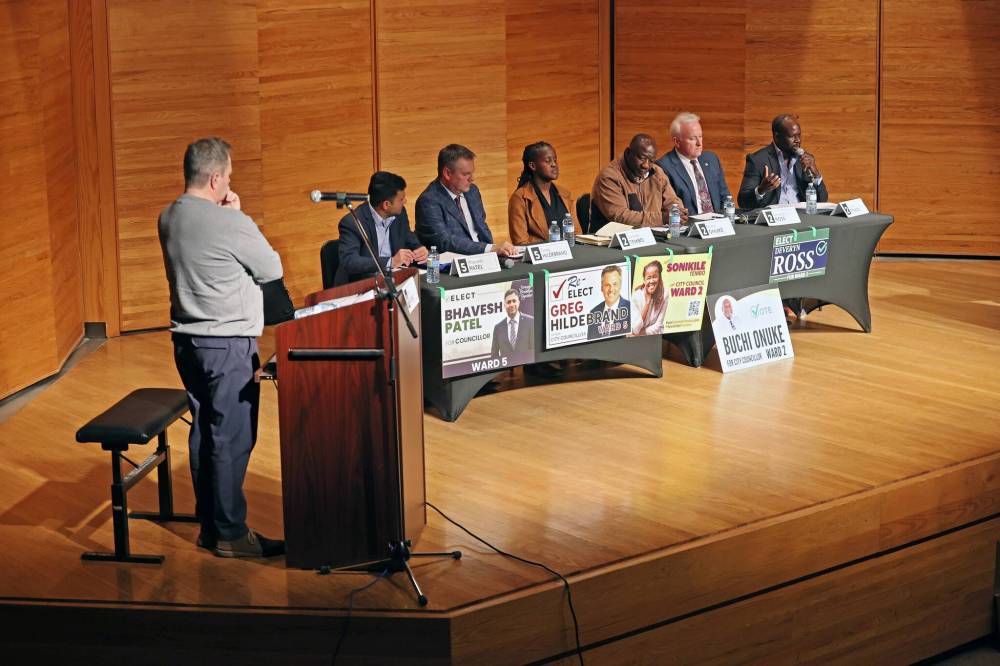
Candidates in Ward 2 and Ward 5 take part in a Brandon city council debate at Brandon University's Lorne Watson Recital Hall on Oct. 14. Brandon University professor Jennifer Mateer writes that we shouldn't restrict local candidates from using artificial intelligence, but adds that "we should expect a little transparency." (Tim Smith/The Brandon Sun files)
There is a fair case for using AI in local politics. Running for city council or school board trustee costs money, and most candidates can’t hire a graphic designer or a communications consultant. If AI lets someone on a shoestring budget put out a poster that holds its own next to one from a better-funded opponent, I can see the appeal.
Still, there is a difference between using AI to present your ideas and using it to develop them. A candidate using AI to design a campaign poster is one thing. A candidate using it to answer a constituent’s question or explain where they stand on a local issue is another.
When I write to a candidate about something that matters to me, I want to know what they think, not what a large language model predicts would be the most politically “safe” response.
AI is also not neutral. Researchers have found that because these models are trained on materials that reflect existing political and social biases, their responses can reproduce those biases. When a candidate uses AI to draft a response, whose values are we hearing: the candidate’s or the technology company’s?
This matters most when candidates are writing to community organizations or answering questions about housing, inclusion or public safety. If a candidate sends a beautifully worded statement of support to a local advocacy group, does it matter whether they wrote it themselves?
Maybe the candidate genuinely supports the group, but if AI chooses the words, it’s hard to know what their support will mean in practice.
Now, I’m not naïve. Political communications have never been entirely authentic. Politicians have relied on speechwriters and talking points for a long time. At the municipal level, though, few candidates have ever had a speechwriter, so voters could reasonably assume the person at the door and the person answering their email were the same.
Today a candidate can produce polished, seemingly thoughtful responses to almost any issue in seconds. When we vote, are we evaluating candidates’ ideas or their ability to generate appealing political content?
This question matters even more locally. While federal and provincial politics dominate news cycles, local governments make many of the decisions we feel most directly. The Federation of Canadian Municipalities estimates that cities maintain approximately 60 per cent of Canada’s essential infrastructure. City councils shape whether your kid can walk to school safely, and what is built on the empty lot in your neighbourhood. Over time, they decide what kind of city Brandon becomes.
For decisions like these, I want to know how a candidate will think them through, and a well-written email doesn’t tell me much about that.
I’m not suggesting we ban candidates from using AI. The signs that look AI-generated along 18th Street or Victoria Avenue aren’t necessarily a democratic crisis.
That said, we should expect a little transparency. If candidates are using AI to make campaign materials or respond to voters, should they disclose that? More importantly, when we write to a candidate, we should be able to trust that the reply reflects their own thinking.
With election day approaching, it’s worth asking what kind of political communication we want in Brandon. Democracy depends on more than getting the message right. When we ask a candidate a question, we should know who is answering.
» Jennifer Mateer is an assistant professor in the department of geography and environment at Brandon University.