
Is Canada headed for time chaos this weekend?
Advertisement
Read this article for free:
or
Already have an account? Log in here »
We need your support!
Local journalism needs your support!
As we navigate through unprecedented times, our journalists are working harder than ever to bring you the latest local updates to keep you safe and informed.
Now, more than ever, we need your support.
Starting at $15.99 plus taxes every four weeks you can access your Brandon Sun online and full access to all content as it appears on our website.
Subscribe Nowor call circulation directly at (204) 727-0527.
Your pledge helps to ensure we provide the news that matters most to your community!
To continue reading, please subscribe:
Add Brandon Sun access to your Free Press subscription for only an additional
$1 for the first 4 weeks*
- Enjoy unlimited reading on brandonsun.com
- Read the Brandon Sun E-Edition, our digital replica newspaper
*Your next Free Press subscription payment will increase by $1.00 and you will be charged $20.95 plus GST for four weeks. After four weeks, your payment will increase to $24.95 plus GST every four weeks.
Read unlimited articles for free today:
or
Already have an account? Log in here »
When Manitoba Premier Wab Kinew declared Sept. 17 that the province would remain on permanent daylight time, he suggested it was a historical moment people would share with their “great-great-grandkids.” But, while Sunday, Nov. 1 has been heralded as the date many Canadians will stop changing their clocks, there are rumblings behind the scenes that suggest this will actually cause more trouble than ever before.
There are, of course, the warnings from chrono-biologists and sleep scientists about the damage permanent daylight time will do. The lighter evenings will mean many more dark mornings. But there is another set of problems in the offing in the critical infrastructure that underpins our digital lives.
While it used to be common to spend the Sunday morning after a time change going around our homes updating the clocks, we now wake up to devices that have already adjusted to the new time. These automatic updates occur regularly for daylight time and when we travel to new time zones.
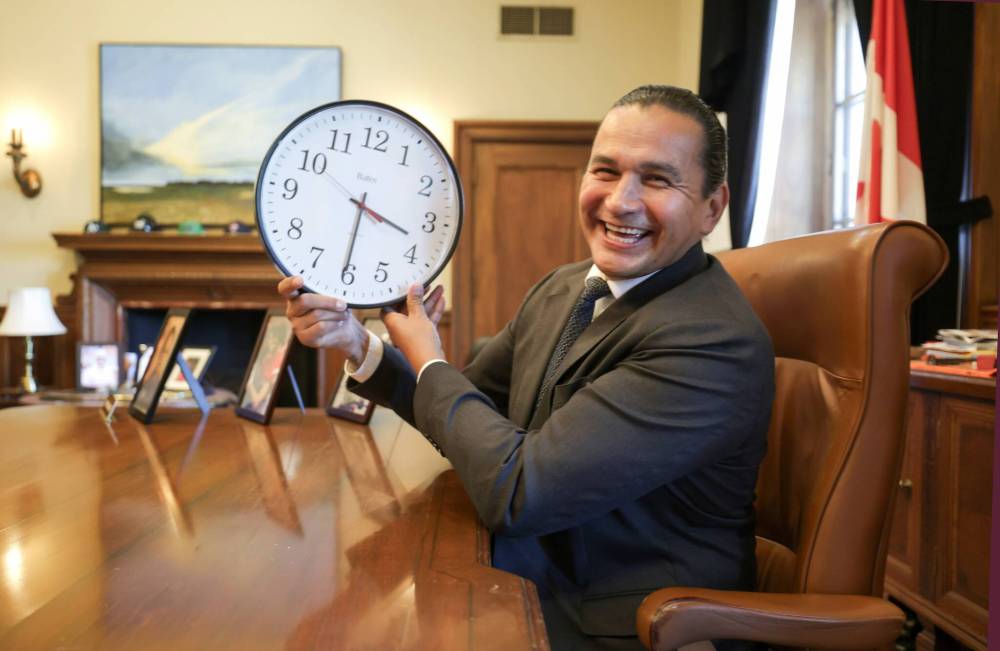
Premier Wab Kinew poses for a photo with a clock in his hands at the Legislative Building in September after declaring Manitoba will permanently adopt daylight saving time. (Ruth Bonneville/Winnipeg Free Press)
Our clocks are able to change by themselves owing to the hard work of a group of volunteers who were recently named in a list of the people who hold up the internet. This group, led by Paul Eggert, a computer scientist at UCLA, maintains a little-known tool called the Time Zone Database.
Since the 1980s, it has kept track of regional, national and international debates about clock time and provided an up-to-date table of what time it should be on our walls.
As Kim Davies of the Internet Assigned Numbers Authority (IANA), which hosts the database, points out, “For most people, the fact that their devices keep up with time changes happens like magic. But it is a magic born of hard work by a group of key contributors who diligently update the time zone database”.
Despite the diligence of the maintainers of the database, time zone chaos will occasionally break out. Governments and other authorities have usually never heard of the time zone database and believe that changing rules around daylight saving or time zones is just a matter of declaring that it will be so.
But, for a new time rule to be implemented on your phone, it needs to be officially adopted by the relevant authority, updated in the database, and released to software providers. This release is then shared with systems such as Linux, Android and Apple, who test the changes before sending them via updates to your device. You then need to be able to apply the updates (which is harder on older, unsupported systems) and restart your phone.
In an infamous case from 2015, Turkey decided to delay the end date of daylight time by two weeks, owing to an upcoming election — with only three weeks’ notice. Without the lead time to make the necessary changes, millions of digital clocks changed automatically on the originally intended date, creating widespread confusion.
This year, experts are warning of a far more dire situation in Canada on Nov. 1. While provinces have given more notice than Turkey did, the decision to stop changing clocks altogether is trickier for our computer systems to handle. A permanent daylight time change is treated not as time simply staying the same, but as the province moving to a new time zone.
This means the software will not only have to update to stop the time change already programmed, but also to revise the time zone in which each device is located. For example, to avoid confusion with U.S. Pacific Standard Time (UTC−8), British Columbia decided last month to use PCT for its new “Pacific Time” (UTC−7). Changes to time zones are much less frequent than changes to daylight time rules, and so getting everything updated behind the scenes takes longer.
As Canadian IT consultancy firm Regroove has stated, the new permanent daylight time rules are “a change to rules that have been built into every operating system, server and network device for decades, and those rules do not update themselves.”
Any systems that have not updated by Nov. 1 could thus lead to disruption in transport schedules, financial transactions, firewall settings, phone systems, time-stamped records for things such as camera footage, door access records, and payroll systems.
Users of Google tools and Microsoft Outlook are also being warned to check that their time zones are correct and to verify all future meeting times, since meetings made under the old rules will still update for the daylight time change.
It seems that only the Nunavik region in northern Québec has recognized the potential danger, announcing on Oct. 14 that it was pausing its plans to adopt permanent daylight time, owing to “technical and administrative challenges”.
If Canada’s time changes have already started to feel chaotic, let’s hope the story told to our great-great-grandkids is not the Y2K that hardly anyone saw coming.
» Michelle Bastian is a senior lecturer in theory, culture and environment at the University of Edinburgh. This column was originally published in the Winnipeg Free Press.