
Trump faces a tough couple of years
Advertisement
Read this article for free:
or
Already have an account? Log in here »
We need your support!
Local journalism needs your support!
As we navigate through unprecedented times, our journalists are working harder than ever to bring you the latest local updates to keep you safe and informed.
Now, more than ever, we need your support.
Starting at $15.99 plus taxes every four weeks you can access your Brandon Sun online and full access to all content as it appears on our website.
Subscribe Nowor call circulation directly at (204) 727-0527.
Your pledge helps to ensure we provide the news that matters most to your community!
To continue reading, please subscribe:
Add Brandon Sun access to your Free Press subscription for only an additional
$1 for the first 4 weeks*
- Enjoy unlimited reading on brandonsun.com
- Read the Brandon Sun E-Edition, our digital replica newspaper
*Your next Free Press subscription payment will increase by $1.00 and you will be charged $20.95 plus GST for four weeks. After four weeks, your payment will increase to $24.95 plus GST every four weeks.
Read unlimited articles for free today:
or
Already have an account? Log in here »
Tuesday was definitely not a good night for the Republican Party.
But it was an especially painful night for U.S. President Donald Trump, who has now lost control of both chambers of Congress. Without sufficient numbers of Republicans in the U.S. House of Representatives and the Senate, he can no longer dictate the terms for his legislative agenda.
More significantly, the Trump administration will effectively lose congressional control over the “power of the purse.” In a divided U.S. government, it is much harder for the executive branch to secure funding for its various programs, departments and agencies — along with discretionary policy initiatives, tax measures and supplemental wartime requests.
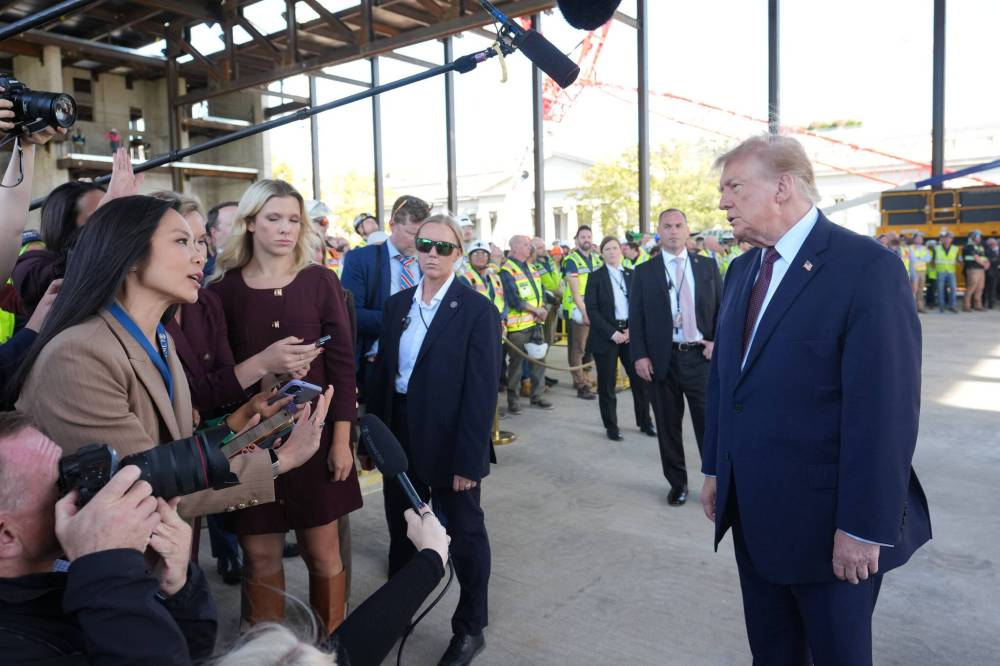
U.S. President Donald Trump talks to reporters during a tour of White House Ballroom construction at the White House on Wednesday. (The Associated Press)
On the positive side, divided government can lead to greater oversight or scrutiny by the legislative branch over the executive — or vice versa. These checks and balances are integral to the U.S. democratic process and can motivate both branches of government to find compromises.
When government is divided, though, it almost invariably produces gridlock, stalemate and partisan division. It can only be rectified by careful negotiations that can go on for months.
Especially concerning for Trump is the prospect of the Democrats constantly throwing sand in the legislative gears, outright blocking his core legislation, and seeking to control the public political narrative. A Democrat-led Congress will also have control over the committee structure and subpoena power to call witnesses before those same committees, and to demand the release of all the Jeffrey Epstein-related documents.
Moreover, it will have the power to confirm or reject the president’s nominees for judgeships, ambassadors, senior administration officials and even cabinet secretaries.
Would all of this mean that a lame-duck Trump would be presiding over what some political scientists call the end of his “two-year presidency”? Or, would he still have considerable political power to wield?
Besides resorting to presidential executive orders or directives and pointing fingers at the congressional Democrats, Trump can also pull out his black-Sharpie veto pen. And without the Democrats holding a two-thirds majority in the House, President Trump could override any efforts by Congress to reverse his signature legislative achievements.
In addition, there is the power of the presidential “bully pulpit.” That is to say, Trump could use his megaphone standing before the presidential podium to galvanize the American people and thus put pressure on congressional Democrats to back off.
While Trump is not likely to pull a Franklin Roosevelt and dust off his radio broadcasts and fireside chats, he is still a master of media manipulation and direct communication.
It is also instructive to note that a U.S. president still has wide latitude in a divided government when it comes to foreign policy. Trump will be in a position to dictate America’s external relations and to operate on the world stage as he sees fit. Now, he may not be able to pull off another Venezuela-like incursion or to invade Cuba — but he could certainly try. It is also not clear, particularly given the current makeup of the U.S. Supreme Court, whether Trump’s authority over tariff policy could be circumscribed by Congress.
But I fully expect the Democratic majority to move to construct walls around the president’s authority to go to war. It will face all kinds of legal, political and constitutional hurdles, though the Democrats could slash defence spending, dust off the 1973 War Powers Act and convene congressional hearings into the ongoing U.S.-Iran War or Trump’s family business dealings. They could, most importantly, count on the backing of the American people and a new electoral mandate.
On the trade and tariff front, the Democrats will also rightly profess that the U.S. Constitution mostly gives Congress jurisdiction over trade policy. There are a series of moves that they could undertake — blocking new tariffs through appropriation bills, initiating congressional investigations into executive overreach on tariffs and trade laws, and even introducing new legislation to restrict presidential tariff authority. All of this could amount to nothing more than blowing smoke, but at least the politics will play well domestically. The Democrats might roll the dice and seek to impeach Trump for the third time; it’s likely under active consideration.
No matter what happens over the next two years or so, life for Trump is going to get a whole lot more difficult. A Democratic Congress will do everything that it can to impede, frustrate and, ultimately, torpedo the president’s policy actions and decision-making authority.
Some might say: what goes around comes around.
» Peter McKenna is professor of political science at the University of Prince Edward Island in Charlottetown. This column appeared in the Winnipeg Free Press.