
Why Carney continues betting big on Europe
Advertisement
Read this article for free:
or
Already have an account? Log in here »
We need your support!
Local journalism needs your support!
As we navigate through unprecedented times, our journalists are working harder than ever to bring you the latest local updates to keep you safe and informed.
Now, more than ever, we need your support.
Starting at $15.99 plus taxes every four weeks you can access your Brandon Sun online and full access to all content as it appears on our website.
Subscribe Nowor call circulation directly at (204) 727-0527.
Your pledge helps to ensure we provide the news that matters most to your community!
To continue reading, please subscribe:
Add Brandon Sun access to your Free Press subscription for only an additional
$1 for the first 4 weeks*
- Enjoy unlimited reading on brandonsun.com
- Read the Brandon Sun E-Edition, our digital replica newspaper
*Your next Free Press subscription payment will increase by $1.00 and you will be charged $20.95 plus GST for four weeks. After four weeks, your payment will increase to $24.95 plus GST every four weeks.
Read unlimited articles for free today:
or
Already have an account? Log in here »
When European Union officials Ursula von der Leyen and Antonio Costa recently joined Mark Carney on the docks of Montreal’s Old Port for the Canada-EU Summit, Canada’s prime minister presented closer ties with the EU as a good deal for Canadian households.
He argued a closer relationship promised more choices and lower costs for families at a time when American tariffs are causing pain on both sides of the Atlantic.
In April 2025, my colleague, Léandre Benoit, and I argued that the newly elected Carney would pursue a pragmatic and globally engaged liberalism, definitively aligned with Europe. The Montreal summit confirms that alignment.
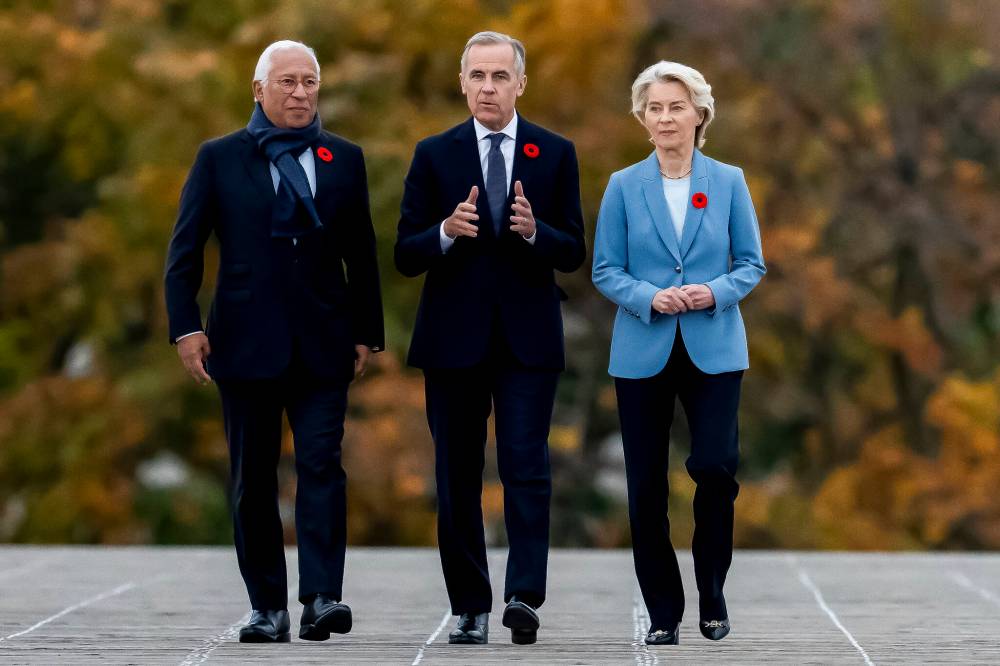
Prime Minister Mark Carney (centre) arrives at the EU-Canada summit with European Council President Antonio Costa (left) and European Commission President Ursula von der Leyen in Montreal on Oct. 30. (The Canadian Press)
The meeting’s firmest commitments concern democracy, while much of its economic measures are still to be carried out. With autocracies gaining ground around the world, and with Trump’s United States no longer a reliable ally — although that may shift with the Democratic rout in the U.S. midterm elections — Canada and the EU have found in each other stable liberal partners who take democracy seriously.
WHAT MONTREAL DELIVERED
On the economic side, the results of the summit are quite modest. Of the 20 measures announced, two are concluded agreements: one is a digital trade agreement and the second is a treaty that lets the European Investment Bank finance Canadian critical minerals projects.
The remaining measures are promises to be negotiated, for example on the Erasmus+ education program and on LNG exports. For a summit sold as offering relief for household budgets, few of these announcements will have an impact on Canadian kitchen tables any time soon.
Left out of the final statement was the most ambitious and symbolic proposal: Carney set June 2027 as the deadline for Canada to become the European Union’s first “associate member,” a category that exists nowhere in EU law.
ALLIES IN DEFENDING DEMOCRACY
The associate membership process is driven by shared values. Canada, one of the few established democracies to have avoided democratic backsliding, has strong institutions where no reforms are needed before it qualifies to be a partner of the EU.
Even though the details of associate membership are still unclear, the partnership’s significance is in “elective affinity,” as Carney had set out in Strasbourg in September when addressing the European Parliament.
So far, security and defence are where these shared values have produced concrete results. The joint statement warns that hybrid threats now target Canadian and European institutions, and it promises an early-warning system against foreign interference and disinformation.
This is a clear acknowledgment that Russian aggression goes beyond Ukraine and that defending democracy has become a matter of national security. In the current global context where holding states accountable via international bodies is under threat — for example, the recent American sanction of the International Criminal Court — both the EU and Canada need each other more than ever in protecting their liberal values and their security.
The joint statement stretches Canada’s commitment along Europe’s whole eastern flank through the EU Common Security and Defence Policy, from the Arctic to the Black Sea, and frames it as a reinforcement of NATO.
BEYOND THE BALANCE SHEET
While a Canada Pulse Insights poll found that 73 per cent of Canadians support the idea of closer ties with the EU, the status of “associate member” is a problem in Europe.
Germany and several other member states oppose the label. At home, Conservatives argue that the summit produced zero tariff removals or trade-barrier eliminations, and they’ve also raised concerns about what the agreement would mean for Canada’s independence and sovereignty.
Judged on tariffs alone, the critics might have a point — after all, the EU cannot undo U.S.-imposed trade penalties. Diversifying away from Canada’s top trading partner demands both political will and time. In the meantime, the summit’s true value lies in the political message it sends.
By offering a country outside Europe a place close to its family, the EU is saying that being European is as much a matter of values as of geography. If the process works, it could become a model for other partners outside Europe. For Canada, the membership would make clear to the U.S. and Canadian voters that the country has other partners and options beyond its southern neighbour.
The Montreal summit gave Canada a safe harbour on the other side of the Atlantic. What holds the two partners together is a shared conviction that democracies must stand together as autocracies gain ground, beyond trade deals.
By June 2027, we’ll know whether that conviction survives the doubts of some European capitals and whether Canada becomes the EU’s first associate member in name as well as in spirit.
» Katerina Sviderska is a PhD candidate in politics at the University of Cambridge.
» This column was originally published at The Conversation Canada: theconversation.com/ca