
Ladders, not robots, attract specialists
Advertisement
Read this article for free:
or
Already have an account? Log in here »
We need your support!
Local journalism needs your support!
As we navigate through unprecedented times, our journalists are working harder than ever to bring you the latest local updates to keep you safe and informed.
Now, more than ever, we need your support.
Starting at $15.99 plus taxes every four weeks you can access your Brandon Sun online and full access to all content as it appears on our website.
Subscribe Nowor call circulation directly at (204) 727-0527.
Your pledge helps to ensure we provide the news that matters most to your community!
To continue reading, please subscribe:
Add Brandon Sun access to your Free Press subscription for only an additional
$1 for the first 4 weeks*
- Enjoy unlimited reading on brandonsun.com
- Read the Brandon Sun E-Edition, our digital replica newspaper
*Your next Free Press subscription payment will increase by $1.00 and you will be charged $20.95 plus GST for four weeks. After four weeks, your payment will increase to $24.95 plus GST every four weeks.
Read unlimited articles for free today:
or
Already have an account? Log in here »
Manitoba’s shortage of medical specialists is partly a technology story. It is more a story about how a system decides to get ready.
The Winnipeg Free Press editorial board argued last week that Manitoba must give its doctors the tools and conditions they need, or the gains in recruitment will not hold. That is true, and not where the story begins. The Doctors Manitoba report behind the editorial carries a line that lands hard with anyone who has tried to recruit a surgeon here: physicians are “trained in the medicine of today” and arrive to find “the tools of yesterday.”
The report carries good news and the government deserves credit for it. But most of the shortage that remains is in the specialties, and one surgical robot is just a start.
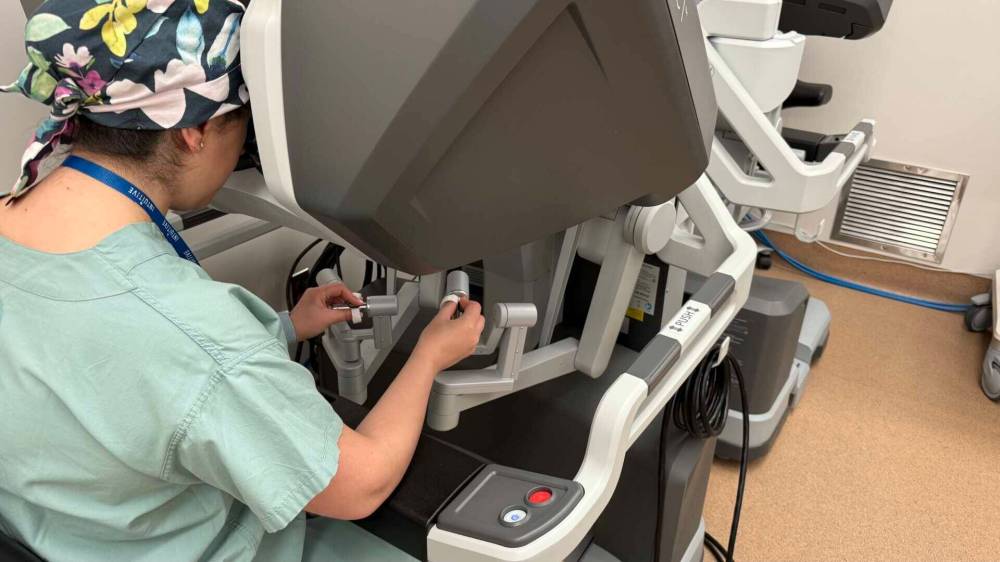
Dr. Akhtar Danesh operates the Da Vinci Xi at Health Sciences Centre in Winnipeg. The medical robot is the only one in Manitoba. (File)
Recruitment is working. It is also only half the task. Recruitment is what we do to bring a doctor here; attraction is what makes one want to come. The two answer different problems: recruitment offsets departure, attraction earns retention.
A system that must always recruit has not built the conditions that attract, and the shortfall shows in retention, which the report understates. Only 63 per cent of the residents we train are still here five years later, against a national average of 73.
Among the reasons are the equipment and facilities young specialists cannot picture working without and the teams without whom no program runs.
I have some history with this question.
I came of age when heart and heart-lung transplantation was the frontier, recruited to Western University in London, Ont., where it was being pushed. We took ECMO, the heart-lung machine, to the bedside for adults in cardiac emergencies and children awaiting transplant. I worked alongside many who built the transplant field, and in robotic cardiac surgery from its early days. More than any machine, I learned what new technology can do for patients.
When I came to Winnipeg, the question I heard most was: when do we get a robot, and start a transplant program? My answer was not popular. Not yet, and for some things perhaps never, if our population could not sustain them. When I arrived, 13 cardiologists and fewer than three catheterization labs served a catchment of 1.25 million, below the Canadian standard.
A robot or a transplant program sits at the top of a pyramid. Beneath it must be reliable standard and intensive care, perfusion, anesthesia, specialized nursing, the volumes that keep teams sharp, the outcome data and the governance to make these silos a coherent team. Leap to the top before the base is built and you get a showroom, not a program. Patients pay the difference.
But “not yet” is not “never.” As Samuel Johnson wrote in 1759, “Nothing will ever be attempted, if all possible objections must be first overcome.” Between 2011 and 2016, I twice invited Intuitive Surgical to bring a da Vinci robot to St. Boniface Hospital, and showed videos of our procedures in London. The purpose was not a purchase but a conversation: to show where surgery was heading and build the case before the need became urgent.
The reception was mixed. A decade later, some of the same skeptics spoke of robotic surgery as their own idea. I say that without complaint; the one who opens the door rarely holds the deed. But the lesson is structural, not personal: if a system takes 10 years to move from skepticism to ownership, it will always equip its surgeons with the tools of yesterday.
There are two ways to fail. The first is the foundation without a ladder: competent standard care with no plan to climb. The second is the leap without foundations: the gadget bought for the ribbon cutting, with no program to use it well.
Manitoba has more often suffered the first. But a culture too cautious for small steps will take one big swing when pressure builds and wonder why it struck out. Caution and recklessness are not opposites here; both come from having no plan.
One robot shared among several specialties is not a technology problem. It is a planning problem. Someone must own which programs a technology serves, what justifies a second unit, who is trained and how outcomes are reported. Otherwise decisions default to the budget cycle and the budget cycle never rewards foresight.
Three things would help. Plan major technology, from the surgical robot to advanced records and artificial intelligence, with the clinical programs it serves, not as a capital purchase, and give it a named clinical owner, a training pathway and honest outcome reporting. Keep a rolling horizon, so the next unit is timed to patient need as our population ages. And give those closest to the work real standing, because they see the ladder first.
Young specialists do not expect everything in place when they arrive. They do expect to see a ladder and a system serious about climbing it. That is what attracts them and what keeps them.
The robot is the last rung, not the first, and the ladder beneath it must be sound. Otherwise we will go on buying the newest machines, yet keeping the oldest habits.
» Alan Menkis is a retired cardiac surgeon, former WRHA medical director of cardiac sciences at St. Boniface Hospital and professor of surgery at the University of Manitoba. The column was first published in the Winnipeg Free Press.