
Federal budget relies on sunny financial forecast
Advertisement
Read this article for free:
or
Already have an account? Log in here »
We need your support!
Local journalism needs your support!
As we navigate through unprecedented times, our journalists are working harder than ever to bring you the latest local updates to keep you safe and informed.
Now, more than ever, we need your support.
Starting at $15.99 plus taxes every four weeks you can access your Brandon Sun online and full access to all content as it appears on our website.
Subscribe Nowor call circulation directly at (204) 727-0527.
Your pledge helps to ensure we provide the news that matters most to your community!
To continue reading, please subscribe:
Add Brandon Sun access to your Free Press subscription for only an additional
$1 for the first 4 weeks*
- Enjoy unlimited reading on brandonsun.com
- Read the Brandon Sun E-Edition, our digital replica newspaper
*Your next Free Press subscription payment will increase by $1.00 and you will be charged $20.95 plus GST for four weeks. After four weeks, your payment will increase to $24.95 plus GST every four weeks.
Read unlimited articles for free today:
or
Already have an account? Log in here »
Affordability for households was a big winner in last week’s federal budget. Affordability for government, not so much. When you title your budget “Masters of Our Destiny,” ensuring the country has the financial wherewithal to live up to this big billing would seem important.
The Carney government’s second budget was the moment to put Canada on a true path to affordable government. It didn’t.
The government went to more lengths to explain its budget as being affordable than it did with actual decisions to make it affordable. But when you receive an unexpected financial windfall in higher tax revenues and splurge it all on more government spending, it’s fair to doubt the commitment.
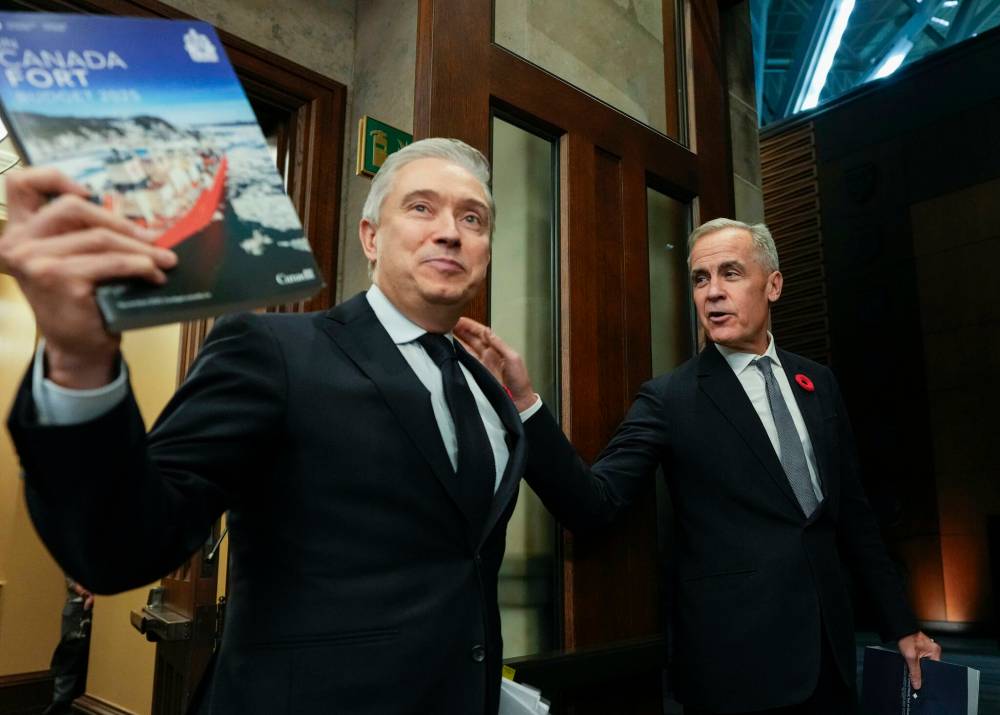
Prime Minister Mark Carney (right) and Finance Minister François-Philippe Champagne make their way into the House of Commons for the tabling of the federal budget on Nov. 4. (The Canadian Press files)
The first clue can be found in the length of the budget, not just the size of the spending. This one clocked in at more than 500 pages, the second-longest in history. Only the 2021 post-pandemic budget was longer, at 740 pages. It combined two budgets in one because the 2020 budget had been postponed with the onset of COVID.
Once upon a time, budgets were shorter, tidier affairs. A 2019 decision to absorb the separate supplementary information on tax measures has since made every budget longer. Add gender-based analysis and other mandatory reporting, and no wonder we’re at phone-book-length proportions.
For the record, provinces are not immune to this. Manitoba’s budget length grew from 95 pages in 2019 to 156 pages this year under the Kinew NDP government. Alberta’s total budget package routinely exceeds 500 pages.
Transparency has a price. Whether it brings more clarity is a separate question. On affordable government, the answer is no.
The Carney government made a big deal about balancing some of the books, just not all of them. Their want to balance the operating expenditures of government. The idea is to spend less on day-to-day government operations so there is more money to spend on capital investment. “Spend less, invest more” was the Liberal government’s election mantra. The budget claims to have achieved this a full year earlier than planned. It projects an $11-billion surplus next year compared with a $3.5-billion deficit this year.
So, that means they shrank overall government spending, right? Not so fast. “In one door, out the other” is the unofficial policy.
Last year’s budget projected a deficit of $67 billion. But then, more money came in via higher-than-expected income tax revenues, owing to higher oil and energy prices. That translated into a deficit of $39 billion for the current fiscal year and smaller and smaller deficits ahead, if they stuck to it. Except that unexpected cash was reassigned to new spending quicker than you can ask, “How much money was that, exactly?”
Instead of a deficit of $21 billion in 2030-31, it will now be $53 billion. You know where that leads. Higher deficits financed by more borrowing means higher debt-interest charges to pay off that borrowing. Money may be cheap, but it’s not free. And those costs compound like the interest on your personal credit card. Ottawa’s debt charges will rise from $53.5 billion this year to $85.5 billion five years hence, more than what it transfers to provinces and territories for health care.
Behind all this is more spending. Overall government revenues, or money in, are projected to increase by 3.8 per cent on average over the next five years. Overall government spending, or money out, is projected to increase by the same amount, 3.8 per cent.
Even the claim that the government is running a positive day-to-day operating balance hinges on counting revenue gains from new capital investments while simultaneously not counting the cost of those investments. Strip away any reference to capital investment costs and revenues, and the government still runs a deficit of almost $14 billion in 2030-31.
Is it any wonder no real progress will be made on balancing the overall budget?
The government’s argument is all this is affordable. They have a point. Considered as a proportion of Canada’s total economic value, or gross domestic product (GDP), the deficit averages just 1.5 per cent of GDP. It could be paid off. Total federal debt hovers at 40 per cent of GDP over each of the next five years. Much harder to pay off, but stable.
The government’s financial message really boils down to: “It’s not getting any worse.”
In a world of deep uncertainty and at a time when Canadians get the need to invest and pivot from economic dependence on an unreliable and unstable United States, this feels salutary, if not entirely satisfying. The government seems to have forgotten the old saying that it is best to fix the roof when the sun is shining, not when it is raining.
The budget’s numbers tell us Ottawa is hoping the financial weather remains sunny, while praying it doesn’t start raining.
The inescapable fact remains that with this budget the government avoided taking any serious action to buttress Canada as a master of its financial destiny when it had the chance.
» David McLaughlin is a former clerk of the executive council and cabinet secretary in the Manitoba government. This column also appeared in the Winnipeg Free Press.