
Remembrance and reflections of war and peace
Advertisement
Read this article for free:
or
Already have an account? Log in here »
We need your support!
Local journalism needs your support!
As we navigate through unprecedented times, our journalists are working harder than ever to bring you the latest local updates to keep you safe and informed.
Now, more than ever, we need your support.
Starting at $15.99 plus taxes every four weeks you can access your Brandon Sun online and full access to all content as it appears on our website.
Subscribe Nowor call circulation directly at (204) 727-0527.
Your pledge helps to ensure we provide the news that matters most to your community!
To continue reading, please subscribe:
Add Brandon Sun access to your Free Press subscription for only an additional
$1 for the first 4 weeks*
- Enjoy unlimited reading on brandonsun.com
- Read the Brandon Sun E-Edition, our digital replica newspaper
*Your next Free Press subscription payment will increase by $1.00 and you will be charged $20.95 plus GST for four weeks. After four weeks, your payment will increase to $24.95 plus GST every four weeks.
Read unlimited articles for free today:
or
Already have an account? Log in here »
It’s a tradition for my wife and I to watch the national TV Remembrance Day Ceremony every Nov. 11. We’ve also attended some local ones “live”, especially when we had grandchildren in cadets. This year’s events included the added tragedy of the Wainright, Alta. training fire that killed four soldiers and significantly injured many more, with life-altering consequences.
War has likely touched every family in some way. In ours, my wife lost an uncle in the Second World War, an event that the family still marks and grieves. She and I have twice visited his grave at Brookwood Cemetery in England and also toured Biggin Hill, the based he flew out of, which is now part of Greater London. Another uncle on her side also fought in that war and, while returning home safe, still suffered afterwards.
I lost a cousin at the Battle of Ortona in Italy during that war, and while my dad fought and survived, my mother said he wasn’t quite the same afterward. He certainly wouldn’t talk about his experience and had no interest in visiting Europe again afterward.
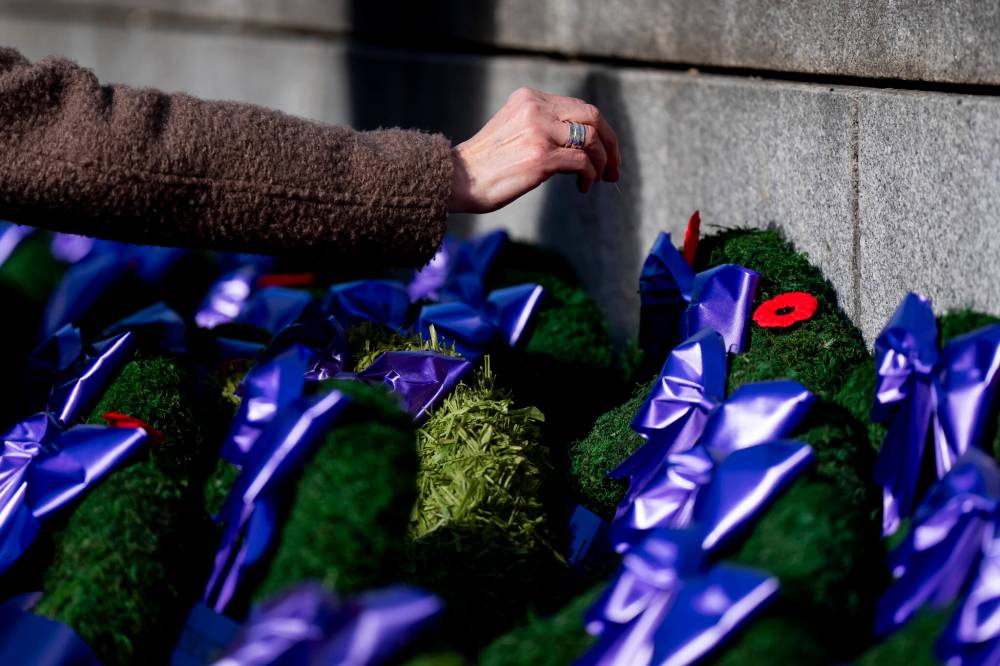
People place poppies on ceremonial wreaths at the Montreal Cenotaph following a Remembrance Day ceremony in Montreal on Nov. 11. (The Canadian Press)
There is always the argument made by some that to commemorate Nov. 11 is to glorify war. The question was put to veterans at the national event and they were quick to say that we should honour those who fight for their country and “make the ultimate sacrifice” but that our main message should be to find peaceful means to confront international disputes and resort to war no more.
In my career, trying to engage students (and adults) in global citizenship, I was often invited to speak at Remembrance Day events and to bring a different perspective to the occasion. That is, to say that the money spent on weapons could be used to improve the lives of those marginalized by poverty in the developing world and here at home. And to say that conflict creates death, injury and destruction of property that destroys lives, families, societies, environments and economies. As I’ve quoted on occasion in this column in the past, the great philosopher Immanuel Kant, in his book Perpetual Peace, written in 1795, to the backdrop of revolutions in North America and in France, said that he couldn’t understand why people fought, given that all the outcomes were negative. He prescribed ways that the global powers could operate with shared policies that would avoid death, destruction and resulting poverty.
So, here we are in 2026 and can look back on the past century as being always a time of war somewhere in the world. Weapons have become more sophisticated and deadly, but our ability to manage a world where everyone has a say and everyone benefits has not come to pass. Some of us might support opinions and actors on the political right, and others on the political left, but neither have a solution to this conundrum, and both have seemingly become more extreme. Those in the middle – or in the muddle – are vilified as not having taken the correct side.
As we are hearing today from our leaders, the world has changed in the past few years, and has become less certain and more dangerous. Friends we have relied on are now questionable at best. Progress in diplomacy, science and social development are at risk, to say the least. Canada, once known as the peacemaker, is bolstering its military as we and our allies face economic and military threat.
Some “old-timers” around the Brandon area may remember a generation ago, in the face of the nuclear weapons build-up, that there was an active peace group and annual peace marches that were well attended. Delegations spoke to city council and a small monument of paper cranes was set up in the lobby of city hall. This was to commemorate the Hiroshima and Nagasaki nuclear strikes in Japan at the end of the Second World War.
In those days, it was said that students were stressed by a fear of nuclear war. In another age, today — along with war —comes an additional stress about the environment and climate change. Parents got involved in peace groups to show their children that they cared about their kids’ future and were prepared to work on their behalf to make the world a better place. Not to take sides, but to push for a global ethic that embraced a culture of “no more war”.
These thoughts, somewhat jumbled, crossed my mind on Nov. 11 and linger still. How do we keep our kids and our grandkids from going to war?
» Zack Gross is president of the Marquis Project, a Brandon-Westman based international development organization. Learn more at www.marquisproject.com.