
Deal with U.S. may have to wait
Advertisement
Read this article for free:
or
Already have an account? Log in here »
We need your support!
Local journalism needs your support!
As we navigate through unprecedented times, our journalists are working harder than ever to bring you the latest local updates to keep you safe and informed.
Now, more than ever, we need your support.
Starting at $15.99 plus taxes every four weeks you can access your Brandon Sun online and full access to all content as it appears on our website.
Subscribe Nowor call circulation directly at (204) 727-0527.
Your pledge helps to ensure we provide the news that matters most to your community!
To continue reading, please subscribe:
Add Brandon Sun access to your Free Press subscription for only an additional
$1 for the first 4 weeks*
- Enjoy unlimited reading on brandonsun.com
- Read the Brandon Sun E-Edition, our digital replica newspaper
*Your next Free Press subscription payment will increase by $1.00 and you will be charged $20.95 plus GST for four weeks. After four weeks, your payment will increase to $24.95 plus GST every four weeks.
Read unlimited articles for free today:
or
Already have an account? Log in here »
What good is a trade deal with a country whose president doesn’t respect trade deals? That’s becoming an increasingly relevant question for Canada as Prime Minister Mark Carney continues trying to negotiate a new economic arrangement with U.S. President Donald Trump.
Of course a deal with the United States would be welcome. It would provide some badly needed stability for Canadian businesses and workers. But there’s a catch: the president has repeatedly shown that he can change the terms of the relationship whenever he feels like it, regardless of what his country has already agreed to.
That makes negotiating a new trade agreement a rather peculiar exercise.
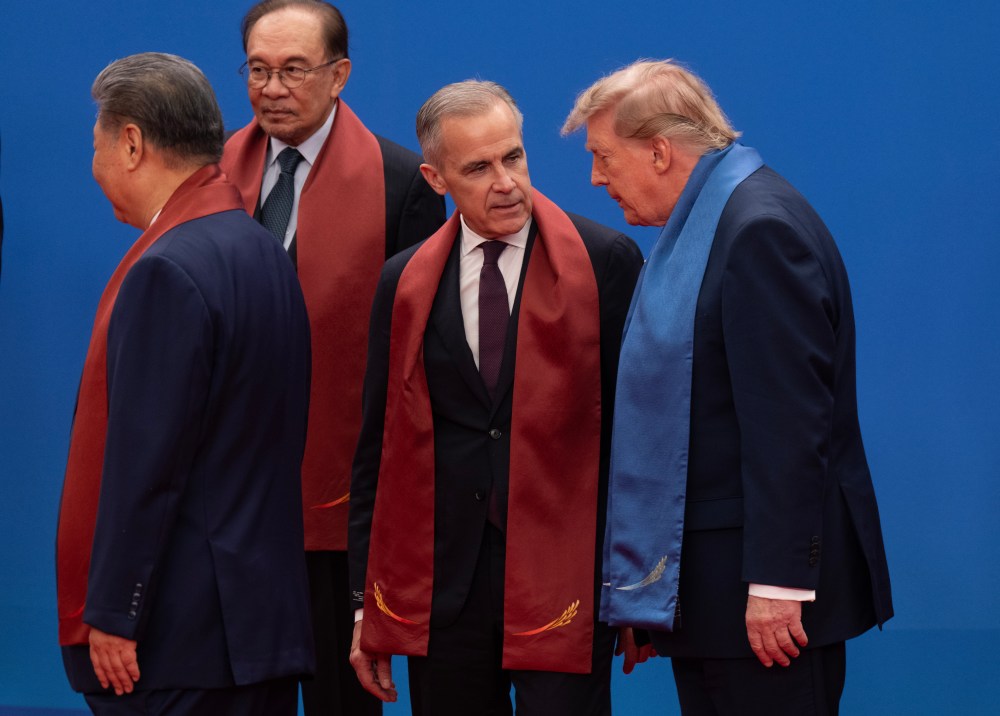
Canada could spend months negotiating a deal, make concessions, secure Trump’s signature and announce a diplomatic breakthrough, only to find itself right back where it started when the president decides he doesn’t like the arrangement anymore.
What kind of economic certainty is that?
The whole purpose of a trade agreement is to establish predictable rules. Businesses need to know what the rules will be tomorrow, next month and five years from now. They need confidence that governments will honour their commitments and that cross-border trade won’t suddenly be disrupted by political tantrums.
Trump has made a mockery of that principle.
The Canada-U.S.-Mexico Agreement was supposed to provide a stable framework for North American trade. Yet the American president has repeatedly used tariffs and economic threats to pressure Canada, demonstrating that even an existing agreement offers limited protection when Washington decides to disregard the spirit, if not the letter, of its commitments.
So while Carney is right to keep negotiating, Canadians shouldn’t assume that securing a new deal would necessarily solve the underlying problem.
The problem isn’t simply the absence of an agreement. It’s the person Canada has to negotiate with.
Carney seems increasingly comfortable acknowledging that Canada has other economic priorities and isn’t going to put everything on hold while waiting for Trump to make up his mind.
“We would like to do the deal. But if the U.S. doesn’t want to do the deal, we’re busy,” he said.
Carney pointed to trade agreements recently reached with the Association of Southeast Asian Nations and the Philippines, as well as an anticipated agreement with India in the coming months. Canada has also made progress in resolving trade disputes with China, including those affecting Canadian canola, seafood and pork.
It’s a remarkable contrast with the chaos of dealing with Washington.
Carney said a U.S. agreement should have been completed six months ago, but Canada wasn’t prepared to sign something that didn’t make sense for the country.
That’s an important distinction. Getting an agreement isn’t necessarily the same as getting a good agreement. And getting a good agreement with Trump doesn’t necessarily mean it will be respected.
The Conservatives have criticized Carney for appearing to put too much emphasis on expanding trade with China, and they’re right to point out that Canada’s relationship with the United States is far more important. China has a troubling record on human rights and economic retaliation. Canada shouldn’t be naive about the risks of doing business with Beijing.
But diversification doesn’t mean abandoning one trading partner in favour of another. It means reducing the risks of relying so heavily on any single country.
Canada’s economic future shouldn’t depend on the temperament of whoever happens to occupy the White House.
Trump’s repeated threats against Canada, including his talk of making this country the 51st state, have fundamentally altered the relationship. His willingness to use tariffs as a political weapon has made it clear that economic integration can also become an economic vulnerability.
That’s why Carney’s efforts to develop new markets are so important. Canada needs more customers for its products, more export opportunities and more options when dealing with Washington. The more diversified our trade becomes, the less leverage an American president has over us.
None of this means Canada should stop pursuing a new agreement with the United States. If Washington is prepared to negotiate a reasonable arrangement that provides genuine protections for Canadian industries, Ottawa should be ready to sign.
But there should be no desperation to get something done just to declare victory.
Perhaps the best Canada can realistically hope for is to keep the relationship functioning until Trump leaves office in two years. A serious, lasting trade agreement may have to wait for an American president who understands that international agreements aren’t supposed to be rewritten every time political circumstances change.
In the meantime, Carney should keep talking to Washington while getting on with the business of building Canada’s economic relationships elsewhere.
The United States will remain an enormous market for Canadian goods long after Trump is gone. But the American president has given Canada a valuable, if expensive, lesson about the dangers of economic dependence.
Canada can’t control who wins the next American election. It can’t control Trump’s impulses or his next tariff threat.
But it can control how much of its economic future it places in his hands.
» Tom Brodbeck is a Winnipeg Free Press columnist.