
Neutrality not the same as impartiality
Advertisement
Read this article for free:
or
Already have an account? Log in here »
We need your support!
Local journalism needs your support!
As we navigate through unprecedented times, our journalists are working harder than ever to bring you the latest local updates to keep you safe and informed.
Now, more than ever, we need your support.
Starting at $15.99 plus taxes every four weeks you can access your Brandon Sun online and full access to all content as it appears on our website.
Subscribe Nowor call circulation directly at (204) 727-0527.
Your pledge helps to ensure we provide the news that matters most to your community!
To continue reading, please subscribe:
Add Brandon Sun access to your Free Press subscription for only an additional
$1 for the first 4 weeks*
- Enjoy unlimited reading on brandonsun.com
- Read the Brandon Sun E-Edition, our digital replica newspaper
*Your next Free Press subscription payment will increase by $1.00 and you will be charged $20.95 plus GST for four weeks. After four weeks, your payment will increase to $24.95 plus GST every four weeks.
Read unlimited articles for free today:
or
Already have an account? Log in here »
Recently, Alberta proposed Bill 38, which would establish legislative requirements for institutional neutrality policies across the province’s post-secondary sector.
Under pressure from political leaders, universities across the globe are lining up to embrace the principle of “institutional neutrality,” enshrining commitments to refrain from adopting official positions on contested political, social or moral questions of the day.
This policy shift has been both swift and striking. Since 2023, more than 160 colleges and universities in the United States have adopted institutional neutrality policies. In the United Kingdom, a 2026 study found that 18 per cent of universities had formalized a commitment to institutional neutrality.
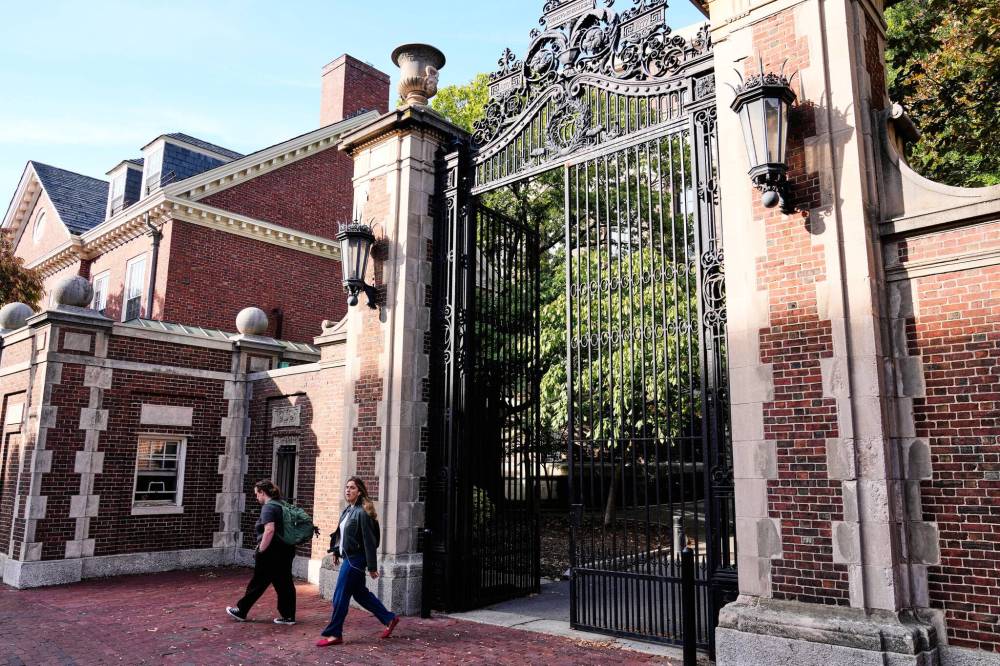
Harvard University is one of more than 160 U.S. post-secondary institutions to adopt neutrality policies. (The Associated Press files)
The reasons for and the ways in which this is unfolding are cause for real concern.
Advocates for institutional neutrality argue that it is a necessary safeguard for academic freedom, intellectual plurality and open debate. They claim that official institutional positions can discourage dissent and competing views.
This concern deserves serious consideration. Universities have a responsibility to question prevailing orthodoxies, including their own.
Refraining from public statements on matters of social consequence does not place a university outside the sphere of politics. Universities make consequential choices about their values, priorities and responsibilities every day (consider program, curricular, partnership and funding decisions as a few examples).
A commitment to neutrality does not make those choices impartial or relieve public institutions of the obligation to justify them.
Education is never simply the neutral transmission of objective knowledge from one party to another. Education cannot exist outside the social, political and ideological conditions in which it occurs.
Decisions about what is taught (and how), which histories are remembered (and whose are denied) reflect underlying relations of power and competing understandings of society.
To acknowledge this is not to advocate partisan indoctrination, but to recognize that the kind of critical education required in a democracy is one of which the assumptions underlying these choices are made visible, subjected to scrutiny and always open to challenge.
Canadian universities do not exist outside the reach of history. For example, their development is bound up with the dispossession of Indigenous peoples, the appropriation of land and the privileging of particular systems of knowledge and power. To suggest that these institutions can retreat neatly into neutrality is to overlook the profoundly political conditions out of which they were born and within which they continue to operate.
To be clear, the antidote to neutrality is not a requirement that universities weigh in or issue official pronouncements on every political, social or moral issue of the day — that would be neither feasible nor responsible. Nor is it appropriate for institutional leaders to presume to speak for scholars or students whose views may differ. But to carry out their obligations to the public, universities and academics must be free of partisan political constraints.
At issue in the U.S., and in Alberta, are the near-ubiquitous commitments of Canadian universities to reconciliation, decolonization, equity, diversity and inclusion. Would institutional neutrality prevent a university from confronting residential school denialism? From flying the Pride flag? From defending the rights and dignity of transgender students? A democratic dialogue regarding the purpose of our public institutions necessarily includes room for all others.
We must be wary of government efforts and universities’ own efforts to frame neutrality as impartiality or as principled, responsible restraint. Academic freedom requires space for disagreement, dissent and the interrogation of institutional authority. But the freedom to challenge prevailing ideas will never be secured by pretending that the schools within which those ideas are produced and contested are themselves free of value-based decisions with socio-political implications.
When intersecting social, economic and environmental crises are intensifying, and humanitarian catastrophes unfold before our eyes and on our phones, we need more from our democratic institutions and from our public universities. Their response cannot be to do less — to stand apart from the world, when their responsibility is to engage critically and thoughtfully within it.
Neither coerced silence nor the fabricated pretense of institutional consensus serves democracy well. Instead, we need institutional courage: the willingness to exercise judgment, practise discernment, confront uncomfortable truths, defend principled commitments, and remain open to criticism and dissent.
Hopefully, the Manitoba government and Manitoba universities don’t succumb to this latest urge to curtail the mandates of post-secondary institutions. Neutrality, put this way, is nothing but a ruse to control.
» John R. Wiens is dean emeritus at the faculty of education at the University of Manitoba. This column previously appeared in the Winnipeg Free Press.