
Tariffs run roughshod over U.S. legal system
Advertisement
Read this article for free:
or
Already have an account? Log in here »
We need your support!
Local journalism needs your support!
As we navigate through unprecedented times, our journalists are working harder than ever to bring you the latest local updates to keep you safe and informed.
Now, more than ever, we need your support.
Starting at $15.99 plus taxes every four weeks you can access your Brandon Sun online and full access to all content as it appears on our website.
Subscribe Nowor call circulation directly at (204) 727-0527.
Your pledge helps to ensure we provide the news that matters most to your community!
To continue reading, please subscribe:
Add Brandon Sun access to your Free Press subscription for only an additional
$1 for the first 4 weeks*
*Your next subscription payment will increase by $1.00 and you will be charged $20.00 plus GST for four weeks. After four weeks, your payment will increase to $24.00 plus GST every four weeks.
Read unlimited articles for free today:
or
Already have an account? Log in here »
Hey there, time traveller!
This article was published 04/06/2025 (301 days ago), so information in it may no longer be current.
It’s been rather evident for years now that Donald Trump considers himself above the law.
There have been numerous examples in Trump’s personal and professional life that we can point to in making that statement, not to mention dozens of indictments in various courts.
From his conviction for falsifying business records, to charges of mishandling of national security documents and his attempt to overturn the results of the 2020 U.S. presidential election, there’s been more than enough evidence to show that the man cares little for the rule of law.
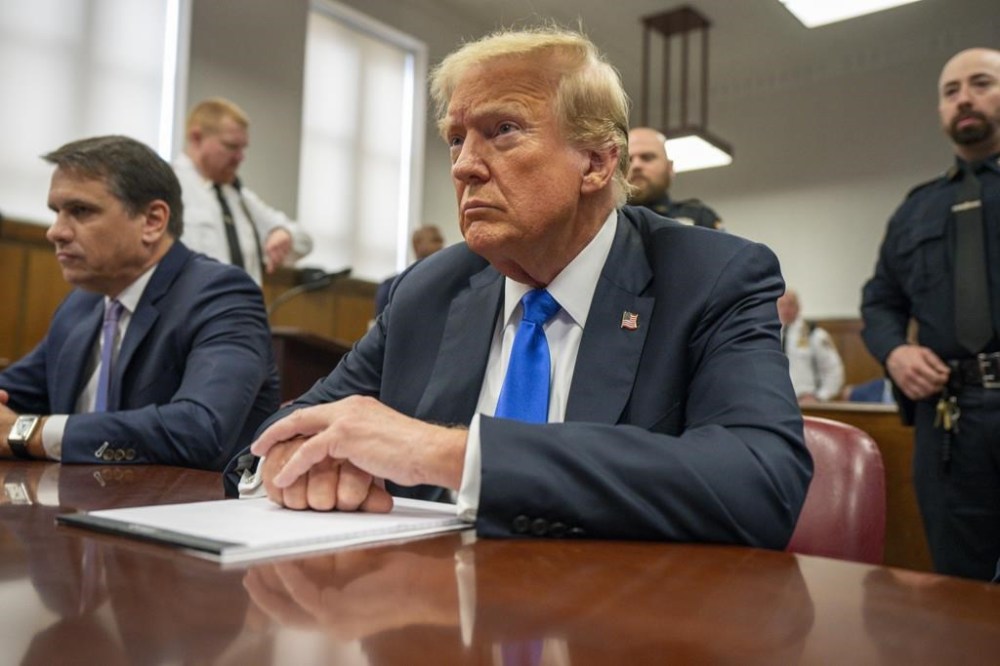
And considering that Trump has yet to spend any hard time behind bars, it’s not hard to see that the U.S. justice system has turned into a rather ineffectual paper tiger when it comes to defendant Trump and his loyalist cronies in the Republican Party.
And we’re about to see more proof of that fact today as U.S. tariffs on steel and aluminum imports are set to double.
Last month, the U.S. Court of International Trade confirmed what everybody already knew: that Trump can’t use trumped-up emergency powers to address magically created emergencies and then implement trade tariffs at his whim.
The panel of three judges unanimously ruled last Wednesday that Trump does not have the authority to impose a wide range of global tariffs using the International Economic Emergency Powers Act of 1977.
The act is usually referred to by the acronym IEEPA. It’s a law that lets the U.S. president step in and control economic transactions to address a national emergency. That move overrides the U.S. Congress, which has the exclusive power to “lay and collect taxes, duties, imposts and excises” and to “regulate commerce with foreign nations” under the U.S. constitution.
The judges were scathing in their decision, writing that “any interpretation of IEEPA that delegates unlimited tariff authority is unconstitutional.”
“The president’s assertion of tariff-making authority in the instant case, unbounded as it is by any limitation in duration or scope, exceeds any tariff authority delegated to the president under IEEPA. The worldwide and retaliatory tariffs are thus ultra vires and contrary to law,” the decision said.
It continued, “The challenged tariff orders will be vacated and their operation permanently enjoined,” halting the imposition of the duties countrywide, and ordering both “Liberation Day” global tariffs and the fentanyl-related duties against Canada and Mexico to be removed within 10 days. Some other tariffs, such as steel and aluminum tariffs levied against Canada and others, remain in place because they weren’t put in place using IEEPA.
Of course, the Trump administration appealed the court’s decision, and as a result, the court hearing the appeal has halted — albeit temporarily — the removal of the tariffs. The case will most likely reach the U.S. Supreme Court, where the original ruling will meet a distinct hurdle — a majority of Republican-appointed Supreme Court judges who have pandered more often than not to Trumpian politics rather than holding true to their own self-proclaimed literal interpretation of the U.S. constitution.
As soon as the decision came down, you could imagine administration spokespeople such as Trump deputy chief of staff Stephen Miller announcing that the decision was made by a Marxist, power-seeking, appointed judiciary — because that’s been the pat response to a steady march of court decisions striking down arbitrary actions by the White House.
Miller did so when the original ruling came down in the first place.
In the hours afterwards, White House spokesman Kush Desai said, “It is not for unelected judges to decide how to properly address a national emergency … President Trump pledged to put America First, and the administration is committed to using every lever of executive power to address this crisis and restore American greatness.”
Whether the U.S. Supreme Court justices support the U.S. Court of International Trade, or continue using the excuse of a fake “national emergency” to allow Trump to run roughshod over balanced economic policy and international trading norms, is anyone’s guess.
But the ongoing question over the legality of his tariffs and Trump’s ability to enforce them seems to have been merely a minor inconvenience to the U.S. president. A moot point, if you will, when it comes to his misguided economic whims.
As of Tuesday, White House press secretary Karoline Leavitt told media that the Trump administration will move forward with plans to double steel and aluminum tariffs today to 50 per cent — double what Trump imposed last March.
As Canada is the largest steel supplier to the United States — accounting for nearly 25 per cent of all imports in 2023, according to a Canadian Press report — Canada’s economy will no doubt bear the brunt of this in the coming months.
It’s possible, of course, that the Supreme Court may force an end to Trump’s tariff dalliance. But that would require the will of the ultimate arbiters of U.S. justice to keep Trump within the law and accountable for his actions.
And thus far, any faith in that system has proven false.
» The Brandon Sun and The Winnipeg Free Press