
A little more information might ease some stress
Advertisement
Read this article for free:
or
Already have an account? Log in here »
We need your support!
Local journalism needs your support!
As we navigate through unprecedented times, our journalists are working harder than ever to bring you the latest local updates to keep you safe and informed.
Now, more than ever, we need your support.
Starting at $15.99 plus taxes every four weeks you can access your Brandon Sun online and full access to all content as it appears on our website.
Subscribe Nowor call circulation directly at (204) 727-0527.
Your pledge helps to ensure we provide the news that matters most to your community!
To continue reading, please subscribe:
Add Brandon Sun access to your Free Press subscription for only an additional
$1 for the first 4 weeks*
- Enjoy unlimited reading on brandonsun.com
- Read the Brandon Sun E-Edition, our digital replica newspaper
*Your next Free Press subscription payment will increase by $1.00 and you will be charged $20.95 plus GST for four weeks. After four weeks, your payment will increase to $24.95 plus GST every four weeks.
Read unlimited articles for free today:
or
Already have an account? Log in here »
Hey there, time traveller!
This article was published 01/04/2020 (2384 days ago), so information in it may no longer be current.
For the last number of weeks, the provincial government and the media have been locked in a daily back and forth as public health officials announce the latest statistics on the COVID-19 infection rate, and the general districts where infections have been found. And media try to pry more information out of them.
While these daily media briefings are useful in terms of relaying new COVID-19 policies that change from day to day, it’s rather clear that our health officials regard this daily ritual — and the written information bulletins that are emailed daily — as a way to guide the public rather than fully inform the public.
As Winnipeg Free Press columnist Dan Lett noted in his column this week, details have been scant regarding Manitoba’s first virus fatality — a 60-something woman named Margaret Sader who worked at a Winnipeg dental supply company.
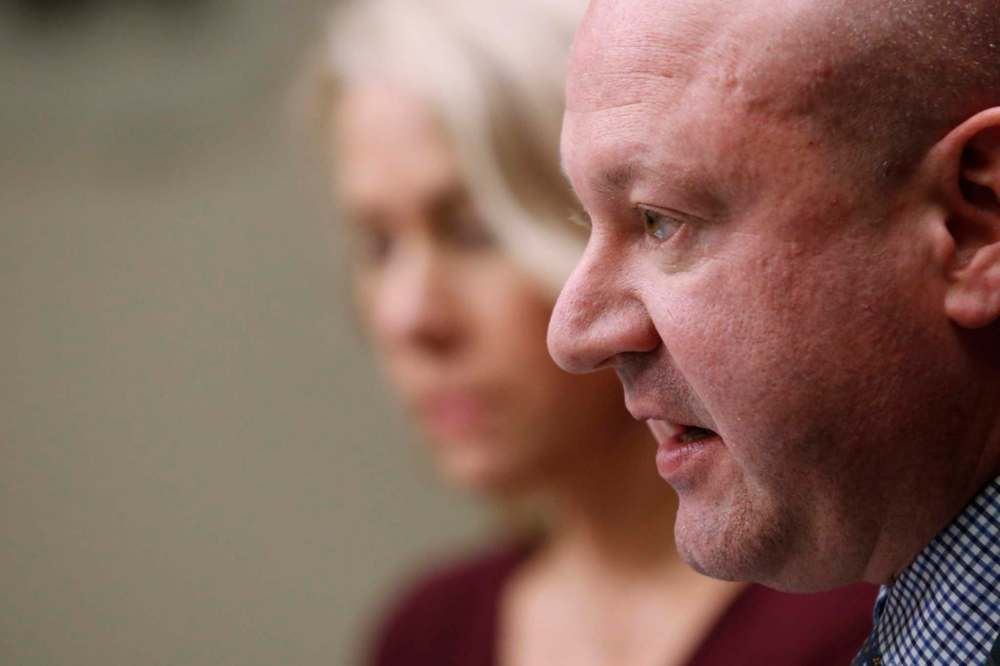
“Last week, Manitoba chief public health officer Dr. Brent Roussin refused to tell us anything about the 60-something woman who passed away after being treated in a hospital intensive care unit,” Lett wrote. “This included a blackout on all details of how, when and where she may have contracted the virus, and whether she could have passed it on to anyone else.”
Roussin has offered no explanation for his refusal to provide further information about this case, which is problematic in the bigger picture. As Lett points out, “a lack of information in a pandemic can lead to tragic results,” as the public does not then have the necessary information to make informed decisions.
To be fair to Dr. Roussin, this is an ongoing debate around the world — how much information is too much information? And by releasing more information, would the government only increase Manitoban anxiety over the spread of the disease? Is too little giving us a false sense of security, by making us think the situation is not as bad as it is elsewhere?
In the last few days, however, we have to wonder why some information regarding the virus seems to be slow to come to the public consciousness.
On Saturday, the province updated its list of flights and events with confirmed cases of the coronavirus, and on that list was WestJet flight WS 3256, which flew from Calgary to Brandon on March 15. Two separate sets of affected rows were listed on the flight, including rows 2-8 and rows 9-15. These rows were considered as being in close contact with the virus and were at risk of exposure. But keep in mind this information was only released one day before any 14-day isolation that could have been imposed upon landing would have ended.
But that information suddenly changed on Sunday evening, and now there were two separate WS 3256 flights that were affected between Calgary and Brandon — one on March 14, with seat 12A affected according to the provincial website, and the second on March 15, with rows 2-8 affected. So, were passengers in rows 9-15 on March 15 exposed or not? We do not know.
On Monday, we learned that of the 96 total cases of COVID-19 that day (the province announced a new total of 103 on Tuesday morning) nine were found in Prairie Mountain Health Region. But information about more precise locations — in Brandon? Dauphin? Melita? — has not been forthcoming. And while there is likely a good explanation for withholding this information, absence of detail has also had the effect of raising anxiety throughout the region.
Also on Tuesday, it was announced that a health-care worker at Selkirk Regional Health Centre had not only been diagnosed with COVID-19 — likely contracted through travel within Canada — but that the person had also reported for work on four separate days between March 19 and March 22 without self-isolating themselves.
While it was noted this person’s return to the province came before the province ordered people to self-isolate for 14 days following interprovincial travel, we should question why that information only became public nine days after the person’s last shift. There is no telling how many people they interacted with, and how many could have been infected as a result.
We understand that this is an unprecedented time for our health officials and we have to be cognizant of the fact that they are under duress to get information to ministers and decision-makers in a timely fashion, while trying to limit giving out private details about individual cases. It is no doubt a difficult position in which to find themselves.
And while we, too, want to avoid causing Manitobans unnecessary anxiety and stress about the movements of the virus, we also believe that people have a right to timely and useful information that could affect their health, or the health of someone they care about.
At the very least, the province must avoid confusing people, and must ensure that situations like what happened in Selkirk do not happen again.