
IIU needs to explain itself
Advertisement
Read this article for free:
or
Already have an account? Log in here »
We need your support!
Local journalism needs your support!
As we navigate through unprecedented times, our journalists are working harder than ever to bring you the latest local updates to keep you safe and informed.
Now, more than ever, we need your support.
Starting at $15.99 plus taxes every four weeks you can access your Brandon Sun online and full access to all content as it appears on our website.
Subscribe Nowor call circulation directly at (204) 727-0527.
Your pledge helps to ensure we provide the news that matters most to your community!
To continue reading, please subscribe:
Add Brandon Sun access to your Free Press subscription for only an additional
$1 for the first 4 weeks*
- Enjoy unlimited reading on brandonsun.com
- Read the Brandon Sun E-Edition, our digital replica newspaper
*Your next Free Press subscription payment will increase by $1.00 and you will be charged $20.95 plus GST for four weeks. After four weeks, your payment will increase to $24.95 plus GST every four weeks.
Read unlimited articles for free today:
or
Already have an account? Log in here »
Hey there, time traveller!
This article was published 16/03/2022 (1685 days ago), so information in it may no longer be current.
Manitoba’s Independent Investigation Unit continues to have a clarity problem in how it holds police officers to account for their behaviour.
On March 2, Court of Queen’s Bench Justice Sandra Zinchuk found both the City of Brandon and Terry Lynn Peters jointly and severally liable for damages in the city’s intimate images case.
Brittany Roque sued Peters for sharing Roque’s intimate images without her consent. The trial was heard virtually in mid-February 2021. The City of Brandon is listed as a third party in the lawsuit.
Zinchuk found both Peters and the city jointly and severally liable for general damages of $45,000, and Peters liable for aggravated damages of $15,000.
The case stems from a 2017 incident in which Peters shared Roque’s intimate images with the Brandon Police Service senior executive during a police hiring competition Roque applied for.
In March 2017, Roque underwent a polygraph test as part of the hiring process, where she disclosed her past relationship with Brandon police officer Ryan Friesen, Peters’ then-partner.
At the end of the meeting, she was told she could either withdraw from the hiring process or else she would be removed by the Brandon Police Service, according to the agreed statement of fact in Zinchuk’s decision.
Roque declined to withdraw from the competition and subsequently filed complaints with the IIU and the RCMP.
In the written decision, Zinchuk said while she agrees it is in the public’s interest for BPS to do a thorough background check on applicants, there is “no rational explanation for why any of the images needed to be provided to BPS in order to fully consider and assess her application.” She wrote that distributing the intimate images was not in the public’s interest.
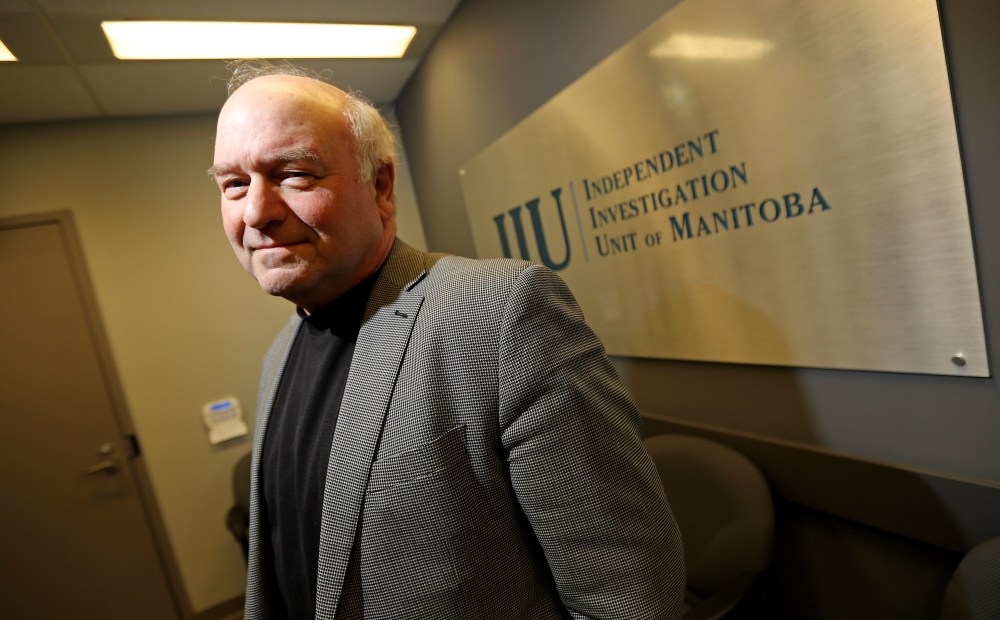
The IIU, the province’s civilian-led police watchdog, investigated the incident after Roque made a complaint, but did not file charges against Brandon police deputy chief Randy Lewis.
“On careful review of the available evidence and material facts obtained in this investigation, together with consideration of the applicable law, I am not satisfied that there are reasonable and probable grounds to believe [the officer’s] conduct warrants charges under the Criminal Code, or any other federal or provincial statute. Accordingly, no charges will be laid against [the officer],” IIU civilian director Zane Tessler concluded in his final report released in July 2018.
But Lewis was in breach of a law by viewing Roque’s intimate images, Zinchuk said. A person has the right to control who sees intimate and private images of their body, she wrote, and Lewis viewed the image without her consent.
“I find that this substantially, and unreasonably violated her privacy,” Zinchuk wrote, adding Lewis receiving and using the images was “not in the public interest.” While he did not distribute the images, he still accepted and viewed them in the hiring competition.
The test in civil court is lower than in criminal court, but Zinchuk states Lewis did make a mistake in how he dealt with the intimate images.
“I would still find that Lewis, in his capacity as a police officer with BPS, committed the tort of breach of privacy pursuant to the [Privacy Act],” she wrote.
The Justice’s decision out of the civil trial leads us to wonder whether the IIU will revisit the case given the decision. It also makes us wonder why Tessler said the conduct didn’t breach any other “federal or provincial statute.”
The Sun asked these questions to the province’s media relations line, but was told the IIU’s report “speaks for itself.”
“It is important to note that it was completed from the perspective of whether criminal or quasi-criminal charges could or should be pursued. The burden of proof, or standard of review is different in a civil suit which could lead to a different interpretation of whether there was a breach of the Privacy Act,” the province said in a statement.
The Sun also asked the Brandon Police Service for comment at the time, but Chief Wayne Balcaen said the decision was still being reviewed by the City of Brandon’s legal team. While that is perhaps fair for the time being, the Brandon police and city administration both have an obligation to address the outcome of this case with the public, especially considering that taxpayers may well be on the hook for the restitution to Roque should Peters be unable to pay her court-ordered share.
The story has also gone national as a result of an article that appeared in the Globe and Mail this week. Kevin Toyne, a lawyer who represented Roque in the case, called it a “precedent-setting” decision, and he’s likely correct on that assumption, given that Zinchuk referenced other cases out of Ontario in her decision, and not federal or provincial legislation.
Other people embroiled in similar situations will be able to look to the decision and see courts can recognize the wrong committed.
The IIU’s mandate is extremely important and the work the organization does is critical. The police, who we trust to uphold the law, should be held to an extremely high standard and deserve full scrutiny. On the surface of it, that does not appear to have happened in this case.
At the same time, the public deserves to know how the province’s police watchdog operates and how it makes decisions. Given the attention on the case and the $45,000 for which Brandon taxpayers could be on the hook, the public is owed more explanation from the IIU.