
‘Beyoncé’s a no-go’: Figure skaters face music-rights clearance issues at Olympics
Advertisement
Read this article for free:
or
Already have an account? Log in here »
We need your support!
Local journalism needs your support!
As we navigate through unprecedented times, our journalists are working harder than ever to bring you the latest local updates to keep you safe and informed.
Now, more than ever, we need your support.
Starting at $15.99 plus taxes every four weeks you can access your Brandon Sun online and full access to all content as it appears on our website.
Subscribe Nowor call circulation directly at (204) 727-0527.
Your pledge helps to ensure we provide the news that matters most to your community!
To continue reading, please subscribe:
Add Brandon Sun access to your Free Press subscription for only an additional
$1 for the first 4 weeks*
- Enjoy unlimited reading on brandonsun.com
- Read the Brandon Sun E-Edition, our digital replica newspaper
*Your next Free Press subscription payment will increase by $1.00 and you will be charged $20.95 plus GST for four weeks. After four weeks, your payment will increase to $24.95 plus GST every four weeks.
Read unlimited articles for free today:
or
Already have an account? Log in here »
MILAN – Madeline Schizas knew she’d be starting her routine to a different note when she stepped on the ice for Friday’s Olympic team event – thanks to Queen B.
For the past season, Schizas has been charming audiences with a short program based on music from the Disney movie “The Lion King.”
But at the Milan Cortina Games, the opening section of her routine was altered because of one of the biggest music stars in the world.
“The first 35 seconds were owned by Beyoncé, and so I believe that was the problem,” Schizas said.
“Beyoncé’s a no-go.”
Even before the season began, Schizas believed she would have to scrap the mostly Disney-owned music entirely.
That changed three months ago when Skate Canada secured the rights to the final two-and-a-half minutes, something she called a “big relief” at the Canadian championship in January.
“It’s been a long year. It seemed like nothing was there. Not the Lion King, not anything else,” she said. “It was just back and forth and back and forth.”
The 22-year-old from Oakville, Ont., is one of several figure skaters to run into music-rights legalities leading up to the Olympics.
Spanish skater Tomas-Llorenç Guarino Sabaté grabbed international headlines this week after learning days before the Olympics that his lovable medley from the “Minions” movie – paired with a costume depicting the mischievous yellow sidekicks – could not be used in Milan.
He ultimately gained clearance Friday for a final piece of music by Pharrell Williams, avoiding a nightmare scenario.
Music-rights issues have become more common since 2014, when the International Skating Union loosened its rules to allow songs with lyrics, which unlike classical music doesn’t often fall in the public domain.
Skate Canada hired a third-party that specializes in music clearances more than a year ago to help procure all the required licenses for athletes participating in the Games.
But the music-rights clearance process, made more difficult at the Olympics due to costly international broadcast and streaming agreements, has been described as “very complicated” by seasoned figure skating observers and the ISU itself.
Guarino Sabaté, for example, said he followed the prescribed procedure for getting his music approved through a system called ClicknClear in August, before the figure skating season began.
Canadian ice dancers Marie-Jade Lauriault and Romain Le Gac were forced to change their rhythm dance from “Thunder” and “Cream” by Prince to a “Sexbomb” by Tom Jones mix after learning they wouldn’t get clearance in December.
Meanwhile, fellow ice dancers Marjorie Lajoie and Zachary Lagha removed “Thunderstruck” and “Are You Ready” by AC/DC from their rhythm dance to avoid a copyright violation.
“It doesn’t matter like how I feel, I just have to adapt,” the blunt and dry-humoured Lagha said. “We have no choice. So, it sucks, that’s it.
“But that’s OK, we’ll manage. There is plenty of music to skate to.”
Lajoie said the change may have been a blessing in disguise.
“It was really repetitive, the ‘Thunderstruck’ song,” she said of the classic rock track. “We really liked it, it was really fun. But when we changed it, we were like, oh OK, there’s other layers that we can use.”
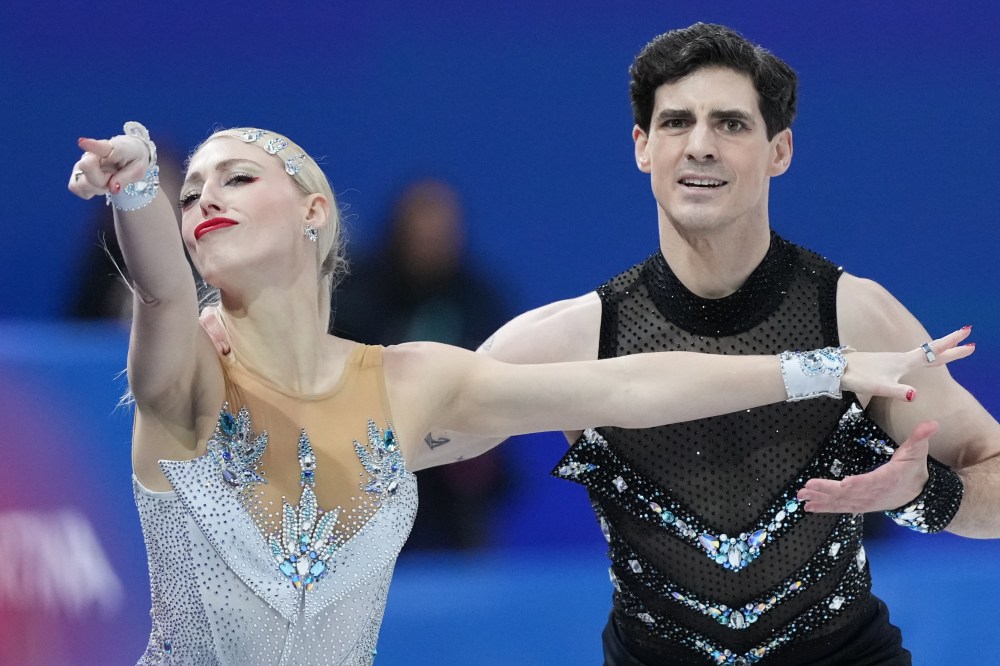
Veterans and four-time world medallists Piper Gilles and Paul Poirier didn’t face the same hurdles for their programs to “Supermodel” by RuPaul and Govardo’s cover of “Vincent” by Don McLean.
Gilles explained they were lucky to have already paid for the rights to Govardo’s music when they first skated to it seven years ago, though she added the situation requires attentiveness.
“Even like six, seven weeks ago, I sent our lawyer, ‘Hey, are we good with everything?’” she said. “It’s just another thing on our plate, but everybody’s doing it. It’s part of our plan and our process.
“It’s a tricky situation. I think all of us are navigating it all together at one time.”
— With files from The Associated Press
This report by The Canadian Press was first published Feb. 7, 2026.