
Mighty Canada stumbles, losing mixed doubles curling matches to Great Britain and Estona
Advertisement
Read this article for free:
or
Already have an account? Log in here »
We need your support!
Local journalism needs your support!
As we navigate through unprecedented times, our journalists are working harder than ever to bring you the latest local updates to keep you safe and informed.
Now, more than ever, we need your support.
Starting at $15.99 plus taxes every four weeks you can access your Brandon Sun online and full access to all content as it appears on our website.
Subscribe Nowor call circulation directly at (204) 727-0527.
Your pledge helps to ensure we provide the news that matters most to your community!
To continue reading, please subscribe:
Add Brandon Sun access to your Free Press subscription for only an additional
$1 for the first 4 weeks*
*Your next subscription payment will increase by $1.00 and you will be charged $20.00 plus GST for four weeks. After four weeks, your payment will increase to $24.00 plus GST every four weeks.
Read unlimited articles for free today:
or
Already have an account? Log in here »
CORTINA D’AMPEZZO, Italy (AP) — The desperation played on the faces of Canadian curling couple Brett Gallant and Jocelyn Peterman on Saturday as they watched Great Britain’s Bruce Mouat and Jennifer Dodds send red stones pummeling into their carefully set yellows. It grew when they lost 8-6 to Estonia, a team competing at the Olympics for the first time, later in the day.
Canada’s losses Saturday in mixed doubles curling came after their defeat Friday at the hands of the U.S. team.
If the matchups marked faceoffs between the historic dominance of Canada, and the growing rigor of other nations’ training programs in the sport, the results Saturday cemented just how much the field has changed through the last few Olympiads.
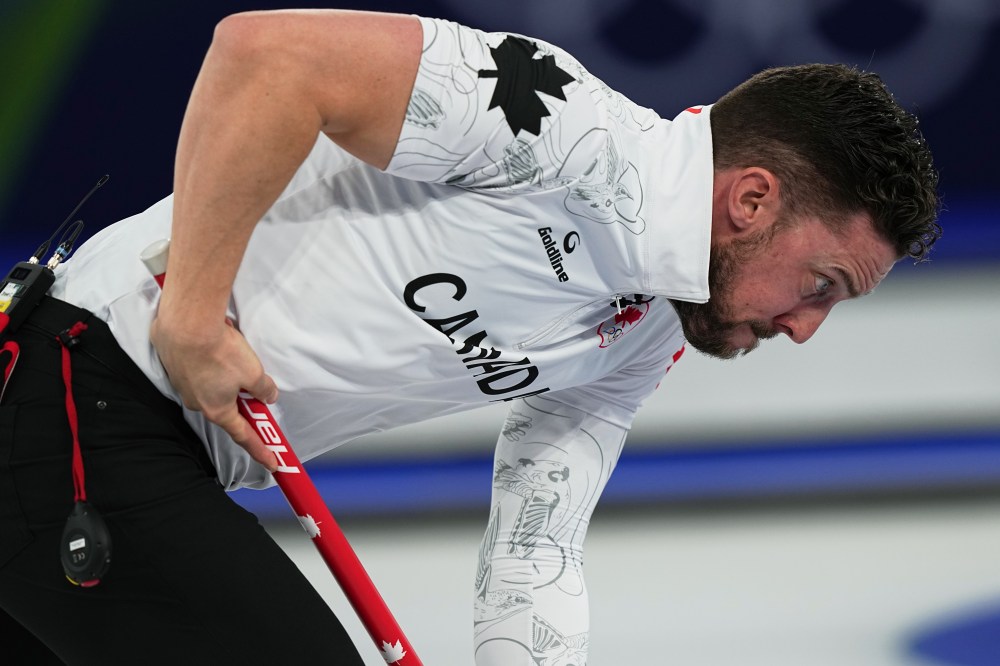
“We’re in the thick of it, obviously we would have liked one more win today — or a win,” said Brett Gallant. “But we’re still in control. We got to come in on the right foot tomorrow. We’re still in the mix.”
There is immense pressure on Canadian curlers at these games, as the competition stiffens and a particularly knowledgeable fanbase back home closely watches. These games comes after the powerhouse won only 1 bronze medal across all curling disciplines in the Beijing Olympics in 2022.
“It’s an exact representation of where curling is at,” Devin Heroux, an Olympics reporter for the Canadian Broadcasting Corporation who has spent years watching the Canadian duo curl, said after the match. “For a long time in Canada, there was this feeling that the country produced the best rock hurlers in the world. Now they are realizing that the world has not just caught up with them, it has surpassed them.”
The current and former presidents of Estonia, Alar Karis and Kersti Kaljulaid, were there to watch proudly as the debut Estonian Olympic curling team took down the mighty Canadians.
It’s not the first time the Estonians have taken down the Canadians. After the match, Estonian curler Marie Kaldvee described beating Canada as “kinda our thing.”
“We have one curling club and three sheets of ice and Canada probably has, times ten thousands at least,” she added, smiling.
There are 10 teams in total playing mixed doubles at the 2026 Milan Cortina Games, and the field mainly remains scrambled. In another shakeup, the U.S. team of Cory Thiesse and Korey Dropkin – currently tied for second place with Italy — lost 6-5 to Korea, which is currently tied with Czechia in last.
Great Britain, currently in first, is the only team to have a secure spot in the playoffs.
Great Britain’s Bruce Mouat and Jennifer Dodds are best friends who have honed their craft through years spent curling side by side at Scotland’s National Curling Academy, founded in 2017. They’re one team out of several that has emerged in recent Olympiads as formidable opponents to the Canadians.
“I think we’re in a really good spot. We’re communicating very well and we now know what the ice is gonna do for the rest of the event,” said Mouat after the morning victory against Canada.
Mouat was one of several athletes to say the ice conditions were “quicker” than usual and had massively changed from the day before, forcing them to adjust their game.
Canada was less positive about the changes. Gallant compared it to “taking a Honda civic for a drive down the highway and then jumping in a Ferrari.”
“It’s not an excuse,” he added. “The team that adjusts to the changes better will get the advantage, so that’s on us. They adjusted quicker than we did.”
So far at Cortina, the ice changes have shown to be so significant that “being able to embrace and adapt to the changing conditions will be what allows one of these teams to win gold,” said Heroux.
__
AP Winter Olympics: https://apnews.com/hub/milan-cortina-2026-winter-olympics