
Canadian skiers suffer disappointing day at Olympic downhill in Bormio
Advertisement
Read this article for free:
or
Already have an account? Log in here »
We need your support!
Local journalism needs your support!
As we navigate through unprecedented times, our journalists are working harder than ever to bring you the latest local updates to keep you safe and informed.
Now, more than ever, we need your support.
Starting at $15.99 plus taxes every four weeks you can access your Brandon Sun online and full access to all content as it appears on our website.
Subscribe Nowor call circulation directly at (204) 727-0527.
Your pledge helps to ensure we provide the news that matters most to your community!
To continue reading, please subscribe:
Add Brandon Sun access to your Free Press subscription for only an additional
$1 for the first 4 weeks*
*Your next subscription payment will increase by $1.00 and you will be charged $20.00 plus GST for four weeks. After four weeks, your payment will increase to $24.00 plus GST every four weeks.
Read unlimited articles for free today:
or
Already have an account? Log in here »
BORMIO – It was a disappointing day for Canadian skiers as Switzerland and Italy hogged the top five at the Olympic men’s downhill Saturday.
Swiss world champion Franjo von Allmen won the first goal medal awarded at the Milan Cortina Games, covering the daunting Stelvio course in one minute 51.61 seconds. Italians Giovanni Franzoni (1:51.81) and Dominik Paris (1:52.11) were second and third with Switzerland’s Marco Odermatt (1:52.31) and Alexis Monney (1:52.36) fourth and fifth.
Toronto’s James (Jack) Crawford was top Canadian in ninth (1:53.00). North Vancouver’s Cameron Alexander was 14th (1:53.49), Jeffrey Read of Canmore, Alta., finished 25th (1:54.56) and North Vancouver’s Brodie Seger placed 28th (1:54.96) in the field of 36.
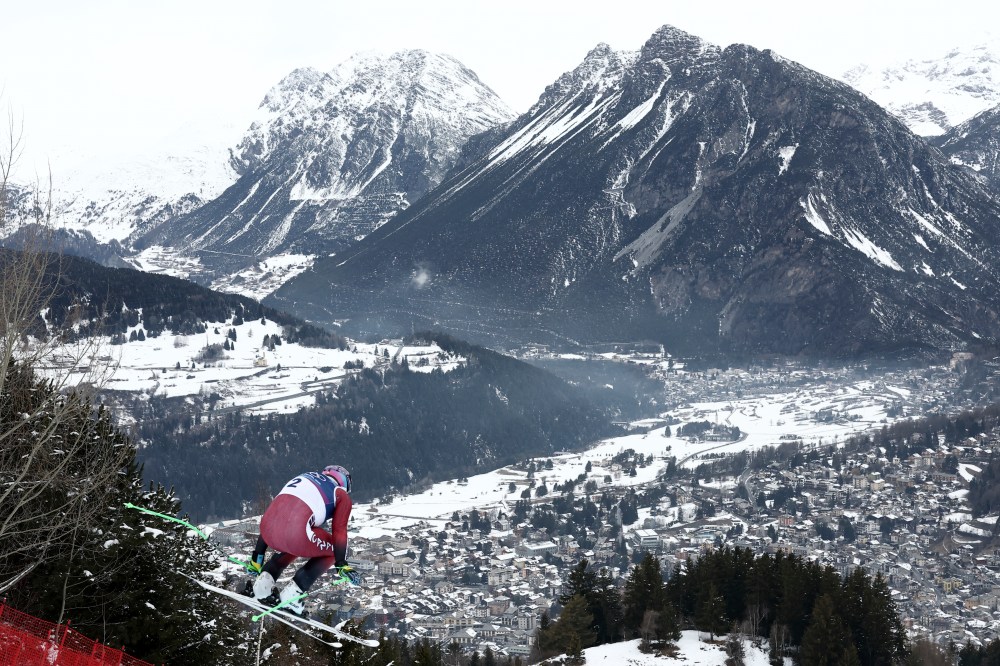
While a beaming Read, the son of Crazy Canuck Ken Read, savoured becoming the latest Olympian in his family, the other three Canadians pondered what might have been.
“I’ve been struggling a little bit to find form and confidence in my skiing. And today I thought I finally brought that,” said Crawford, who won bronze in the combined event four years at the Beijing Olympics. “I definitely brought a level that could have won the race today. I just made a few mistakes here and there that unfortunately cost me that podium.”
One of those mistakes “basically killed all my speed,” he lamented.
Crawford and other racers topped 145 kilometres per hour in parts of the course.
He has experienced disappointment in the Olympic downhill before. He just missed making the podium in Beijing, finishing seven 100-hundredths behind bronze medallist Matthias Mayer of Austria.
Crawford, making his third Olympic appearance, has had past success in Bormio, however. He was runner-up to Austrian Vincent Kriechmayr in a December 2022 World Cup race.
Crawford now turns his attention to Wednesday’s super-G, looking to improve on his sixth-place performance four years ago.
Alexander, who has five World Cup downhill podiums including two in Bormio, also cited a couple of costly missteps.
“It’s a tough sport. You have two minutes and you can’t really make a mistake if you want to have a good day,” he said.
Seger acknowledged his confidence has taken a hit in the last month, after failing to finish a couple of races and crashing in a super-G.
“To be honest I found some really good feelings on my skis (today),” he said. “I was enjoying myself on the run. So to try and reconcile that with such a slow time is tough.”
The severe Stelvio course is 3,442 metres long with a vertical drop of 1,023 metres.
And it has bite.
Norway’s Fredrik Møller was helicoptered to hospital Wednesday after crashing halfway down the opening training run. The Norwegian team later announced later that he dislocated his left shoulder.
The next day, Austrian Daniel Hemetsberger suffered a bloodied nose and swollen eye when his helmet flew off during a fall and he crashed into the safety nets.
In December 2024, three skiers were airlifted to hospital during a World Cup weekend here, with France’s Cyprien Sarrazin requiring surgery to drain bleeding on the brain after crashing during training.
The top of the course has a gradient of 63 per cent with racers hitting speeds of 140 km/h in seconds.
The good news is that it’s February. Racers normally ski the course in December when the light is darker. It was a balmy 1 C Saturday, feeling even warmer.
“The conditions were good,” said Crawford. “It’s Bormio. It’s super-bumpy. It’s hard. It’s one of the hardest if not the hardest World Cup tracks of the year.”
Seger finished 22nd in the downhill four years ago in Beijing and was ninth in the combined. His younger brother Riley is also part of the Canadian ski team at the Milan Cortina games.
It was bucket-list day for Read, who added to the family Olympic tree.
His older brother Erik skied for Canada in both the 2018 and 2022 Olympics while cousin Stefan Read competed in ski jumping in 2010.
Father Ken Read skied in the 1976 and 1980 games while uncle Jeff Read skied in the 1984 and 1988 Olympics. Another uncle, Derek Robbins, skied in the 1972 games.
“A long list,” Jeffrey Read said with a smile. “So skiing’s definitely the family business.”
These widespread games mean the alpine skiers are only getting a taste of the Olympic experience. Housed in Bormio away from athletes competing in other sports, their experience is “extremely similar to what the World Cup is like,” said Crawford.
“Just a little more media, a little more security,” he added.
“It was kind of weird the first couple of days,” said Alexander. “I’m not sure that it really hit me, I guess, because it almost kind of felt like a World Cup because it’s just the guys here. But things definitely changed getting closer to today. It’s been really cool.”
Canada has won 12 Olympic medals (four gold, one silver and seven bronze) in alpine skiing, with Crawford’s combined bronze in Beijing the most recent. Eight of those medals have been won by women.
All four of the Canadian men’s medals have been bronze.
—
This report by The Canadian Press was first published Feb. 7, 2026