
Roaming The Range
Advertisement
Read this article for free:
or
Already have an account? Log in here »
We need your support!
Local journalism needs your support!
As we navigate through unprecedented times, our journalists are working harder than ever to bring you the latest local updates to keep you safe and informed.
Now, more than ever, we need your support.
Starting at $15.99 plus taxes every four weeks you can access your Brandon Sun online and full access to all content as it appears on our website.
Subscribe Nowor call circulation directly at (204) 727-0527.
Your pledge helps to ensure we provide the news that matters most to your community!
To continue reading, please subscribe:
Add Brandon Sun access to your Free Press subscription for only an additional
$1 for the first 4 weeks*
*Your next subscription payment will increase by $1.00 and you will be charged $20.00 plus GST for four weeks. After four weeks, your payment will increase to $24.00 plus GST every four weeks.
Read unlimited articles for free today:
or
Already have an account? Log in here »
Hey there, time traveller!
This article was published 29/03/2018 (2836 days ago), so information in it may no longer be current.
Once a seemingly unstoppable force in North America, bison trampled the plains in the millions, serving as an important source of sustenance for Indigenous peoples.
With colonialization came over-hunting, and by the late 19th century bison were on the verge of extinction.
Despite their dwindling numbers, pockets of bison persevered.
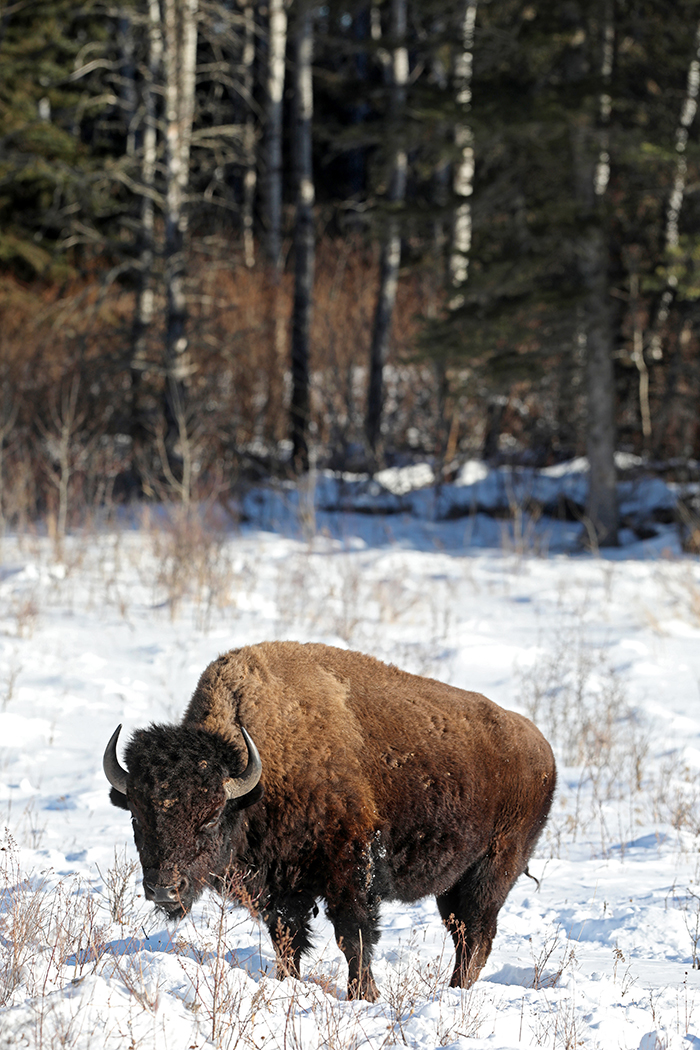
Sprinkled throughout Manitoba, many of these pockets are available for public viewing. Although most of them are kept at for-profit ranches, some efforts have been led by communities intent on preserving the animals for future generations.
Of those herds of bison to survive, only one is truly free range.
Riding Mountain National Park, Sioux Valley Dakota Nation and the Town of Minnedosa all maintain herds, but they’re both limited to a fenced-in area.
Initiated by Skownan First Nation, a Government of Manitoba-maintained herd in the northern Interlake region constitute the province’s only free range bison. Manager of game, fur and human wildlife conflict for the Wildlife and Fisheries Branch Brian Joynt said that the herd of wood bison is approximately 300 to 350 in number, although this is just a rough estimate since it has been a while since they’ve done a survey. “The herd is doing well,” he said, adding; “It’s not growing excessively. It’s a wild herd that’s taking care of itself with very little management effort on the part of the department.”
The herd originates from Alberta’s Elk Island National Park, with animals released in the 1980s and ’90s.
The natural habitat finds these bison co-habit their territory with predators; namely, wolves.
With these wild bison situated within a wide range of land between Highway 60 and Highway 328, between Lake Winnipegosis and Lake Winnipeg, Joynt said that few Manitobans are likely to see them without a guide.
As such, those keen on viewing bison are more likely to find success with those Manitoban herds that have been fenced off.
The Town of Minnedosa maintains a herd of a dozen bison year-round.
Located along Highway 262 between downtown Minnedosa and Minnedosa Lake, Bison Park sees newborn calves arrive every spring.
The community manages the bison through an agreement with a nearby rancher, wherein the community takes care of their feeding in exchange for their remaining at Bison Park.
A walking trail circles the enclosure, allowing people to get a closer look at the bison, which public works director Kevin Marcino said are a unique sight in the area that draws a steady stream of people throughout the year.
Sioux Valley Dakota Nation has a herd of about 35 bison housed on 100 acres of land at the west side of the community, which are overseen by councillor Anthony Tacan.

This herd is unique for its inclusion of three white bison.
“To the Dakota, the white buffalo is part of our history; our teachings, so they’re to be looked after and respected,” Tacan said “It came into this world where it brought the teachings with it that we have to follow, humility and the prophecies.”
The herd started up several years ago out of the realization that non-Indigenous farmers in the area were raising bison, which Indigenous people relied on for generations.
Tacan said that it was strange that they didn’t have any, so they created a herd, with the community purchasing bulls from the nearby Bison Spirit Ranch and heifers from Spirit Lake Nation in North Dakota. “It’s partly our people; giving them hope, with all the sickness,” Tacan said, adding that community members will oftentimes to go the bison to pray and seek solutions and healing.
The herd is open to the public, with anyone interested in experiencing them encouraged to do so, Tacan said. Although they’re available for viewing at any time, he is also able to arrange tours for those interested in gaining a greater understanding of the animals.
Situated just north of Sioux Valley Dakota Nation, Bison Spirit Ranch co-owner Trevor Gompf said that he’s also keen on showing people around.
Although he raises the animals for the commercial practice of meat production, Gompf said that he’s nonetheless captivated by the creatures, whose rugged ability to withstand the elements is an inspiration.
The bison enclave at Riding Mountain National Park is another option for the prospective bison viewer, where wildlife biologist Doug Bergeson said that their five-square-kilometre fenced off region finds the bison meander about year-round.
“We have some native, or natural grasslands out there for the bison to graze on, so it’s kind of a small remnant of what was probably the historic prairie ecosystem in the west,” he said. “We do get quite a few visitors out there; it’s a popular attraction because people are almost guaranteed to see bison out there.” Situated on the west side of Clear Lake near Lake Audy, the herd of approximately 30 bison was introduced in 1931, when 20 bison were transferred from Buffalo National Park near Wainwright, Alberta. A cattle gate allows visitors to drive right up to the bison to see them in action, which Bergeson said is quite popular.
“It’s a good opportunity to learn about the grasslands, and how the west, historically, was like with these animals,” he said, adding; “You get a good appreciation for how impressive they are and how the prairies must have looked back in the day, when there were thousands if not hundreds of thousands of these animals roaming around.”