
Gone Gardenin’ – Geraniums give winter the slip
Advertisement
Read this article for free:
or
Already have an account? Log in here »
We need your support!
Local journalism needs your support!
As we navigate through unprecedented times, our journalists are working harder than ever to bring you the latest local updates to keep you safe and informed.
Now, more than ever, we need your support.
Starting at $15.99 plus taxes every four weeks you can access your Brandon Sun online and full access to all content as it appears on our website.
Subscribe Nowor call circulation directly at (204) 727-0527.
Your pledge helps to ensure we provide the news that matters most to your community!
To continue reading, please subscribe:
Add Brandon Sun access to your Free Press subscription for only an additional
$1 for the first 4 weeks*
- Enjoy unlimited reading on brandonsun.com
- Read the Brandon Sun E-Edition, our digital replica newspaper
*Your next Free Press subscription payment will increase by $1.00 and you will be charged $20.95 plus GST for four weeks. After four weeks, your payment will increase to $24.95 plus GST every four weeks.
Read unlimited articles for free today:
or
Already have an account? Log in here »
Hey there, time traveller!
This article was published 04/09/2010 (5783 days ago), so information in it may no longer be current.
Last week, I wrote about how I go about taking my dragon wing begonias indoors for the winter. As many of you know, I over winter a large number of plants in my sun room to use as "parent" plants for propagation purposes to produce more plants for my next year’s outdoor garden.
Which plants are best suited to be wintered indoors and how does one go about bringing in plants for the winter? These are questions that I often get asked at this time of year, and plants that a lot of people consider wintering over, in particular, are their geraniums.
Geraniums are well suited to growing indoors and have served as reliable house plants for years. Although I over winter them as growing/blooming plants, some people simply winter the roots buried in peat moss — the plants are taken out of the pots, the tops cut off, the soil removed from the roots, and the roots are buried in slightly dampened peat moss and stored in cardboard boxes in a cool, dark place.
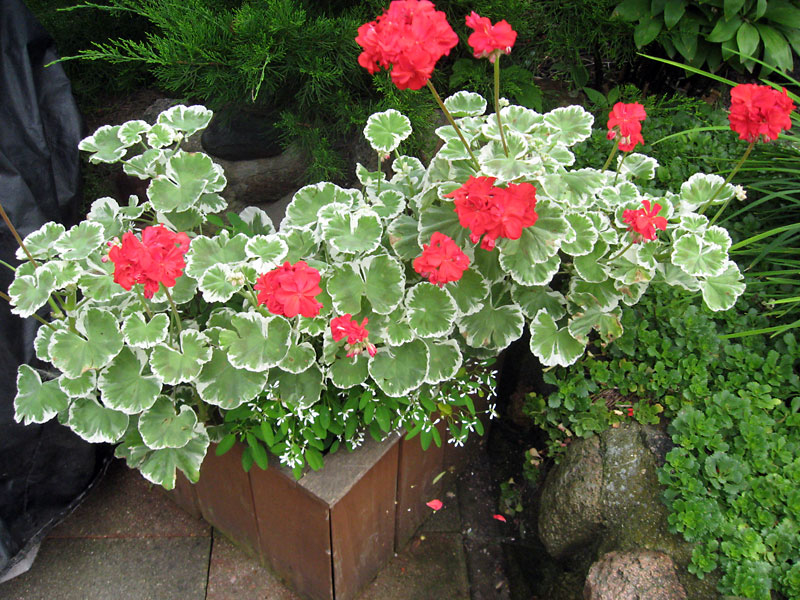
I even know one gardener who ties the plants in bundles and hangs them in the basement for the winter, bare root, and pots the roots up in the spring. The foliage gradually dries and dies, but the roots remain turgid during the winter and remain alive.
Although I have tried both of these methods, I have not been particularly successful at over wintering geraniums with either method, so I do not recommend them — although if it works for you, go for it! Plants are wonderfully resilient, and often a gardener will find a method of doing something that works well, so if a particular method is successful, use it.
I also know gardeners who have no space to grow geraniums during the winter — no sun room or window sills, or they don’t want potted plants sitting around all winter — so the pots of geraniums are simply put downstairs in the basement for the winter. The foliage gradually dies back as the soil dries out and the lack of light takes its toll.
A bit of water may have to be added a couple of times during the winter to ensure that the roots do not completely dry out, but the soil is kept only slightly damp; some weak growth may appear, but unless there is substantial light, it will wither and dry up. While I have tried this method with some success, I winter my plants as growing plants in my sun room.
Many gardeners simply take healthy slips from their outdoor plants at this time of year. The slips are either rooted in water and then potted up, or the slips are planted directly into a pot of soilless mix.
I, however, like to take a piece of a plant that is growing outside and remove the piece from the parent plant, disturbing it as little as possible. I often do this well before the fall frosts threaten so this method allows the outdoor plantings to remain attractive for as long as possible.
Each piece I take will have a piece of root attached to it to ensure success. I could simply take some slips, but by taking pieces of plant with some root attached, I am almost guaranteed success. I cut the top back to a height of about 10 cm and pot it up in a soilless mix to which I often add a bit of compost and perhaps a handful of sand.
Geraniums like light, porous soil with excellent drainage. They do not require large pots — in fact, they bloom better if they are under potted. Because I have a rather large geranium collection, to maximize space I often use a large pot, such as a hanging basket with the handle removed, and plant a half-dozen different geraniums in it. The plants do not seem to mind being grown in the same pot and a nice display of bloom can result in the winter with such a large pot of various coloured blooms.
I always ensure the pots have good drainage, and I sprinkle a bit of soil insecticide on the soil surface to deter fungus gnats and other insects from setting up shop. For the same reason, I often wash any plants or slips that I bring indoors in an insecticidal soap solution before I pot them up — an ounce of prevention is worth a pound of cure!
As fall progresses and the newly potted geranium plants begin to put forth new growth, I often pinch the plants because I want them to bush out to create as many stems as possible. This will allow me to be able to take the maximum number of slips from bushy plants in the spring when I am propagating them.
I have often grown ivy geraniums and these I sometime just leave in the hanging basket in which they are growing outdoors. They seem to grow more slowly than zonal geraniums, so I don’t cut them back very much, although I do pinch them to encourage bushiness.
By "stealing" pieces of geranium plant early in the fall to winter over, I avoid the rush that would come if I had not done this before frost is imminent, at which time I would be scrambling around taking slips and bringing pieces of plants inside. This way, I can do the job at my leisure and still leave my patio pots of geraniums looking good until they are finally struck down by Jack Frost.
The newly potted plants do not need to be fertilized. I don’t begin feeding them until spring, when rapid development of new growth occurs as a result of increased light levels as the days lengthen.
Other than removing the odd spent bloom or discoloured leaf, keeping the soil moderately moist — but not too wet — and ensuring that the plants get as much light as I can give them, my geraniums pretty much look after themselves during the winter. They are never bothered by insects, so I never have to worry about checking them for bugs.
Whichever method you use to over winter your geraniums, come spring time you will be glad you did as you will have your plants all ready to go into the outdoor garden for another year without having to buy new plants. Also, these geranium plants will provide a bit of an opportunity to garden, even in the winter!
» Albert Parsons is a consultant for garden design and landscaping who lives in Minnedosa.