
Ervin Szabo, the famous librarian
Advertisement
Read this article for free:
or
Already have an account? Log in here »
We need your support!
Local journalism needs your support!
As we navigate through unprecedented times, our journalists are working harder than ever to bring you the latest local updates to keep you safe and informed.
Now, more than ever, we need your support.
Starting at $15.99 plus taxes every four weeks you can access your Brandon Sun online and full access to all content as it appears on our website.
Subscribe Nowor call circulation directly at (204) 727-0527.
Your pledge helps to ensure we provide the news that matters most to your community!
To continue reading, please subscribe:
Add Brandon Sun access to your Free Press subscription for only an additional
$1 for the first 4 weeks*
- Enjoy unlimited reading on brandonsun.com
- Read the Brandon Sun E-Edition, our digital replica newspaper
*Your next Free Press subscription payment will increase by $1.00 and you will be charged $20.95 plus GST for four weeks. After four weeks, your payment will increase to $24.95 plus GST every four weeks.
Read unlimited articles for free today:
or
Already have an account? Log in here »
Hey there, time traveller!
This article was published 13/02/2020 (2314 days ago), so information in it may no longer be current.
Last week, my sister emailed me a photo of herself in front of the Budapest Metropolitan Library. It’s a grim but glorious building, with a blond stonework façade and baroque cornicing around the windows. Its majesty is only diminished slightly by the fleet of mopeds parked out front.
Actually, my sister sent two photos, one of the library’s exterior, and the other of a metal bust of a distinguished-looking fellow in a moustache and a 1900s-era suit jacket.
“Who’s the guy?” I typed back.
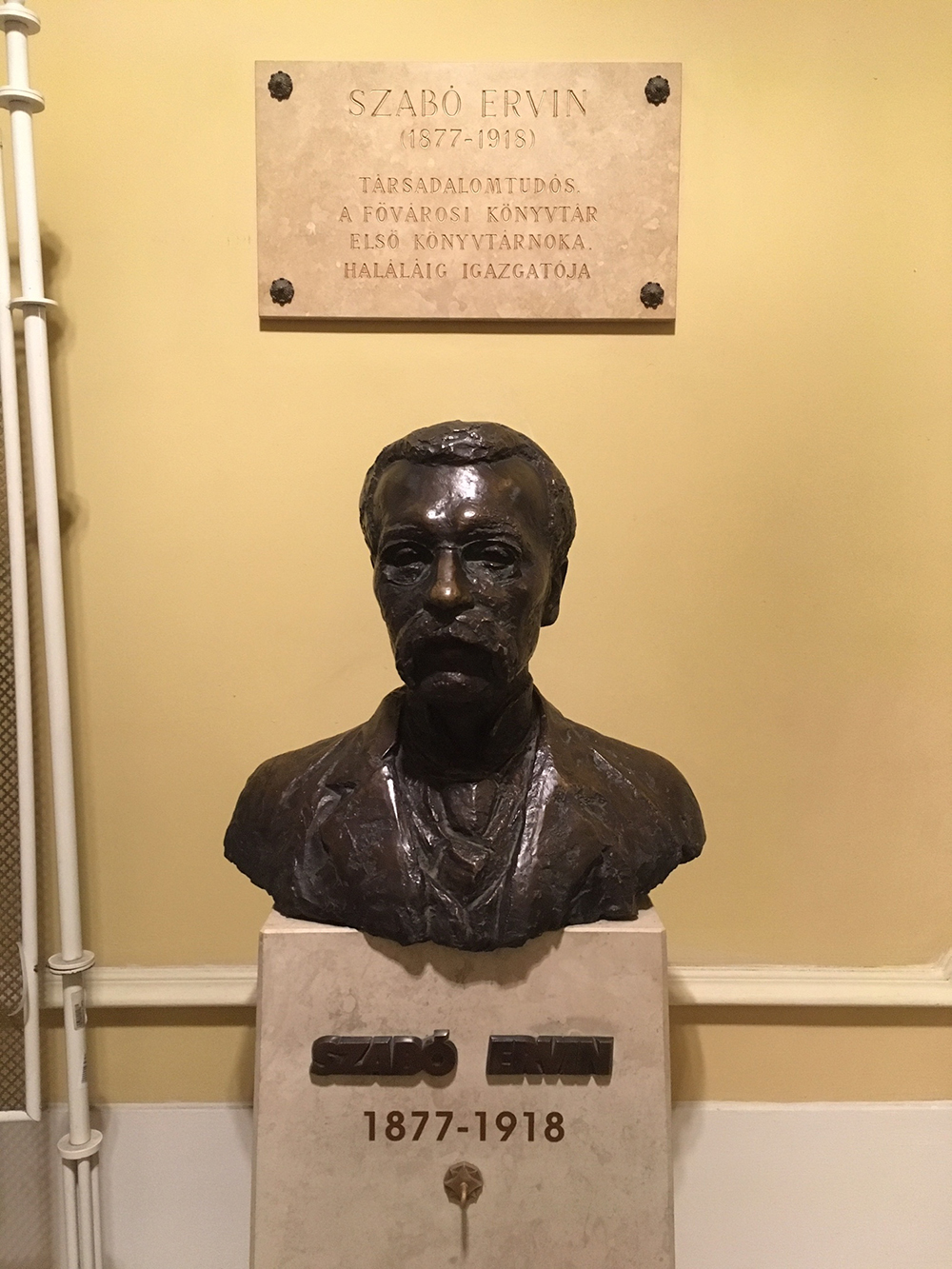
“Ervin Szabo,” came my sister’s response. He was apparently a “famous librarian,” though she didn’t know more.
Well, this was intriguing! How many famous librarians are there, aside from Rupert Giles from “Buffy the Vampire Slayer?” Personally, my favourite famous librarian is the wizard-turned-orangutan librarian in Terry Pratchett’s “Discworld” series. This 41-volume comedy-fantasy romp was so popular in my household growing up that when I landed my first professional librarian job, my dad gifted me with a wee orangutan stuffy for my desk.
I was vacationing in Ixtapa, Mexico, when this email exchange with my sister occurred. As one does, I promptly set about researching Ervin Szabo. Sure enough, this was a guy worthy of fame. In addition to directing the Budapest Metropolitan Library, Szabo translated the works of Karl Marx into Hungarian, and then became a leader of Hungary’s First World War anti-war movement. Budapest’s public library is properly called The Metropolitan Ervin Szabo Library. I have a sinking feeling I’m unlikely to attain such pinnacles of notoriety in my career.
Two things struck me while lying in bed, messaging my sister. One was the revelation above: “Man, this guy was a serious-business librarian.”
The other was a strong sense of how small the world is, figuratively speaking. Here I was overlooking the Pacific Ocean, emailing in live time with my sister in Budapest, while at the same time reading messages from my parents in Florida and my brother in Victoria. I’d spent the night before catching up on work email from my own little library in Brandon. My afternoon plans consisted of going on a hike with my writing notebook. I’m working on a master’s degree in creative writing through the University of British Columbia, you see, and I had a poetry deadline coming up, Mexican escape or not.
How bizarre. Not only was my own intellectual experience being spread between Ixtapa, Brandon, and Vancouver this week, but between my other family members and I, we were spanning four countries.

In Ervin Szabo’s time (1877 to 1918), no such cybernetic globetrotting was possible. Szabo was born in Arva County, an administrative region of the former Kingdom of Hungary. He studied law at the University of Vienna. By today’s standards, this comprises a fairly narrow sphere of activity, geographically speaking. Szabo may not have snorkelled the Pacific, boated the Everglades, or hiked Slovak Paradise Park (my sister’s week), but he had achieved a different kind of trotting: time-trotting. His intellectual work as a socialist, an anti-war activist, and not least as a library director, was substantive enough that we were still reading and writing about it today.
On the plane ride home, I listened to Malcolm Gladwell’s “David and Goliath: Underdogs, Misfits, and the Art of Battling Giants.” The book begins with an exploration of the David and Goliath legend. What did David the shepherd boy do to defeat Goliath, the Philistine strongman? As David stepped forward with his sling, did he have any idea how far around the globe or how far through time his story would travel? As each of us goes about our lives and pursues our passions, can we ever accurately predict how the future will remember us, or if it will? Air travel and the internet have changed the dimensions of the physical and intellectual world, but we haven’t yet found a way to change the slippery nature of our own timelines.