
REGIONAL VIEWPOINT: Northern lights intersection of Indigenous science, spirits
Advertisement
Read this article for free:
or
Already have an account? Log in here »
We need your support!
Local journalism needs your support!
As we navigate through unprecedented times, our journalists are working harder than ever to bring you the latest local updates to keep you safe and informed.
Now, more than ever, we need your support.
Starting at $15.99 plus taxes every four weeks you can access your Brandon Sun online and full access to all content as it appears on our website.
Subscribe Nowor call circulation directly at (204) 727-0527.
Your pledge helps to ensure we provide the news that matters most to your community!
To continue reading, please subscribe:
Add Brandon Sun access to your Free Press subscription for only an additional
$1 for the first 4 weeks*
*Your next subscription payment will increase by $1.00 and you will be charged $20.00 plus GST for four weeks. After four weeks, your payment will increase to $24.00 plus GST every four weeks.
Read unlimited articles for free today:
or
Already have an account? Log in here »
Hey there, time traveller!
This article was published 27/03/2023 (1135 days ago), so information in it may no longer be current.
Mino-dibikad o’o waawaateg.
I first heard this on a Greyhound bus to Winnipeg from my home in Ashern, when I was 11 years old.
“It’s a nice night for the northern lights,” said this kind grandmother who sat beside me.
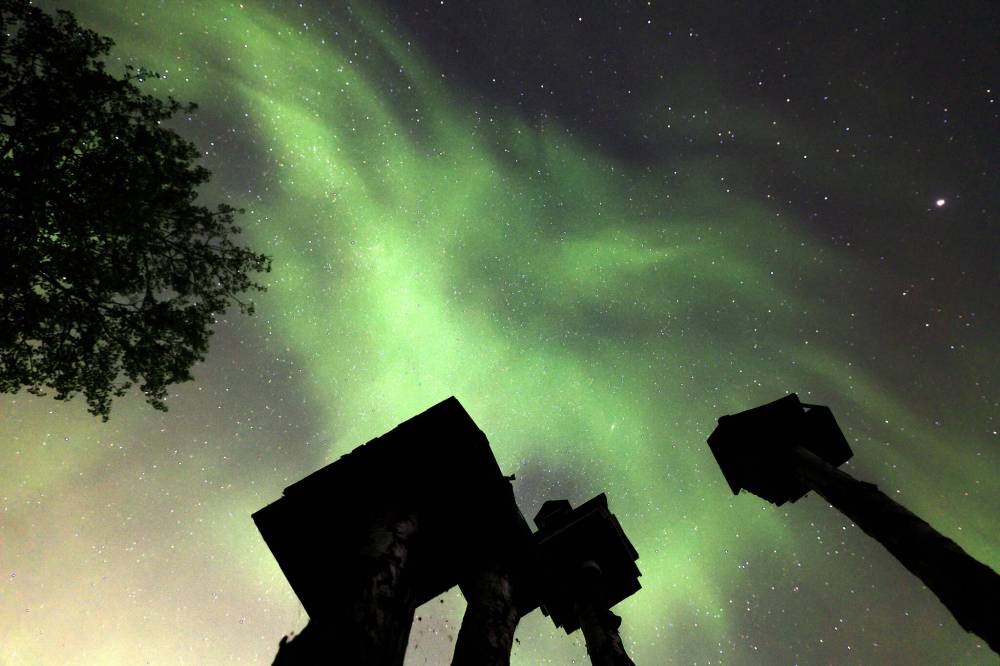
The northern lights are a message from a very distant and old ancestor that teach us about life, power and creation — the mysterious ingredients that make up science. (File)
As we talked more, I asked her what language that was. She said Anishinaabe.
My language.
I wish I could remember her name.
My sister and I would travel to see our father every second weekend. I don’t know if that would be safe anymore, but in the 1980s, we thought nothing about it.
On Friday evenings, I had a front-row seat for three hours to watch the northern lights. As I watched the yellow and green swirls dance across the sky, I remember being in awe. I recall thinking it was better than the four channels we had on TV. I also remember trying to figure out why they were so bright.
This happened again this past week, as the Manitoba sky was lit up with aurora borealis.
For the Anishinaabe, the northern lights are messages from our ancestors. It is said the lights in the sky are reflections of a great fire lit by Waynaboozhoo, the first human. It is also said the motion and beauty of these lights are our relatives, dancing as they travel in the spiritual realm.
Similarly, when Cree elders see the northern lights, they announce: “Cipayak nimehitowak!” (“The spirits are dancing!”) Children are then told to not whistle at the sky or risk being taken to the spirit world before they are ready.
Inuit knowledge keepers call the northern lights “aksarnirq,” meaning “playing with a ball” — referring to games played by spirits in the sky.
Lakota people say northern lights are the spirits of generations to come. Any child born while the sky is lit up is thus seen as a teacher.
Northern lights mean more things to Indigenous communities, too.
Dene people say you can “hear” their crackling.
The great Cree astronomer Wilfred Buck once told me his grandparents told him you can “smell” them.
Tlicho people say you can call them to come to you by rubbing your fingernails together.
In all explanations, the northern lights are framed as indications of distant and loved relations, combined elements of earth and sky, and creations of light and electricity. It’s not enough to call these Indigenous theories “legends” but parts of truth — like cups of water in an ocean of knowledge.
Another word for this is science. Indigenous science.
The brightness of aurora borealis was foretold recently by NASA astronomers, who spotted a giant “hole” in the sun’s corona.
These are generally harmless and cyclical, but this gap was huge (some 20 to 30 times the size of Earth) and ejecting powerful, high-speed solar winds of charged electrons, protons and alpha particles with high kinetic energy.
These would be lethal for humans, but Earth’s atmosphere protects and deflects these particles toward its northern and southern poles.
As the particles collide with gas in our planet’s sky, colours are released from the reaction, creating light in waves across the sky. The most common colour is produced by oxygen (yellow and green) and the farther north and south, the more you see.
The northern lights are a message from a very distant and old ancestor that teach us about life, power and creation — the mysterious ingredients that make up science.
All of science.
There has been so much death in Indigenous communities this past while.
I’ve written so many posts on social media and columns about elders who have passed away I’ve lost count. It seems like while communities were able to protect knowledge keepers and language speakers from COVID-19, we weren’t able to stop time from taking them.
With them has gone so much of the history, science and stories in our cultures.
A friend said to me recently my generation are the adults now. We are the ones making the decisions, stepping into the leadership positions, and struggling politically and socially for an Indigenous future.
For some, this has happened earlier than others, but those of my age group are in these positions in our families, our communities and society now.
The truth is: I still feel like that young Anishinaabe kid on the bus, watching the northern lights with awe. So unsure, uncertain and wondering what it all means.
Some days, I hear that kind grandmother’s voice on that bus in my ears, teaching me my language. It’s probably because she’s still around, dancing in the sky above me.
I hope she knows how much I appreciated her words that one Friday night.
Mino-dibikad o’o waawaateg.
» Niigaan Sinclair is Anishinaabe and is a columnist at the Winnipeg Free Press.