
A new, reset relationship starts with meaningful consultation
Advertisement
Read this article for free:
or
Already have an account? Log in here »
We need your support!
Local journalism needs your support!
As we navigate through unprecedented times, our journalists are working harder than ever to bring you the latest local updates to keep you safe and informed.
Now, more than ever, we need your support.
Starting at $15.99 plus taxes every four weeks you can access your Brandon Sun online and full access to all content as it appears on our website.
Subscribe Nowor call circulation directly at (204) 727-0527.
Your pledge helps to ensure we provide the news that matters most to your community!
To continue reading, please subscribe:
Add Brandon Sun access to your Free Press subscription for only an additional
$1 for the first 4 weeks*
- Enjoy unlimited reading on brandonsun.com
- Read the Brandon Sun E-Edition, our digital replica newspaper
*Your next Free Press subscription payment will increase by $1.00 and you will be charged $20.95 plus GST for four weeks. After four weeks, your payment will increase to $24.95 plus GST every four weeks.
Read unlimited articles for free today:
or
Already have an account? Log in here »
Hey there, time traveller!
This article was published 29/01/2024 (1023 days ago), so information in it may no longer be current.
The election of Premier Wab Kinew is an incredible achievement for our province. It’s also a significant opportunity for a reset in how the provincial government manages its relationship with Indigenous Peoples in Manitoba.
For years, former Manitoba governments adopted an approach of informing Indigenous communities of decisions after they were made, instead of including us in the process. One very specific example of the previous government’s lack of consultation deeply affecting Interlake Reserve Tribal Council communities is the proposed Lake Manitoba and Lake St. Martin Outlet Channels Project.
But where the previous government failed, lives an opportunity for the new NDP government to genuinely walk the path of reconciliation by moving forward in an inclusive manner. One that acknowledges the history of our Peoples, our status as important rights holders, while pragmatically moving forward on projects profoundly impacting our communities.
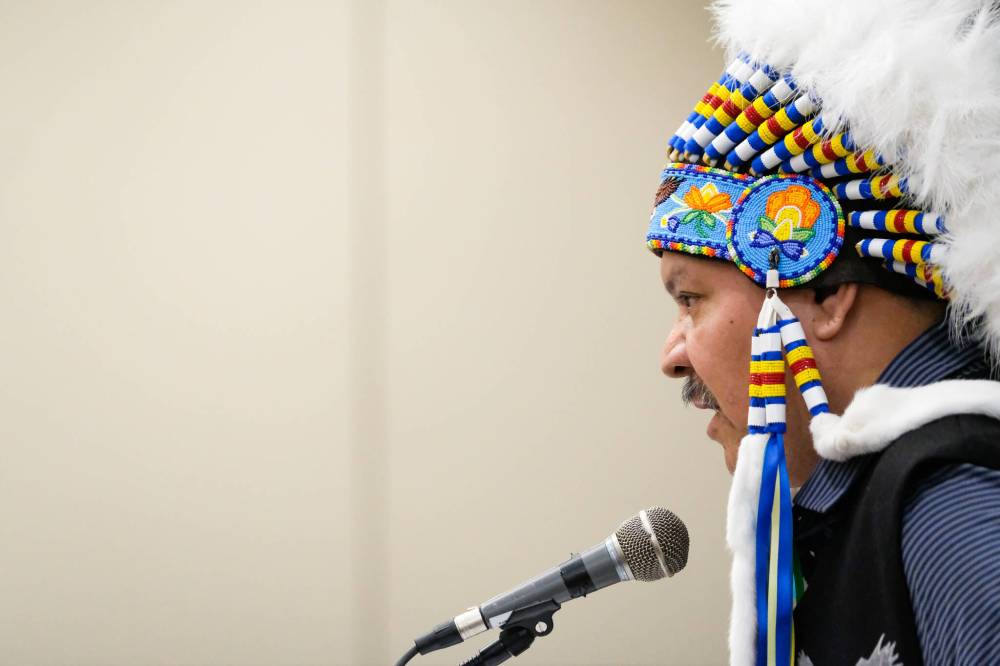
Chief Cornell MacLean of the Lake Manitoba First Nation speaks at a public event hosted by the Interlake Reserves Tribal Council regarding The Lake Manitoba-Lake St. Martin Channels Outlet Project on February 8, 2020. (File)
Water stewardship, flood control, conservation and ecosystems are vital to our communities. Water is intimately tied to the exercise of our Aboriginal and treaty rights, including the survival of our culture and way of life.
It is important that the province’s Water Management Strategy takes that into consideration and considers the long-term cumulative effects of all activities on water quality, quantity, and access for future generations.
Unfortunately, the province’s Water Management Strategy, launched by the previous government, failed to include any direct Indigenous consultation. The strategy as it stands does not mention any cumulative effects on Indigenous rights and how they will be assessed or managed. Further, the environmental impact statement for the Channels project did a very poor job of assessing cumulative effects.
Based on extensive technical advice and Indigenous knowledge, it is apparent that the current design for the Channels project and its impacts are irretrievably flawed. But unfortunately, with the previous government, we saw little evidence of an understanding of, or respect for, the concept of consultation, specifically as it relates to our direct, practical experience with the environmental assessment of the proposed Lake Manitoba and Lake St. Martin Outlet Channels Project.
Our communities agree with the need to address flooding. We understand the need to improve flood protection and increase resilience against climate change.
We are no strangers to the devastating impacts caused by flooding and the province’s response to flooding. We have repeatedly borne the brunt of flood management decisions made by others. Our reserve lands and traditional territories in the Interlake region have been consistently sacrificed in flood management decisions.
In 2011, severe flooding completely wiped out housing and infrastructure on some First Nation reserves and led to the long-term evacuation of entire First Nation communities for years. More than a decade later, we are still dealing with the physical devastation and damage caused to the social fabric of our communities. Our impacted community members have been left to rebuild and are still waiting for promised compensation in those efforts.
But, according to the province’s own assessment, the Channels project will not protect Interlake First Nations. Reserve lands around Lake St. Martin will continue to flood even if the project is built, leaving our communities at continued risk.
This is why, while we believe we need to address flooding, the project as is currently proposed is not the answer. In addition to failing to protect our reserve lands from flooding, it will have significant adverse effects on entire watersheds in the province forever, and permanently damage the lands and waters we rely on to hunt, fish, and maintain our culture. We have had no option but to oppose this current plan.
The effects of this project will be felt not just by Indigenous communities in the region, it will also affect farmers, hunters and commercial fishers who rely on the impacted land and waters to make a living by decreasing the availability and access of plant and animal resources.
The work on the proposed Lake Manitoba and Lake St. Martin Outlet Channels Project should be halted to address ongoing design and operational deficiencies, integrate the socioeconomic and rights impact research, conduct heritage and culture fieldwork, and fulfil the Manitoba government’s legal requirements to consult and accommodate our rights.
The project should also be examined within the broader context of how this province, under the new NDP government, will make flood management decisions in the future.
We are hopeful that the newly elected Manitoba government will undertake to review projects like the Lake Manitoba and Lake St. Martin Outlet Channels Project and assess how to proceed in a manner that is consistent with the United Nations Declaration on the Rights of Indigenous Peoples (UNDRIP) and only after building consent with affected First Nations.
We are hopeful for a future where flood management decisions are made in a manner that complies with modern expectations of Indigenous partnership and consent over the infrastructure that affects our communities. First Nations need to be partners in the making of flood-management decisions that affect us.
We are hopeful that the provincial government seizes the opportunity to meaningfully incorporate all impacted communities, to make water use and its impacts sustainable and safe for all Manitoban communities.
» Chief Cornell McLean is Chief of the Lake Manitoba First Nation and chair of the Interlake Reserve Tribal Council. This column first appeared in the Winnipeg Free Press.