
An important step for provincial child care
Advertisement
Read this article for free:
or
Already have an account? Log in here »
We need your support!
Local journalism needs your support!
As we navigate through unprecedented times, our journalists are working harder than ever to bring you the latest local updates to keep you safe and informed.
Now, more than ever, we need your support.
Starting at $15.99 plus taxes every four weeks you can access your Brandon Sun online and full access to all content as it appears on our website.
Subscribe Nowor call circulation directly at (204) 727-0527.
Your pledge helps to ensure we provide the news that matters most to your community!
To continue reading, please subscribe:
Add Brandon Sun access to your Free Press subscription for only an additional
$1 for the first 4 weeks*
- Enjoy unlimited reading on brandonsun.com
- Read the Brandon Sun E-Edition, our digital replica newspaper
*Your next Free Press subscription payment will increase by $1.00 and you will be charged $20.95 plus GST for four weeks. After four weeks, your payment will increase to $24.95 plus GST every four weeks.
Read unlimited articles for free today:
or
Already have an account? Log in here »
In the recent provincial budget, Manitoba took an important step toward reducing child poverty and strengthening our early learning and child-care system.
By eliminating the $2-per-day fee for the lowest-income families receiving subsidized child care, the province has effectively made child care free for those most in need. This advance is meaningful in building a more inclusive, universal system.
It also reflects the steady progress made under the Canada-wide $10-a-day early learning and child care agreement. Five years in, Manitoba has moved decisively to lower parent fees, expanded access, and recognized child care as essential public infrastructure for both younger children and those up to age 12.
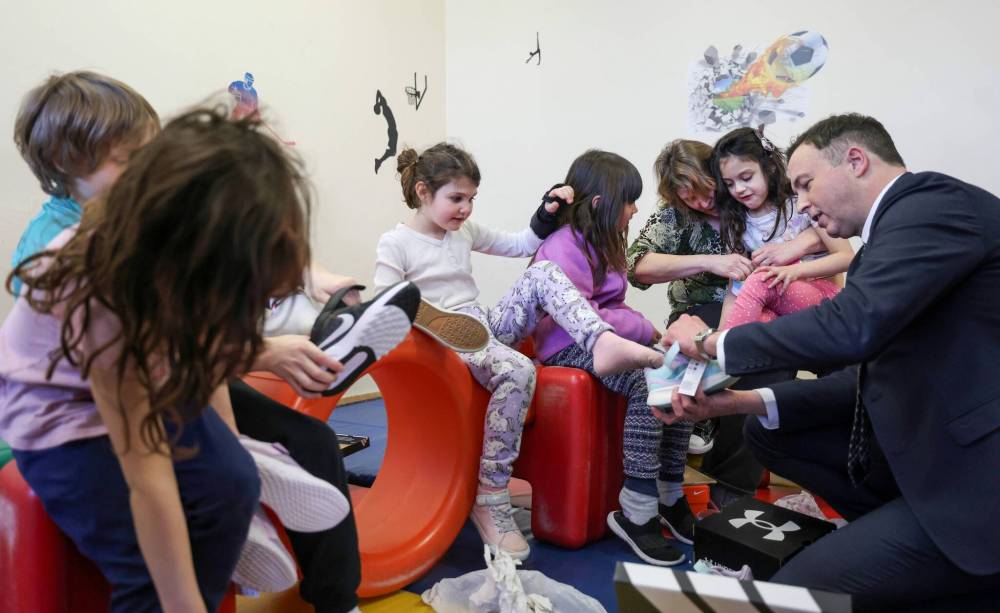
Finance Minister Adrien Sala helps a Grade 1 student, Emilie, put on her new shoes while handing out new shoes as part of a pre-budget event at Linwood Childcare Centre in March. (Ruth Bonneville/Winnipeg Free Press files)
The previous Manitoba government’s adoption of $10-per-day parent fees for licensed child care on regular school days only has since been extended by the current government to all days of the year, including school in-service days and summer break, providing major savings to working families at a time when the price of just about everything else is going up.
For the first time, child care featured prominently in a Manitoba budget, symbolized by the minister of finance delivering new children’s shoes to a local child-care centre as part of the new-shoes-on-budget-day tradition.
The message this gives is clear: child care is as fundamental to our economy as roads and transit. And the evidence bears this out. Since the introduction of $10-a-day child care, Manitoba has seen a sharp rise in mothers’ workforce participation, outpacing provinces like Ontario. Investments in early learning and child care generate economic growth, support family incomes, and strengthen communities over the short and long term.
The Manitoba budget also included important commitments to the workforce that make this system possible. A 2.9 per cent wage increase for early childhood staff and educators, along with a one percent increase in operating funding, builds on last year’s $5-per-hour wage enhancement. These are necessary steps toward stabilizing a highly female-dominated workforce that has long been undervalued, despite its central role in children’s development, in enabling parents to work and in economic development.
While public funding is increasing as Manitoba builds a universal system, strengthening worker voice — including through unionization and collective bargaining — will be key to ensuring this sector is high-quality and sustainable.
Manitoba has a significant advantage to build on. Approximately 95 per cent of child-care centres in the province are non-profit, meaning public dollars are invested directly into programs, wages, and quality improvements — not profits. This is a strong foundation for a truly public system. Unlike in many other provinces, the Manitoba government has made it clear that it intends to build a child-care system for the benefit of children and families, not for private shareholders.
At the same time, the central challenge remains urgent: access to spaces when families need them. Manitoba continues to have among the highest rates of “child-care deserts” in the country. More than half of infants and preschool-age children live in areas with less than one licensed child care space for every three children.
For school-age children, the gap is even more stark, with spaces available for only a small fraction of those who need before- and after-school care. Even with 5,400 new spaces opened and another 6,100 committed, Manitoba is less than halfway to meeting its 2021 commitment to 23,000 new spaces, and demand continues to far outstrip supply. As long as the province continues to rely on volunteers to start new facilities and asks them to raise 40 per cent of the multi-million-dollar capital costs, this situation is unlikely to change.
This shortage is felt most acutely by families in low-income neighbourhoods and in rural and Northern communities. Without sufficient expansion, affordable child care remains out of reach for many.
That is why the next phase of reform must focus on building out the system itself. The Child Care Coalition of Manitoba has called for strengthening the province’s non-profit model through provincial leadership and expanded public options, including direct delivery by school divisions or other public entities. This kind of planned, public expansion is essential to meeting demand, ensuring equitable access across regions and building confidence in the system.
In the midst of a cost-of-living crisis, families are counting on affordable, available and reliable child care. The progress to date shows what is possible. The task now is to finish the job, with sustained and increased investment from both the provincial and federal governments to expand spaces, strengthen the workforce, and ensure that truly universal quality child care becomes a reality for every family in Manitoba.
» Molly McCracken is the chair of the Child Care Coalition of Manitoba, an affiliate of Child Care Now, and the Manitoba director of the Canadian Centre for Policy Alternatives. This column originally appeared in the Winnipeg Free Press.