
Gone Gardenin’ – Dianthus: Continuous colour
Advertisement
Read this article for free:
or
Already have an account? Log in here »
We need your support!
Local journalism needs your support!
As we navigate through unprecedented times, our journalists are working harder than ever to bring you the latest local updates to keep you safe and informed.
Now, more than ever, we need your support.
Starting at $15.99 plus taxes every four weeks you can access your Brandon Sun online and full access to all content as it appears on our website.
Subscribe Nowor call circulation directly at (204) 727-0527.
Your pledge helps to ensure we provide the news that matters most to your community!
To continue reading, please subscribe:
Add Brandon Sun access to your Free Press subscription for only an additional
$1 for the first 4 weeks*
- Enjoy unlimited reading on brandonsun.com
- Read the Brandon Sun E-Edition, our digital replica newspaper
*Your next Free Press subscription payment will increase by $1.00 and you will be charged $20.95 plus GST for four weeks. After four weeks, your payment will increase to $24.95 plus GST every four weeks.
Read unlimited articles for free today:
or
Already have an account? Log in here »
Hey there, time traveller!
This article was published 10/07/2010 (5787 days ago), so information in it may no longer be current.
Some of my favourite plants are those that are multi-purpose, that is, they can be used in a variety of ways to serve several purposes in the garden. One plant family that has this reputation is the dianthus.
In early summer it is not uncommon to see splendid displays of dianthus blooming profusely in yards and gardens because dianthus, although commonly sold as annual bedding plants by garden centres and retail outlets, are in fact perennials. Many people treat them as annuals and pull them up in the fall, but if left in the ground over the winter, many of them will live through the winter and bloom the following year — perhaps they can best be described as "half-hardy" perennials.
What I like about the plants that do winter over is the wonderful display of bloom that they produce. They begin to put forth new growth by early May — they are quite frost tolerant — and by late spring/early summer they will have grown into lovely bushy mounds that will be covered first with a myriad of buds and then innumerable flowers.
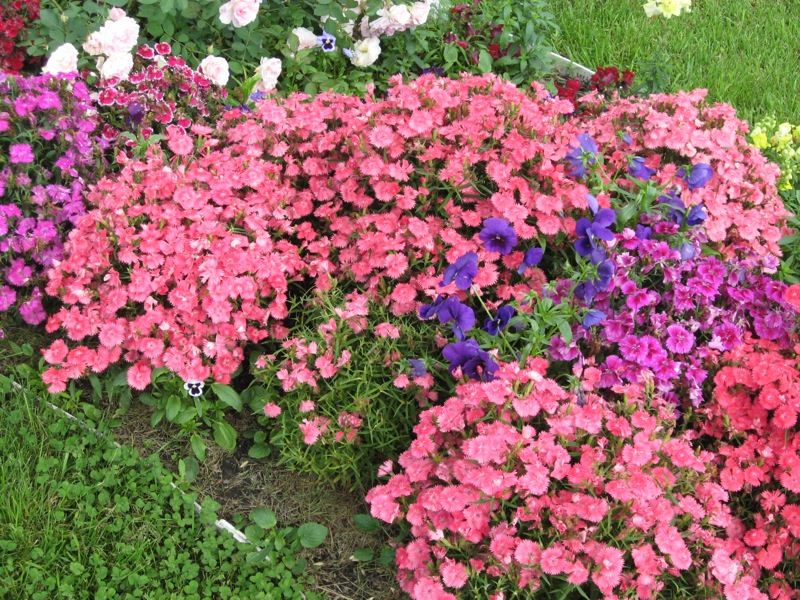
Plants purchased in the spring and planted just for one season as annual bedding plants never get as large or put on such a grand display as those plants which are in their second year of growth. Some of these plants will continue to come up year after year and can become permanent residents of the perennial border — I have a couple of dianthus ‘Gaiety’ which have survived at least three winters.
Dianthus are relatively small plants and so they are used in the front of beds and borders, and in containers. They usually grow about 25 to 30 cm tall, but some are shorter while other varieties get a bit taller.
Some of the new hybrids, such as the ‘Parfait’ series, which includes the well-known ‘Raspberry Parfait’ and ‘Strawberry Parfait’, only grow about 20 cm tall and the blooms are borne right on top of the mound of foliage with little stem projecting above the foliage. Other varieties, such as Dianthus ‘Diana’ get to a height of 25 cm.
Often dianthus are listed in catalogues as pinks or garden pinks. This is an old-fashioned name which refers to the many older varieties — such as one of my favourites, the "Gaiety" series, which has fringed petals that look like they have had their edges trimmed with pinking shears.
Dianthus are not large plants and can be planted close together. They do not resent being somewhat crowded which makes them good candidates for use in containers as well. They do like rich soil and a steady supply of water.
Dianthus are cool weather plants and perform best in early summer and during the fall. The extreme heat of mid-summer can be stressful for these plants and unless they are kept well watered and perhaps can benefit from a bit of mid-afternoon shade during the hottest part of the summer, the plants may flag.
Regular deadheading will ensure that dianthus blooms all season but these plants are deadheaded a bit differently that some other plants. When deadheading, the stems should be cut back to a lower leaf axil so that the plant will produce another flowering stem; just removing the spent blooms will tend to leave a stub of a stem which often will not re-flower.
Dianthus can be used as an edging for a mixed border, planted in rows along walks and driveways, arranged in clumps of several plants in a mixed border, or scattered throughout a rock garden. They look good in large drifts or planted singly, although first year plants may look a bit sparse if planted individually.
Usually dianthus are grown from seed that is planted indoors about eight weeks before planting out time. The seeds germinate easily and if grown in a location with good light and cool temperatures, healthy, stocky plants will be ready for planting outdoors by early May.
The foliage of many of the dianthus varieties — which consists of narrow leaves — has a distinct grey-green or blue-green hue, which adds both colour and texture to any container. The blooms come in every hue of the white-pink-red colour family and while many are single, some are semi-double or fully double.
Dianthus are dependable plants that never fail to put on a great display of bloom. One of the annuals that blooms all growing season, dianthus will add continuous colour to any container or flower border; it’s well worth a try in your garden.
Albert Parsons is a consultant for garden design and landscaping who lives in Minnedosa.
» communitynews@brandonsun.com