
VINE LINES — Vegan wines Alive and well and produced in Canada
Advertisement
Read this article for free:
or
Already have an account? Log in here »
We need your support!
Local journalism needs your support!
As we navigate through unprecedented times, our journalists are working harder than ever to bring you the latest local updates to keep you safe and informed.
Now, more than ever, we need your support.
Starting at $15.99 plus taxes every four weeks you can access your Brandon Sun online and full access to all content as it appears on our website.
Subscribe Nowor call circulation directly at (204) 727-0527.
Your pledge helps to ensure we provide the news that matters most to your community!
To continue reading, please subscribe:
Add Brandon Sun access to your Free Press subscription for only an additional
$1 for the first 4 weeks*
- Enjoy unlimited reading on brandonsun.com
- Read the Brandon Sun E-Edition, our digital replica newspaper
*Your next Free Press subscription payment will increase by $1.00 and you will be charged $20.95 plus GST for four weeks. After four weeks, your payment will increase to $24.95 plus GST every four weeks.
Read unlimited articles for free today:
or
Already have an account? Log in here »
Hey there, time traveller!
This article was published 14/12/2018 (2720 days ago), so information in it may no longer be current.
I read the label. “What?” I wondered to myself.
Then I read it again.
But it was still there. The word that perplexed me.
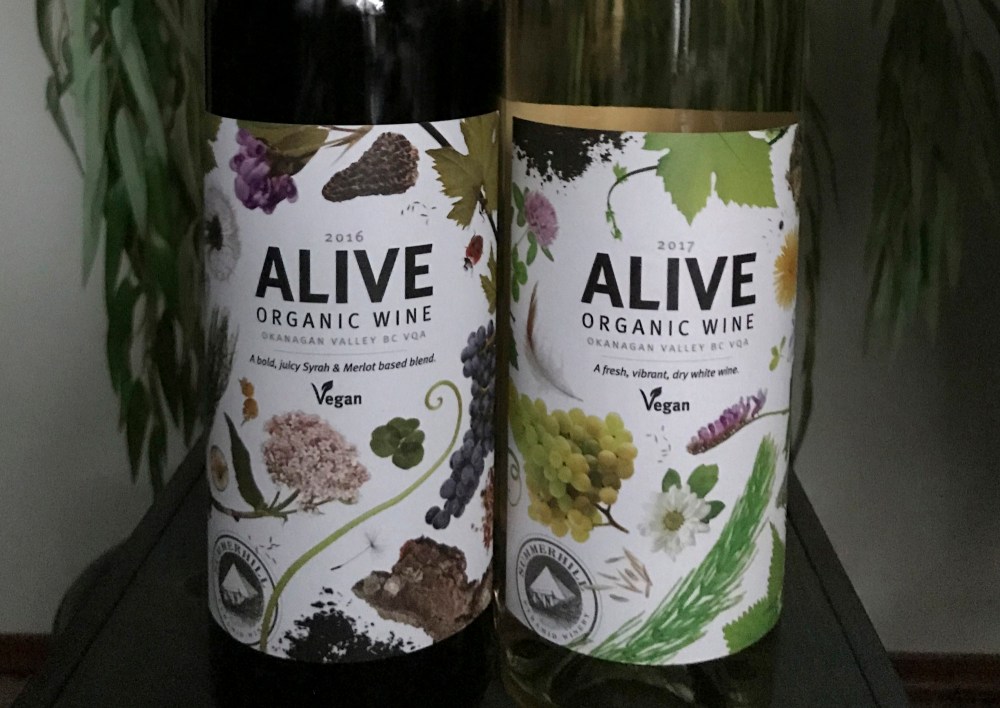
“Vegan.”
“Vegan wine?” I thought. “Really? How is that possible? Or more to the point, why is it necessary?”
I mean, what about wine is connected to animals? And using the word “vegetarian” I could almost understand. But vegan? The very specificity of it had me puzzled.
So I did some research. And it turns out, vegan wine is legit.
And I thought knowing this might come in handy for those of you who have vegans on your Christmas shopping list, or who have vegans who might be joining you — or whom you might be joining — for gatherings or meals during the holidays.
The wine is called Alive Organic Wine. And it’s made in in Canada’s own Okanagan Valley by Summerhill Pyramid Winery. There’s a white, which is a blend of Kerner (which I’d never heard of), Pinot Gris and Gewurztraminer grapes, with a pinch of Chardonnay and Riesling thrown in for good measure. And of course there’s a red too, which is a combination of Syrah, Merlot and Cabernet Franc that is fermented in oak tanks and aged 12 months in neutral oak barrels.
The back label on each reads “Organic Agriculture: By relying on ecological processes, biodiversity and cycles adapted to local conditions, organic agriculture combines tradition, innovation and science. Rather than the use of inputs with adverse effects, organic agriculture sustains the health of soils, ecosystems and people.”
Then it continues with “Biodynamic Preparations aid in fertilization and prevent plant diseases. They have influence on soil structure and micro-organisms, enhancing soil fertility and increasing biodiversity. Components used in making preparations include yarrow, horsetail, stinging nettle, dandelion, oak bark, valerian, and quartz crystal.”
Finally, it says, “Permaculture is an approach to designing human settlements and agricultural systems that mimic the relationships found in natural ecologies.” The advice on both products is, “Pair with Life.”
I really liked that line, because it has implications on so many levels. But as you can see, this is serious business. Despite all the information on the bottle, though, I still didn’t understand how the wine could be vegan, and, quite frankly, how other wine could not be. But as I’ve already mentioned, I did some research after one of the attentive clerks at the South End Liquor Mart said she’d been told the Alive wines weren’t filtered through fish bladders.
I didn’t know non-vegan wines were!
Naturally, I turned to the good old Internet, and found several articles that supported my new-found knowledge about animal products used to make wine. To distill what I discovered, and it was the same on multiple sites, I found the explanation offered by thekitchn.com to be the most easily consumable. Here it is, as concise as I can make it:
“The reason all wines are not vegan or even vegetarian-friendly has to do with how the wine is clarified and a process called ‘fining.’ All young wines are hazy and contain tiny molecules such as proteins, tartrates, tannins and phenolics. These are all natural, and in no way harmful. However, we wine-drinkers like our wines to be clear and bright.
“Most wines, if left long enough, will self-stabilize and self-fine. However, traditionally producers have used a variety of aids called ‘fining agents’ to help the process along. Fining agents help precipitate out these haze-inducing molecules. Essentially, the fining agent acts like a magnet — attracting the molecules around it. They coagulate around the fining agent, creating fewer but larger particles, which can then be more easily removed.
“Traditionally the most commonly used fining agents were casein (a milk protein), albumin (egg whites), gelatin (animal protein) and isinglass (fish bladder protein). These fining agents are known as processing aids. They are not additives to the wine, as they are precipitated out along with the haze molecules.
“Fining with casein and albumin is usually acceptable by most vegetarians but all four are off limits for vegans because tiny traces of the fining agent may be absorbed into the wine during the fining process.”
The website goes on to say that progress is being made, however, and that many winemakers are now using clay-based fining agents such as bentonite and activated charcoal, both of which are vegan and vegetarian friendly. And many producers have decided not to fine or filter their wines, leaving them to self-clarify and self-stabilize.
To my surprise, I also discovered there are apparently plenty of vegan wines out there. But as of this writing, the only ones I’m aware we have in Brandon Liquor Marts are the Alive Organic White and Red. And since they’re Canadian, it seemed only fitting to promote them, both for those who lead a vegan lifestyle and for those who are perhaps challenged by choosing appropriate gifts or providing them with food and drink they can enjoy.
So the next question is, how did the Alive wines taste? Well, they were really interesting, as it turns out. The white is crisp and refreshing and not at all sweet, which was my fear when I saw that Gewurztraminer grapes were in the mix. I could taste the Gewurz, but it was dry, and it’s a delightfully different take on what is usually a sweet wine. With notes of orange blossom, peach and citrus fruit, this wine would likely make the vegans in your life very happy.
Same goes for the red. With notes of blackcurrant and blackberry, along with a pinch of cherry and some herbaceousness, this is a lusty, dusty dry wine that’s multi-layered, with an admirably long finish to boot.
And just a thought: While these wines are created especially for vegan consumers, there’s nothing that says those who are omnivores won’t find lots to like in these beverages. There’s no discernable difference from “regular” wines in the aroma or the flavour. They’re tasty, enjoyable and sure to be a hit with all those you love who gather together to share time, enjoy food and wine, and make memories during the holidays.