
SMALL WORLD: Going bananas over fair trade
Advertisement
Read this article for free:
or
Already have an account? Log in here »
We need your support!
Local journalism needs your support!
As we navigate through unprecedented times, our journalists are working harder than ever to bring you the latest local updates to keep you safe and informed.
Now, more than ever, we need your support.
Starting at $15.99 plus taxes every four weeks you can access your Brandon Sun online and full access to all content as it appears on our website.
Subscribe Nowor call circulation directly at (204) 727-0527.
Your pledge helps to ensure we provide the news that matters most to your community!
To continue reading, please subscribe:
Add Brandon Sun access to your Free Press subscription for only an additional
$1 for the first 4 weeks*
*Your next subscription payment will increase by $1.00 and you will be charged $20.00 plus GST for four weeks. After four weeks, your payment will increase to $24.00 plus GST every four weeks.
Read unlimited articles for free today:
or
Already have an account? Log in here »
Hey there, time traveller!
This article was published 27/06/2022 (1377 days ago), so information in it may no longer be current.
As a post-secondary classroom instructor, I often started a lecture with fun questions about the topic of the day. Teaching courses on global issues and international development, I’d ask students to name the most popular or most sold foods — for example, fruit.
This might sometimes lead to the debate about whether a tomato is a fruit or not, but that aside, for us Canadians, apples seemed like a good answer.
Shopping in our local grocery store one day a few years ago with a visitor from East Africa, he marvelled at the many varieties of apples on display and how apples outnumbered all other fruit on our store shelves.
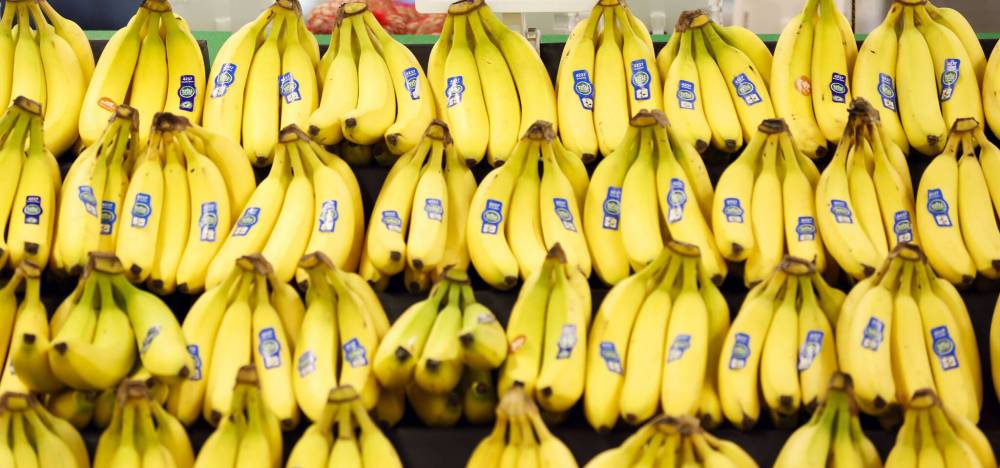
My response to him was that when I had visited his country, I was struck by how many different kinds of bananas were on display — short sweet ones for fresh eating, long dense ones for cooking, and so on. Globally, the most sought-after agricultural products, in order, are cereals, sugar, coffee, cocoa and bananas.
Although we generally only carry pretty uniform bananas, except in ethnically diverse specialty stores, bananas are actually one of the most consumed fruits in our country, with each Canadian, on average, eating 15 kilograms (33 pounds) per year.
Apples, of course, are also very popular and, to my surprise, blueberries rank very high as a key fruit and agricultural export for us! But bananas tend to be moderately priced, easily available and versatile in their usage. Aside from fresh eating, my baking specialty is banana-chocolate chip muffins! Sounds appealing!
When it comes to tropical products, bananas have also recently taken on a new role, as the poster-fruit for sustainable, environmentally, socially and economically friendly eating. Two companies, Equifruit and Discovery Organics, based in Montreal and Vancouver, have sold Fairtrade bananas for a number of years, but they were “small potatoes” compared to the power of the big banana multinationals, like Dole, Chiquita and Del Monte.
Inroads have been made in recent years — for instance, Longo’s in Ontario adopted Equifruit’s product as its only banana — and that was huge! Great respect is due these smaller companies for their pioneering leadership and continued efforts!
This spring and summer, however, the giant corporations are showing that they’ve adopted Fairtrade bananas, and the first indication has been Sobey’s rolling out that product across Canada in May. Costco in Ontario is now selling Fairtrade bananas.
Other large chains are set to follow, so keep an eye on the display in the store where you shop (or switch to where you can get the Fairtrade ones!).
In a press release last week, Del Monte stated: It is incredibly important to us as a company to use ethical and sustainable growing practices. This is just one way the company listens to consumers. The Fair Trade Certified seal meets rigorous standards, including safe working conditions, environmental protection, sustainable livelihoods and community development funds.
The fair-trade system offers producers in the Global South a guaranteed minimum price to shield them from the vagaries of “free market” pricing. It also offers premiums that can be used for producers, often organized as cooperatives, to build clinics or schools in their communities or improve equipment and training.
The fair-trade system also takes on the global marketing of these products, as it has proven very difficult for individual growers to find good deals on their own.
Our bananas come mostly from Central and South America. When my wife and I visited fair-trade producers in Peru a few years ago, we were told that their bananas, under the “free-trade system,” were often sold at a loss.As they had the product on hand, and as it would deteriorate if they didn’t sell it, and as they had debts they needed to pay off, they had no choice but to go ahead and get what they could, every year falling further behind.
Canadian farmers can likely identify with this kind of situation — a product to sell, an investment already made in its growing, bills to pay.
As well, the work was back-breaking. Carrying a bunch of bananas, macheted down from a tree, under hot, humid, dusty conditions, ultimately wore down the shoulders, neck and back of the workers. With the premium, where we visited, they now had a conveyor belt from the field to the adjoining processing station.
They also have been able to add training and methods that are more ecologically friendly in fighting pests and the consequences of climate change. Finally, the prospect of actually making a decent living as a banana producer means that the next generation will stay “on the farm” rather than leave for the perceived better life of the city.
This is a win-win situation. Bananas are just one success story for fair trade in recent years, as sales of coffee, cocoa and other products also grow quickly. Don’t slip up! Get your Fairtrade bananas today!