
Incumbency prevails in civic elections
Advertisement
Read this article for free:
or
Already have an account? Log in here »
We need your support!
Local journalism needs your support!
As we navigate through unprecedented times, our journalists are working harder than ever to bring you the latest local updates to keep you safe and informed.
Now, more than ever, we need your support.
Starting at $15.99 plus taxes every four weeks you can access your Brandon Sun online and full access to all content as it appears on our website.
Subscribe Nowor call circulation directly at (204) 727-0527.
Your pledge helps to ensure we provide the news that matters most to your community!
To continue reading, please subscribe:
Add Brandon Sun access to your Free Press subscription for only an additional
$1 for the first 4 weeks*
- Enjoy unlimited reading on brandonsun.com
- Read the Brandon Sun E-Edition, our digital replica newspaper
*Your next Free Press subscription payment will increase by $1.00 and you will be charged $20.95 plus GST for four weeks. After four weeks, your payment will increase to $24.95 plus GST every four weeks.
Read unlimited articles for free today:
or
Already have an account? Log in here »
Hey there, time traveller!
This article was published 20/08/2022 (1484 days ago), so information in it may no longer be current.
Winnipeggers will have no shortage of choices when casting their ballots for a new mayor in the coming municipal election. As of this writing, no fewer than 14 candidates are running for the city’s top job.
Further, most of the candidates running have recognizable names, with many having previous experience either contesting or holding elected office as mayor, councillor or, in one case, as a member of Parliament.
That’s great news. The role is an important one, and Winnipeggers deserve a long list of high-quality candidates to mull over. We’re getting just that.
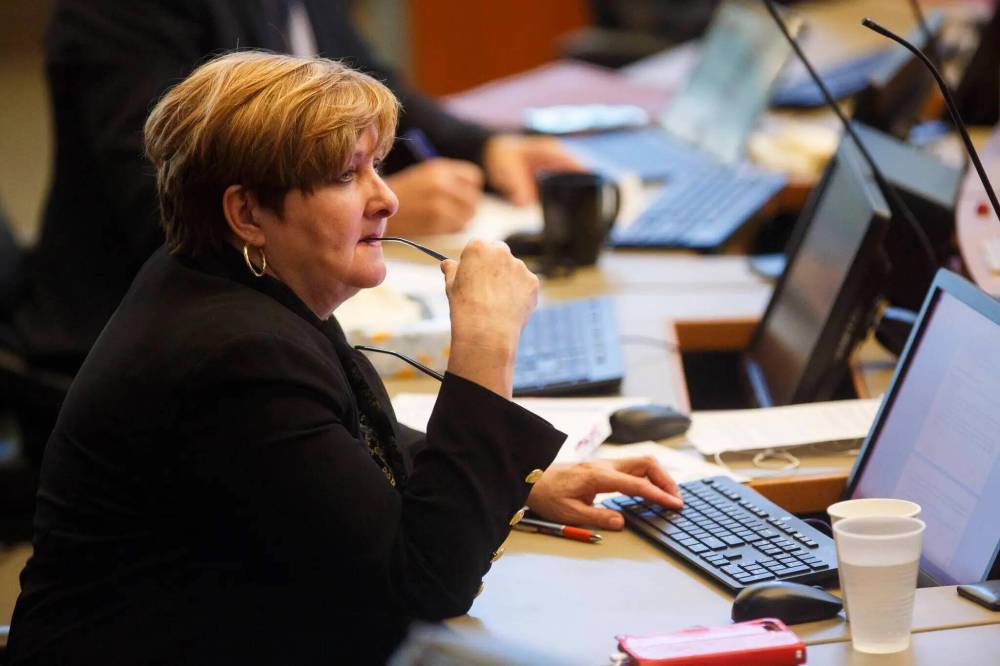
Winnipeg Coun. Janice Lukes (Waverley West) is one of six incumbent councillors currently running unopposed for re-election in this fall’s civic election. (Winnipeg Free Press)
But contrast that with several council races in the city — as of this writing, six of the 15 council races in the city have only a single candidate running. Anyone pondering a run still has about a month left to commit and register, but the fact so many council seats have candidates running uncontested with the election looming is both concerning and confusing.
It’s concerning because it’s obviously difficult to have a vibrant democratic race when only one person is willing to put their name forward for elected office. Acclamations deprive voters of both a real race and a real choice.
The presence of so few candidates in these council races is also confusing. What can explain this, when the mayoral race is packed?
Incumbency is a big part of the answer. At the mayoral level, two-term mayor Brian Bowman is retiring, so ambitious candidates are contesting an open field. No one has an incumbency advantage in the mayoral race.
By contrast, all six council seats currently headed for acclamations have incumbent councillors running: Jason Schreyer in Elmwood-East Kildonan; Sherri Rollins in Fort Rouge-East Fort Garry; Jeff Browaty in North Kildonan; Devi Sharma in Old Kildonan; Markus Chambers in St. Norbert-Seine River; and Janice Lukes in Waverley West.
(Incidentally, Lukes was also acclaimed as councillor in the 2018 municipal election.)
When trying to explain why so many council seats are cruising toward acclamation in this election, some commentators have pointed to the obstacles associated with running for public office. It’s exhausting and, increasingly, expensive. People are often unwilling to sacrifice lucrative careers to go into a demanding public service role with lower pay, and they feel their lives will become a public spectacle.
Politicians and their staffs are sometimes treated abominably by the public, who are quick to condemn politicians without ever acknowledging the work and the good they do. Some particularly sharp anti-politician sentiments that have cropped up in recent years may also be pushing some prospective candidates to reconsider.
We know from surveys that there is some truth to all these explanations. But it doesn’t explain why the mayoral race is jammed while many council races are a one-person show.
Incumbency helps to explain this. In municipal politics in Winnipeg and cities with similar institutions and electoral dynamics, potential candidates know incumbents are very difficult to defeat, so it is seen to be pointless to run against them.
Incumbent councillors can spend four or more years building up name recognition in their wards, working for constituents to boost goodwill, and engaging in a range of representational activities designed to boost votes in any subsequent re-election campaign.
Why would anyone be willing to serve as a sacrificial lamb against a seemingly unbeatable incumbent with such a record?
Incumbents in all sorts of races generally have an advantage. But that advantage is particularly intimidating in Winnipeg council races, and even more so in local school trustee elections.
This is for two reasons. First, these are low-information races. No matter how hard local journalists work, there are only so many stories that can be written about every council and school trustee race. Lacking much information about the race, voters fall back on name recognition and the record of the incumbent, which benefits the incumbent.
Second, we have no political parties to organize municipal elections in Winnipeg. Parties, for all their problems, give voters something to consider beyond the merits of individual candidates. They provide both opportunities and resources for candidates to challenge incumbents. But without real parties to assist them, challengers are left to themselves to try to take on powerful incumbent councillors.
This suggests that if we’re concerned about the democratic implications of these looming acclamations, there are some things that can be done about them. First, we should be concerned about the well-being of media that can provide information about local races, and make sure independent sources of local and community journalism thrive in our city.
Second, we can hold our noses and be open to the presence of political parties to help structure elections in Winnipeg. Maybe that is a local version of federal or provincial parties, or maybe, as in Vancouver or Montreal, we need a distinctively Winnipeg version of local parties.
» Royce Koop is a professor of political studies at the University of Manitoba and academic director of the Centre for Social Science Research and Policy.