
INTERNATIONAL VIEWPOINT: What’s the human speed limit in an emergency?
Advertisement
Read this article for free:
or
Already have an account? Log in here »
We need your support!
Local journalism needs your support!
As we navigate through unprecedented times, our journalists are working harder than ever to bring you the latest local updates to keep you safe and informed.
Now, more than ever, we need your support.
Starting at $15.99 plus taxes every four weeks you can access your Brandon Sun online and full access to all content as it appears on our website.
Subscribe Nowor call circulation directly at (204) 727-0527.
Your pledge helps to ensure we provide the news that matters most to your community!
To continue reading, please subscribe:
Add Brandon Sun access to your Free Press subscription for only an additional
$1 for the first 4 weeks*
*Your next subscription payment will increase by $1.00 and you will be charged $20.00 plus GST for four weeks. After four weeks, your payment will increase to $24.00 plus GST every four weeks.
Read unlimited articles for free today:
or
Already have an account? Log in here »
Hey there, time traveller!
This article was published 11/10/2022 (1224 days ago), so information in it may no longer be current.
I’m writing this on a plane to Greenland — well, actually, on a plane to Denmark, because there’s no way to get to Greenland by a civilian airline without going through Copenhagen first — and it has occurred to me (not for the first time) to wonder where everybody else is.
My wife and I are on our way to shoot a documentary about a handful of scientists who have an idea to slow the speed at which glaciers are sliding into the sea. If it works, it would drastically lower the predicted level of sea level rise.
As the warming proceeds and the world’s remaining ice melts, sea-level rise is going to become a grave problem for every country with a coastline, so you’d think there would be legions of people working it. There are not.
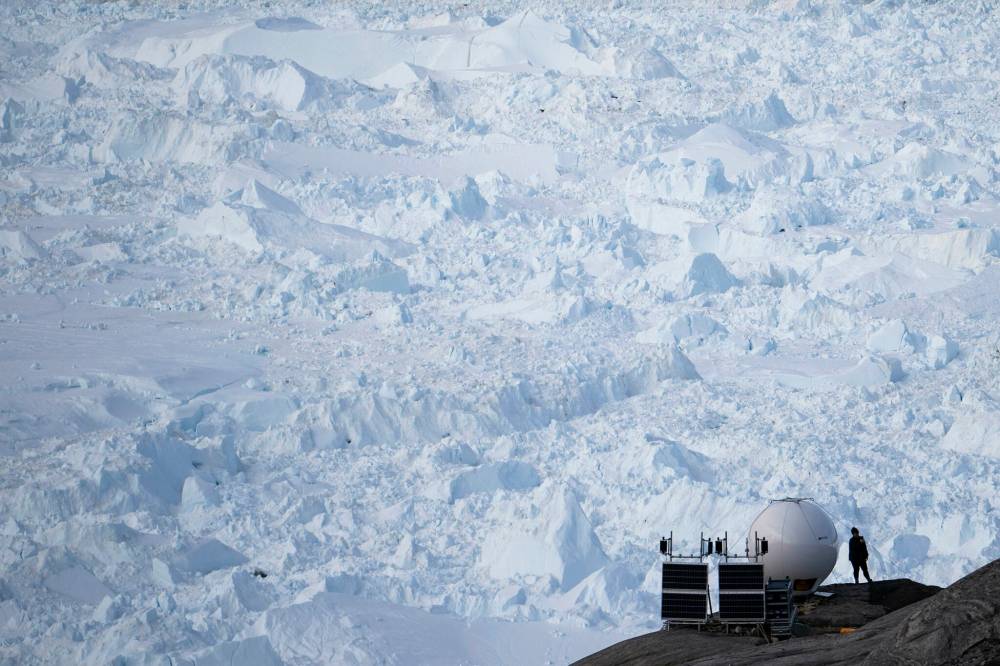
A woman stands next to an antenna at an NYU base camp at the Helheim glacier in Greenland in 2019. Gwynne Dyer and his wife are working on a documentary about a handful of scientists who have an idea to slow the speed at which glaciers are sliding into the sea. (File)
Worldwide, there may be 1,000 scientists working on the “cryosphere,” the frozen parts of the planet, but their energies are divided among many different aspects of climate change: thawing permafrost releasing megatonnes of methane, loss of sea ice cover on the Arctic Ocean, why the Arctic is warming four times faster than the rest of the planet, etc.
How many people are working specifically on accelerating glacial flows? Maybe 100 full-time scientists, if you’re feeling optimistic.
What holds glaciers back is the friction between the ice and the bottom. Warmer ocean currents are eating away at the base of the glaciers and effectively detaching them from the bottom, i.e. taking the brakes off.
The official Intergovernmental Panel on Climate Change report forecasts no more than one metre of sea level rise by 2100. Many scientists think two metres is more likely, given predictable further warming even with rapid cuts to emissions. And if the entire, quite unstable West Antarctic Ice Sheet starts to slide into the sea, four metres by 2100.
A two-metre sea level rise would flood land that is home to a quarter-billion people: in Asia, goodbye to Shanghai, Bangkok and Calcutta; in the U.S., farewell to Miami and New Orleans. At four metres, at least a billion people would be looking for new homes — and they wouldn’t be in the mood to take no for an answer.
So this plane, and lots of others heading to the polar regions, should be full of climate scientists looking for ways to slow down the glaciers and the consequent sea-level rise. We’re already locked into far too much warming, and just cutting emissions is not enough.
However, there are just five scientists and engineers on this trip: an American, two Canadians, a Brit (who’s normally based at a Chinese university) and a Finn. They have a really promising idea for slowing down the glaciers and reducing the speed of sea level rise, but there should be 10 or 30 or 50 teams working on promising ideas.
I’ll get into what their specific idea is in the near future, after everybody has a better feel for how the proposal will be met, but my point right now is how pathetically few they are.
Not only that, but they are all self-financing (although some of their universities are helping with the travel). This is hardly an adequate response to the threat.
Consider, for a moment, the Manhattan Project, which employed 130,000 people in 1942-45 to build the first atomic bombs. It cost about US$23 billion in today’s money, but nobody objected because they were afraid the Germans might get the Bomb first. (In fact, the Germans weren’t even trying.)
Global warming is at least as big a threat as a few first-generation nuclear weapons in Nazi hands — far bigger, I’d say — so why is the response so muted? Can’t people see climate change is an existential threat that would justify dozens of Manhattan-scale crash projects to curb the warming?
No, they can’t, and I suspect our ancestors are to blame. All our ancestors were hunter-gatherers for at least 98 per cent of human history, and hunter-gatherers lived in the short term.
They could react very quickly to immediate and visible threats, but they could do nothing about longer-term challenges such as changes in the climate or in animal migration routes, so they didn’t waste time worrying about them. We are their descendants, and that’s our default mode, too.
What I’m suggesting, I’m afraid, is that there may be a sort of species-specific speed limit on how fast human societies can respond even to very big threats if they are slow-moving, impersonal and invisible. The Manhattan Project people were in the middle of a war against human enemies; we are not.
If there is such a speed limit, does that mean we are doomed? Who knows? How fast is fast enough? But the graduate schools are now full of people studying climate science, and despair is not a useful option.
» Gwynne Dyer’s new book is “The Shortest History of War.”