
NATIONAL VIEWPOINT: Ready for today, but not tomorrow
Advertisement
Read this article for free:
or
Already have an account? Log in here »
We need your support!
Local journalism needs your support!
As we navigate through unprecedented times, our journalists are working harder than ever to bring you the latest local updates to keep you safe and informed.
Now, more than ever, we need your support.
Starting at $15.99 plus taxes every four weeks you can access your Brandon Sun online and full access to all content as it appears on our website.
Subscribe Nowor call circulation directly at (204) 727-0527.
Your pledge helps to ensure we provide the news that matters most to your community!
To continue reading, please subscribe:
Add Brandon Sun access to your Free Press subscription for only an additional
$1 for the first 4 weeks*
*Your next subscription payment will increase by $1.00 and you will be charged $20.00 plus GST for four weeks. After four weeks, your payment will increase to $24.00 plus GST every four weeks.
Read unlimited articles for free today:
or
Already have an account? Log in here »
Hey there, time traveller!
This article was published 11/07/2023 (997 days ago), so information in it may no longer be current.
The burning question of the day is: does Canada have the necessary capacity to combat widespread wildfires? The Globe and Mail is asking. After a pall of Canadian smoke settled on the Big Apple, the New York Times is asking. One eastern newspaper even opined that perhaps eco-terrorism is involved. The definitive answer to this question is a resounding — yes and no.
First, there’s the broader question of how governments prepare for emergencies. An emergency is, by definition, a rare event. Forest fires are not rare events, so governments can and do plan their resource allocation based on experience and gear their preparedness to an “average” fire year.
Preparedness consists of a central command apparatus, trained teams of on-the-ground “attack” personnel (in Manitoba, an unsung group of largely Indigenous firefighters), a fleet of water bombers and assorted other equipment. Nonetheless, in some years the average is exceeded. If not by much, there is enough flex in the system to meet the demand; if by a great deal, as is the case in several provinces this year, there’s a real emergency.
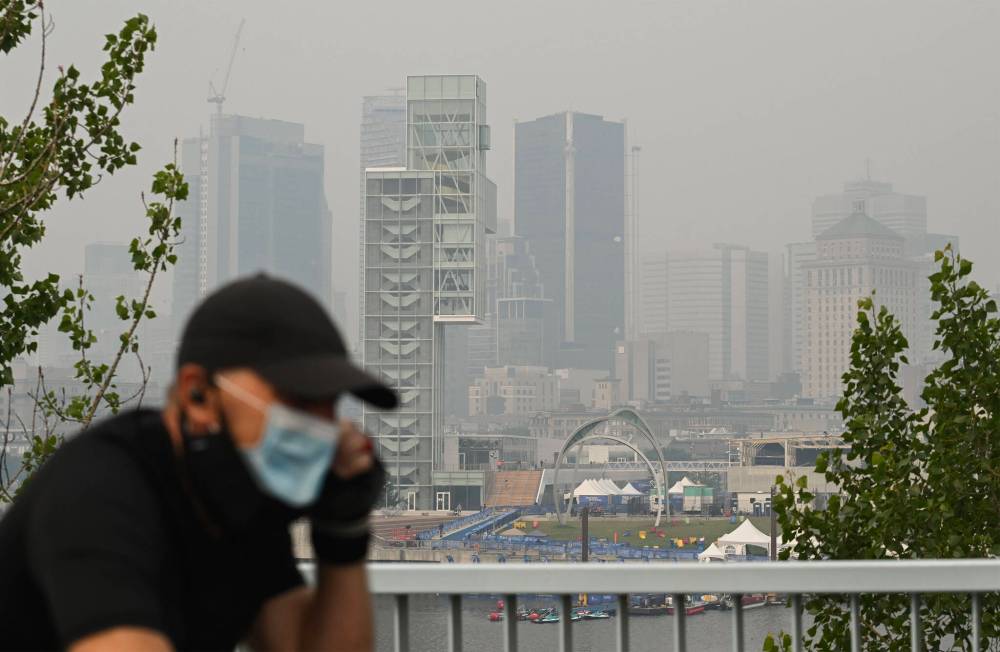
A man wears a face mask as he cycles by the skyline of Montreal amid smoke from wildfires earlier this year. (The Canadian Press)
Recognizing that it would be infeasible for every province to equip itself with the capacity to deal with those emergency fire years, thus tying up resources than might be used once in a decade, the provinces and Canada established a clearinghouse for shunting equipment and personnel to the emergency. The institution that performs this magic is the Canadian Interagency Forest Fire Centre (CIFFC), and it’s located in Winnipeg.
The premise upon which CIFFC rests is that everything is unlikely to be burning at once; so, if for example it’s a bad fire year in Manitoba, other provinces where fire risk is low can send needed equipment and personnel. It has worked very well for a very long time. There is a similar interstate co-ordinating agency south of the border and needed help can cross the international boundary, as when Manitoba has assisted from time to time in suppressing early season wildfires in northeastern Minnesota.
This year, the premise has failed to hold; everything is burning at once. Four provinces have been faced with unprecedented numbers of big fires. CIFFC is doing its job, but there simply isn’t enough spare capacity to go around, particularly people power, to fill all the gaps; hence the influx of fire crews from as far afield as South Africa and the use of the Canadian Armed Forces. And we have a couple of months of prime forest fire season ahead.
So, why is this year so different from other years? Is this just a one-off, the equivalent to the one-in-a-100-year flood? Unfortunately, not. Past mismanagement is teaming up with climate change to dramatically increase wildfire risk.
Fire is a vital element in the natural life cycle of boreal forest ecology. Die-off in mature forests creates the tinder for lightning-ignited fires; fire dependent (pioneer) species like fireweed and jack pine colonize the burn-over; successor species continue to colonize and within a few decades restoration of original forest is well underway.
We have deliberately broken this cycle in order to protect life and property. A good deal of our accessible forest land is subject to commercial logging, a property right that governments feel obliged to protect when it’s ablaze. However, fire suppression simply delays the inevitable; by putting out small fires, we ensure future large ones. Some fires in remote locations that don’t affect human settlement or resource extraction are left to burn out as they did in pre-settlement times, without permanent harm.
Another factor driving our forest fire suppression programs is the presence of people and their property in the forest environment. This includes First Nations and other permanent communities and individuals, as well as significant recreational development. Although essential, our intervention to protect lives and property also breaks the cycle with similar baleful long-term consequences. Permanent and seasonal human presence in the forest is a significant ignition source. Of the 47 wildfires on Vancouver Island so far this year, all have been attributed to human causes.
So, in order to protect life and property, we contain the extent of wildfires, which results in an ever-increasing percentage of forest land that’s extremely vulnerable to fire.
Climate change is piling on an already bad situation. Widespread drought can certainly be a factor and prolonged heat waves can produce “mini-droughts” that can rapidly dry out a forest creating perfect fuel for a conflagration. Insect pests like the pine beetle, thriving because of milder winters, are devastating large tracts in B.C. and Alberta. Dead trees burn very well.
This is one of those negative feedback loops that scientists fear. Widespread wildfires are producing record CO2 emissions, accelerating climate change and its effects on our forests, in turn causing more fires and more CO2, and so on. And of course, the health effects of prolonged exposure to wildfire smoke in major Canadian and northern U.S. cities is already evident.
The answer is “yes,” we are well prepared for wildfires — of the past; and “no,” we are not prepared for a future in which this year’s catastrophe will be an increasingly frequent event.
» Norman Brandson is the former deputy minister of the Manitoba Departments of Environment, Conservation and Water Stewardship.