
Different approaches, attitudes
Advertisement
Read this article for free:
or
Already have an account? Log in here »
We need your support!
Local journalism needs your support!
As we navigate through unprecedented times, our journalists are working harder than ever to bring you the latest local updates to keep you safe and informed.
Now, more than ever, we need your support.
Starting at $15.99 plus taxes every four weeks you can access your Brandon Sun online and full access to all content as it appears on our website.
Subscribe Nowor call circulation directly at (204) 727-0527.
Your pledge helps to ensure we provide the news that matters most to your community!
To continue reading, please subscribe:
Add Brandon Sun access to your Free Press subscription for only an additional
$1 for the first 4 weeks*
- Enjoy unlimited reading on brandonsun.com
- Read the Brandon Sun E-Edition, our digital replica newspaper
*Your next Free Press subscription payment will increase by $1.00 and you will be charged $20.95 plus GST for four weeks. After four weeks, your payment will increase to $24.95 plus GST every four weeks.
Read unlimited articles for free today:
or
Already have an account? Log in here »
Hey there, time traveller!
This article was published 01/11/2023 (917 days ago), so information in it may no longer be current.
It’s a fascinating contrast in strategies, exposing the difference between policies that incentivize good outcomes versus those that punish failures to achieve positive results.
By exposing that difference, it also reveals the stark attitude and personality differences between the Trudeau government and the opposition Conservatives under leader Pierre Poilievre.
It is no secret that Canada is in a housing crisis. A combination of many factors — most notably, inflation, rising interest rates, population growth and urbanization — has made it harder for many Canadians to purchase and pay for a home, or to even secure rental accommodations.
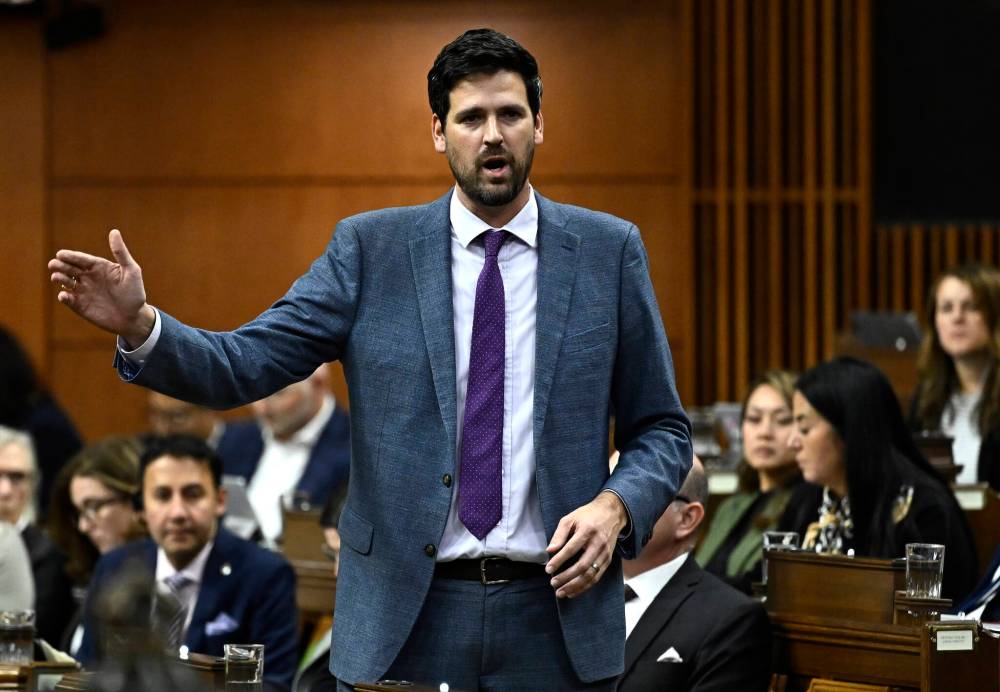
Federal Housing Minister Sean Fraser rises during question period in the House of Commons last week. (The Canadian Press)
In response to the situation, the Trudeau government created the $4-billion Housing Accelerator Fund last year to help local governments implement measures to increase the housing supply. A ministerial statement released last week on behalf of Housing Minister Sean Fraser says that the fund “is not designed to reward communities for tinkering at the margins. Instead … (it) will provide significant financial support to those communities who are willing to implement transformational changes that create a pathway to solving the housing crisis in their community.”
The statement adds that, “Cities have an important role to play in addressing the housing crisis. In different parts of Canada, permitting processes take too long and restrictive zoning practices in many cases make it illegal to build the kinds of homes we need to ensure everyone in Canada can afford a place to live near the services and opportunities their households need.”
In order to be eligible for funding under the accelerator program, cities are expected to take steps to remove barriers to housing construction. That includes ending low-density zoning, making municipally owned land available for housing, streamlining the approval process for housing projects, reducing or eliminating development fees and minimum parking requirements, and eliminating restrictions (including height, setbacks, building floor area and others) to allow for a greater range of housing types.
Those expectations bear a strong resemblance to the mandatory requirements that would form part of a national housing program that would be implemented by a Conservative government, should it win the next federal election.
This past September, Poilievre said his “Building Homes Not Bureaucracy Act” would require cities to “increase the number of homes built by 15 per cent each year and then 15 per cent on top of the previous target every single year (it compounds).” If they don’t reach those targets, their federal funding would be cut.
While cities would receive funding bonuses for “removing gatekeepers” and exceeding the 15 per cent target, a Tory government would withhold transit and infrastructure funding from cities that fail to increase high-density housing near transit stations. A Conservative Party media release says that, “Cities will not receive money for transit until there are keys in doors.”
Poilievre promises to “cut the bonuses and salaries, and if needed, fire the gatekeepers at CMHC if they are unable to speed up approval of applications for housing programs to an average of 60 days.” He also commits to “list 15 per cent of the federal government’s 37,000 buildings and all appropriate federal land (will) be turned into homes people can afford.”
Poilievre’s plan may look like the Trudeau government’s Housing Accelerator Fund in some ways, but there is also a critical difference. Under the Liberal program, cities that do not participate, or fail to see significant growth in housing stock, are not penalized. They simply do not receive funds under the accelerator program.
Under the Conservative plan, however, any city that fails to hit the Tory targets could be subject to huge financial penalties. Just imagine a city having to cut transit service, delay road or sewer projects, or lay off police officers and firefighters because federal funding was suddenly cut. It would create fiscal mayhem for those cities, with the consequences felt by all citizens.
That’s the problem with Poilievre’s housing plan, and many of his other proposals. They may look good in a tweet, but they’re often overly simplistic and needlessly confrontational. They won’t work in the real world and, in many cases, would cause more harm than good.
This is the choice Canadians will have to make in the next election: collaboration or confrontation, incentives or threats, rewards or punishment, Liberal or Conservative.