
Reflect on history this Truth and Reconciliation Day
Advertisement
Read this article for free:
or
Already have an account? Log in here »
We need your support!
Local journalism needs your support!
As we navigate through unprecedented times, our journalists are working harder than ever to bring you the latest local updates to keep you safe and informed.
Now, more than ever, we need your support.
Starting at $15.99 plus taxes every four weeks you can access your Brandon Sun online and full access to all content as it appears on our website.
Subscribe Nowor call circulation directly at (204) 727-0527.
Your pledge helps to ensure we provide the news that matters most to your community!
To continue reading, please subscribe:
Add Brandon Sun access to your Free Press subscription for only an additional
$1 for the first 4 weeks*
- Enjoy unlimited reading on brandonsun.com
- Read the Brandon Sun E-Edition, our digital replica newspaper
*Your next Free Press subscription payment will increase by $1.00 and you will be charged $20.95 plus GST for four weeks. After four weeks, your payment will increase to $24.95 plus GST every four weeks.
Read unlimited articles for free today:
or
Already have an account? Log in here »
Hey there, time traveller!
This article was published 23/09/2024 (609 days ago), so information in it may no longer be current.
Next Monday marks the National Day of Truth and Reconciliation and begins Truth and Reconciliation Week 2024. For a lot of us, this just means a day off from work and an orange shirt. However, reconciliation is a process that requires much more devotion than one day per year.
One of the most crucial aspects of Truth and Reconciliation is learning about Canada’s history with Indigenous peoples and residential schools. Brandon once had its own residential school that operated for nearly 80 years. While thinking about this, I realized that I know very little about the Brandon Residential School and therefore decided to investigate its history.
The Brandon Residential School (often referred to in historic documents as the “Brandon Indian Residential School”) was a controversial school with a very rocky history. It first opened in 1895, federally funded and originally run by the Methodist Church from 1895 – 1925. It would later be run by the United Church from 1929-1970, and the Roman Catholic Church from 1970-1972.
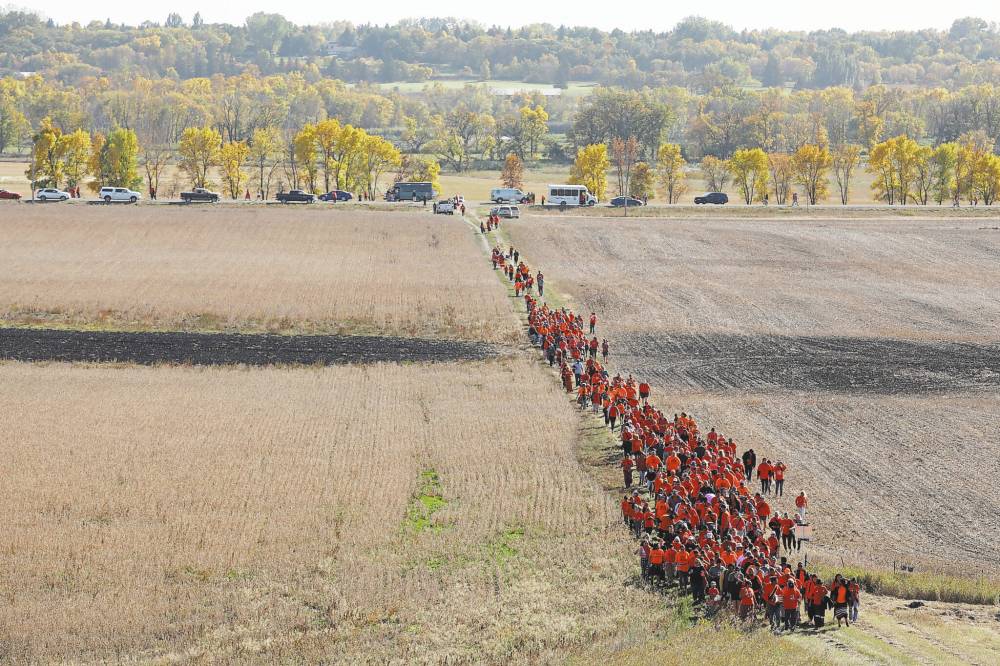
Participants walk to the site of the former Brandon Residential School outside Brandon during the Orange Shirt Day Walk as part of Truth and Reconciliation Week 2022. Columnist Sophie Henderson points to the Brandon Residential School as an example of the need to reflect on history this Truth and Reconciliation Day. (File)
It was planned as a school for the Indigenous communities of the Lake Winnipeg region, including the Cree and Saulteaux communities, where the Methodists had already established missions. The communities involved were never consulted about the location. According to thechildrenremembered.ca, the school being located so far away from the target communities was an intentional choice by the Methodist Church, as they believed that putting a great amount of distance between children and the influence of their families was the key to successful assimilation. This resulted in a great amount of concern and opposition from parents, but unfortunately, even their chiefs held very little power and were unable to sway the Church and the government.
The Brandon Residential School ended up being constructed in the municipality of Cornwallis, just northwest of Brandon. Throughout its years of operation, the Brandon Residential School was often pressed for students. While their goal was to attract students from the Lake Winnipeg region, there weren’t enough. The Methodists were determined to fill their school, and eventually received permission to bring in students from outside of their treaty area, including Ontario and Saskatchewan.
The curriculum consisted of standard subjects like reading, writing, and arithmetic in the morning. The afternoon was reserved for chores. There was a lot of emphasis put on farming at the Brandon Residential School. The location was also chosen for its fertile soil, with the intent of using most of the land as a working farm. In the afternoons, boys would work on the farm and in the vegetable gardens, take care of animals, and learn construction skills. Girls spent most of their time learning housekeeping skills like cleaning, sewing, and cooking, as well as helping with the dairy production. Religious instruction was also heavily incorporated, with several designated prayer times throughout the day. Children would attend local church services in the city on Sundays.
According to the National Centre for Truth and Reconciliation, the Brandon Residential School was a site of controversy during the 1940s and 1950s, when many students ran away from the school. The children who ran away complained of lack of nutritious food, exhaustive work, and unfair discipline, and their parents complained to the government. The issues were raised with the United Church, but ultimately, no changes were made.
It has also been reported in scientific journals and through the CBC that ESP experiments were conducted on the children during this time. Hungry children were given candy in exchange for their participation. While there is no evidence that these specific experiments were physically harmful, it still demonstrates how the children were manipulated into acting as scientific guinea pigs, with neither the full knowledge of what they were agreeing to nor the consent of their parents.
The school closed for good and was abandoned in 1972. It was torn down in 2000. Since its demolition, there have been three sites near the school identified as potential burial grounds. In 2021, 104 potential graves were identified throughout the three locations, with 78 being historically accountable (cbc.ca). At the moment, over 50 bodies have been identified. The names of these children are listed on the National Centre for Truth and Reconciliation’s website.
The Brandon Residential School has not only left lasting impacts on Indigenous communities in Manitoba, but also throughout Canada. To learn more about residential schools, their impact on Indigenous peoples, and reconciliation, be sure to check out all the activities going on next week such as the Orange Shirt Day Walk on Sept. 30. There are also many resources in Brandon dedicated to helping Indigenous families and educating the community, like the Brandon Friendship Centre.
This Truth and Reconciliation Day, be sure to take time to reflect and consider the gravities of the past, and how we can heal moving forward.
» Sophie Henderson is a Grade 11 student at École secondaire Neelin High School.