
A nudge to gender equity
Advertisement
Read this article for free:
or
Already have an account? Log in here »
We need your support!
Local journalism needs your support!
As we navigate through unprecedented times, our journalists are working harder than ever to bring you the latest local updates to keep you safe and informed.
Now, more than ever, we need your support.
Starting at $15.99 plus taxes every four weeks you can access your Brandon Sun online and full access to all content as it appears on our website.
Subscribe Nowor call circulation directly at (204) 727-0527.
Your pledge helps to ensure we provide the news that matters most to your community!
To continue reading, please subscribe:
Add Brandon Sun access to your Free Press subscription for only an additional
$1 for the first 4 weeks*
*Your next subscription payment will increase by $1.00 and you will be charged $20.00 plus GST for four weeks. After four weeks, your payment will increase to $24.00 plus GST every four weeks.
Read unlimited articles for free today:
or
Already have an account? Log in here »
Hey there, time traveller!
This article was published 16/05/2025 (314 days ago), so information in it may no longer be current.
Gender equality in cabinet remains important even if the prime minister isn’t talking about it.
Former prime minister Justin Trudeau seemed to ruffle feathers when he unveiled his first federal cabinet: one that deliberately included gender equality. Alberta’s Rachel Notley had beaten him to the punch months earlier with a gender-equal cabinet, but she did so without making it a headline.
Newly elected Prime Minister Mark Carney seems to be following that lead.
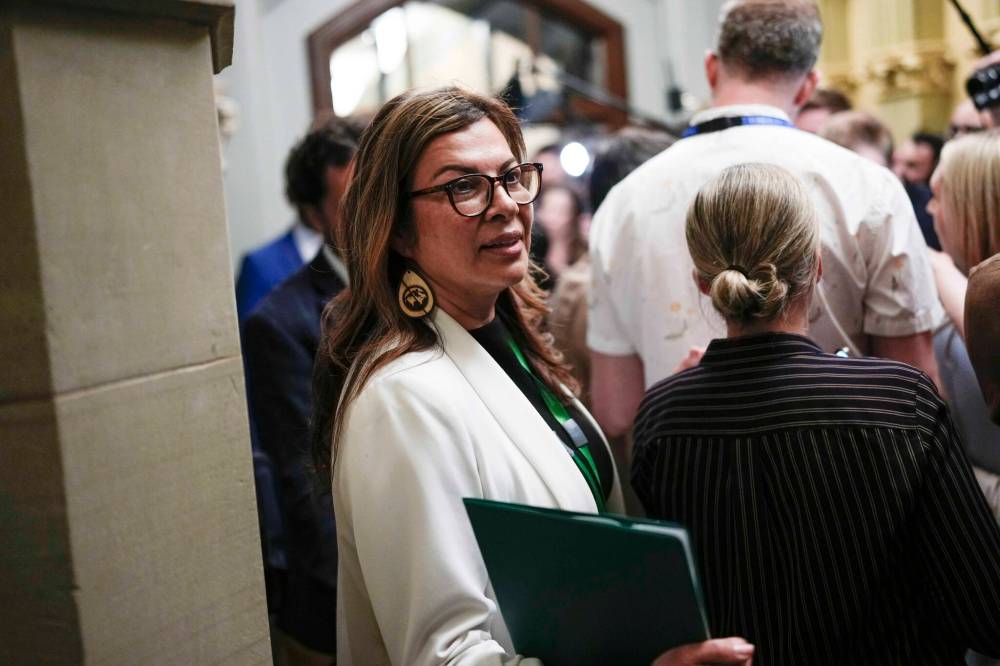
Northern and Arctic Affairs Minister Rebecca Chartrand arrives for a meeting of the federal cabinet in West Block on Parliament Hill in Ottawa on Wednesday. Chartrand is the lone cabinet minister from Manitoba. (The Canadian Press)
The new cabinet sworn in on Tuesday is composed of 28 full ministers: 14 women and 14 men, plus the prime minister. In addition, Carney appointed 10 junior ministers as secretaries of state: four women and six men.
However, he did this after some nudging from feminists, concerned that his first cabinet broke too far away from Trudeau’s commitment to gender balance. Just after taking control of the party, Carney’s new cabinet in March did not reflect a gender-equal balance. In addition, he also eliminated the minister for Women and Gender Equality Canada.
As Jeanette Ashe and Fiona MacDonald point out in an article published in the Tyee, that move prompted criticism from organizations like the Canadian Research Institute for the Advancement of Women, Women’s Shelters Canada, YWCA Canada and Action Canada for Sexual Health and Rights.
But how big a role has Carney provided for these women?
According to Ashe and MacDonald, the “big jobs” have gone to the men — a trend that has been ongoing in politics for years. Women continue to be under-represented in roles like finance minister or defence (although Carney did name a female associate minister of national defence: Jill McNight). Even in Manitoba under the NDP, the finance portfolio remains a job for a man — Adrien Sala.
If women are to be represented in cabinet, then women must first run as candidates in winnable ridings. According to Equal Voice, the NDP was the only federal party with 51 per cent female candidates. That’s impressive, but given the poor polling numbers, those candidates were unlikely to win.
The Conservatives, who had strong polling numbers up until Carney’s win as leader, had a depressing number of female-nominated candidates — only 22 per cent. The Liberals did only slightly better. Just 35 per cent of their candidates were female.
This does suggest however, that the two parties most likely to win the election, are less likely to nominate women than parties who polling numbers are low.
In a social environment in which gender equality risks being dismissed as “too woke,” and with a growing backlash against diversity, equity and inclusion policies, it is important that women’s voices in government continue to be heard and represented, particularly in cabinet.
Canada needs a diversity of voices in our public institutions.
Housing, climate change, health care, food security, the economy, unemployment and the ongoing issues with the United States are experienced differently by women than by men, largely because they likely live longer, they take on familial responsibilities for the most part and they often make less money.
Women also make most of the buying decisions in the household, shoulder the child-care and elder-care responsibilities and as they near the end of their lives, navigate their newfound vulnerability alone.
That’s why policy about housing, finance, defence and unemployment, among others, must at least attempt to understand the consequences and unintended consequences of any cabinet decisions.
Carney has some smart women in his cabinet.
Patty Hajdu, Anita Anand, Chrystia Freeland, Mélanie Joly and of course Manitoba’s own, newly elected Rebecca Chartrand, who was named the minister of Northern and Arctic Affairs and the minister responsible for the Canadian Northern Economic Development Agency.
He would do well to listen to them very closely.
After all, it’s 2025.
» Shannon Sampert is a retired political scientist. This column previously appeared in the Winnipeg Free Press.