
Iran conflict could shatter UN-led global order
Advertisement
Read this article for free:
or
Already have an account? Log in here »
We need your support!
Local journalism needs your support!
As we navigate through unprecedented times, our journalists are working harder than ever to bring you the latest local updates to keep you safe and informed.
Now, more than ever, we need your support.
Starting at $15.99 plus taxes every four weeks you can access your Brandon Sun online and full access to all content as it appears on our website.
Subscribe Nowor call circulation directly at (204) 727-0527.
Your pledge helps to ensure we provide the news that matters most to your community!
To continue reading, please subscribe:
Add Brandon Sun access to your Free Press subscription for only an additional
$1 for the first 4 weeks*
*Your next subscription payment will increase by $1.00 and you will be charged $20.00 plus GST for four weeks. After four weeks, your payment will increase to $24.00 plus GST every four weeks.
Read unlimited articles for free today:
or
Already have an account? Log in here »
Even as American and Iranian officials were participating in Omani-mediated talks aimed at preventing further escalation between the two nations, the United States, alongside Israel, launched military strikes on Iran on Feb. 28.
The mediation had raised cautious hopes of de-escalating long-running hostility between Iran and the U.S. Instead, this use of force reflects a familiar post-1945 pattern of major powers acting unilaterally rather than through multilateral institutions like the United Nations.
Since the end of the Second World War, international conflicts have been addressed one of two ways: collectively — through the UN Security Council — or unilaterally, often via so-called “coalitions of the willing.”
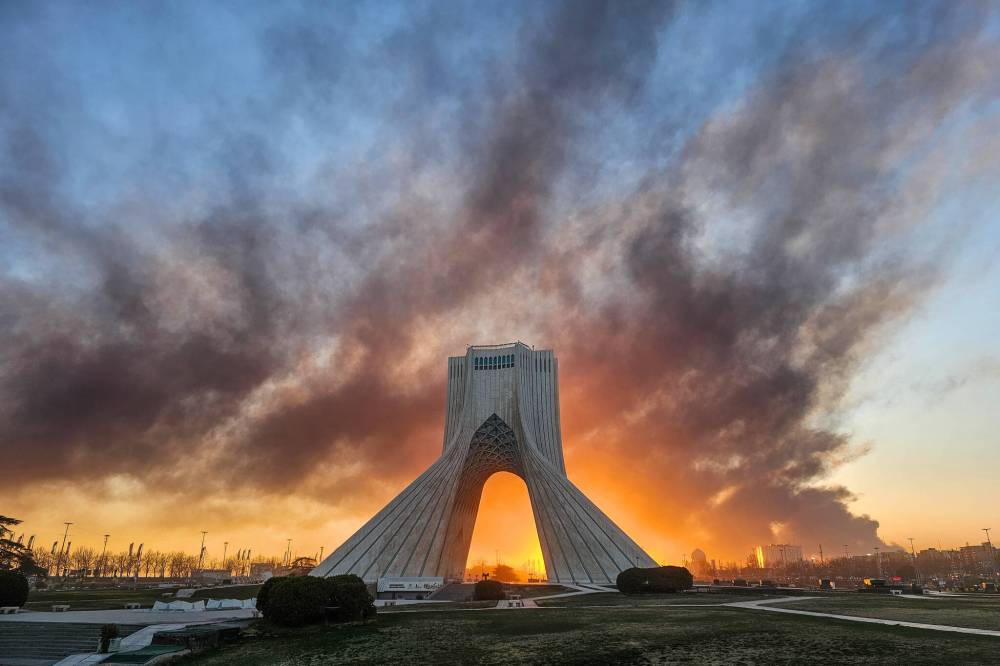
Smoke rises behind the Azadi (Freedom) monument in Tehran, Iran, following a U.S.-Israeli airstrike. (The Associated Press files)
During the Cold War and beyond, global superpowers like the U.S. and Russia have often pursued methods that serve their national interests for regime change or geopolitical balances of power.
It’s against this backdrop that supposed U.S. “just war” objectives in Iran should be scrutinized. According to an official announcement, the U.S. has five primary aims. But how well do these stated objectives align with international law?
From the League of Nations to the UN charter
When rules are broken, there are consequences, whether at a personal, national or global level. Rules are made to bring order to chaos, and human societies have long sought to craft and formalize them.
After the devastation of the First World War, the League of Nations was founded in 1920. Its preamble pledged:
“By the firm establishment of the understandings of international law as the actual rule of conduct among Governments, and by the maintenance of justice and a scrupulous respect for all treaty obligations.”
Without meaningful enforcement power, however, the organization failed to prevent aggression in the 1930s and ultimately set the stage for the outbreak of the Second World War.
The United Nations was founded in 1945 in the aftermath of that war. Its founding document, the Charter of the United Nations, placed particular emphasis on the territorial integrity and political independence of states.
These widely agreed principles are meant to prevent war, especially wars of choice. But the unequal nature of the Security Council, persistence of proxy wars and violent conflict shows how enforcement of international law remains uneven, especially when powerful states act outside collective mechanisms.
Scrutinizing U.S. objectives
When examined critically, significant inconsistencies emerge between Washington’s objectives for Iran and the actual legal realities undermining the rules-based international order laid out in the UN charter.
The first stated aim, according to the official joint statement by the U.S. and Israel, is to “stand united in defence of our citizens, sovereignty and territory.” This frames the attacks as protective and reactive. Yet at the outset of the war, there was no verified report of Iran posing an imminent threat to U.S. territory or allies. Instead, the objective closely aligns with Israel’s priorities in the region.
Second, the war has been framed as necessary to counter Iranian escalation. The joint statement describes Iranian missile and drone launches as “indiscriminate and reckless.” But those strikes only came after U.S. and Israeli strikes killed Iran’s top leadership and caused enormous civilian casualties. Framing Iran’s actions purely as escalation omits the fact that Iran’s regional strikes were responsive, not pre-emptive.
The third justification is to maintain “regional stability” and security. This claim sits uneasily alongside widening instability, including friendly fire incidents, cross-border missile exchanges and mounting casualties in Lebanon, Bahrain, Israel and the United Arab Emirates.
Fourth, the invasion has been defended as necessary to uphold sovereignty norms. The joint statement accuses Iran’s attacks of violating the sovereignty of regional states. Yet prior to the joint offensive, there was no evidence of such a breach.
In contrast, U.S. and Israeli airstrikes penetrated deep into Iranian territory, breaching Iran’s sovereignty under Article 2(4) of the UN charter. Sovereignty appears to be invoked selectively.
Lastly, the war has been framed as an exercise of collective self-defence. However, Article 51 of the UN charter permits self-defence only if an armed attack occurs. As reported, the initial attack was conducted by the U.S. and Israel against Iran.
This raises a deeper legitimacy question: are some states claiming a right to pre-emptive or preventive war under the guise of self-defence while denying that right to others?
Regime change and historical lessons
None of this denies Iran’s long record of supporting regional proxies such as Hezbollah in Lebanon, Hamas in Gaza and the Houthis in Yemen. However, the U.S. nevertheless moved, de facto, into a war that looks a lot like regime change by other means — particularly in light of targeted strikes against senior Iranian leadership.
The apparent calculation was that ordinary Iranians would quickly rise up, the Islamic Revolutionary Guard Corps would surrender and a U.S.-friendly government would emerge. That optimism was reverberated in U.S. President Donald Trump’s social media rhetoric, if not part of comprehensive U.S. strategy.
If history teaches anything, it’s this: bombing can change a ruler, but not the lives of the ruled. Another regime arrives, flags and ideologies shift and everyday people still carry the burden — just ask the people of Iraq, Afghanistan or Libya.
The growing trend of unilateral interventions severely erodes the aspiration of collective security founded in the UN system. It also sets a dangerous precedent that larger powers can usurp smaller ones should they chose to do so.
Russia had already invaded Ukraine in 2022 and though under-reported, Saudi Arabia intervened in Yemen and Bahrain; Turkey in Syria, Iraq and Libya; and the UAE in Libya and Yemen.
The economic consequences of the current war are also great. Oil prices have increased and natural gas prices have spiked almost 70 per cent in Europe. Some countries, like Myanmar, are already preparing to ration oil and gas supplies.
In addition, hundreds of thousands of migrant workers in Gulf nations are stranded and unable to return to their home countries, and people are being displaced from Lebanon again — on top of the millions already suffering in Gaza.
Rich countries may be able to cope with such shocks, but poor ones in the Global South won’t. Unless this chaos stops, households won’t be able to keep the lights on or their engines running.
For the rule of law to prevail, states — especially powerful ones — must respect international norms consistently, rather than invoking them selectively. Without that restraint, the international system risks descending into a jungle where only the strongest survive.
» Kawser Ahmed is an adjunct professor with the University of Manitoba’s Natural Resource Institute. His column was originally published at The Conversation Canada: theconversation.com/ca.