
Politics, not law, should control floor crossings
Advertisement
Read this article for free:
or
Already have an account? Log in here »
We need your support!
Local journalism needs your support!
As we navigate through unprecedented times, our journalists are working harder than ever to bring you the latest local updates to keep you safe and informed.
Now, more than ever, we need your support.
Starting at $15.99 plus taxes every four weeks you can access your Brandon Sun online and full access to all content as it appears on our website.
Subscribe Nowor call circulation directly at (204) 727-0527.
Your pledge helps to ensure we provide the news that matters most to your community!
To continue reading, please subscribe:
Add Brandon Sun access to your Free Press subscription for only an additional
$1 for the first 4 weeks*
*Your next subscription payment will increase by $1.00 and you will be charged $20.00 plus GST for four weeks. After four weeks, your payment will increase to $24.00 plus GST every four weeks.
Read unlimited articles for free today:
or
Already have an account? Log in here »
Controversy has swirled recently around the floor crossing by three Conservative MPs to join the parliamentary caucus of the governing Liberal party. To date, none of the MPs have been appointed to the cabinet of Prime Minister Mark Carney, but there may be future rewards forthcoming. The possibility that the Liberals might gain a majority in the House of Commons without an election added to the controversy.
In my view, floor crossing is not so serious a problem that legal restrictions are required.
Instead, the fate of elected members who switch parties is best left to voters at the next election. Critics of floor crossing argue that it represents a betrayal of the trust of constituents. Persons who campaigned for and donated to a successful candidate may feel particularly betrayed when an elected member switches parties. Defections are said to contribute to voter cynicism. The receiving party looks manipulative, especially if it offers inducements, and the losing party looks divided.
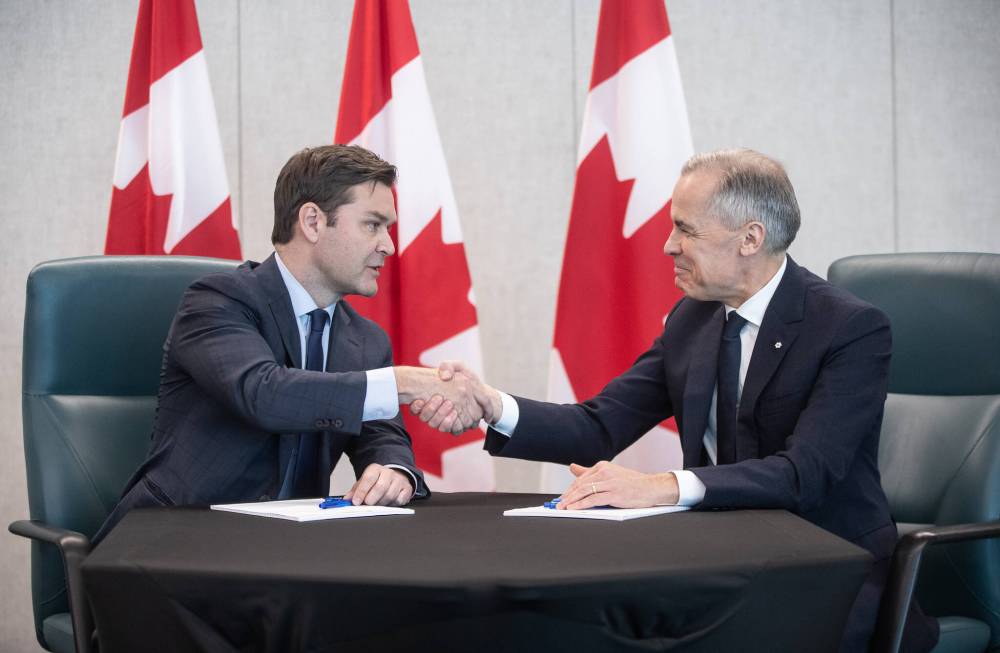
Prime Minister Mark Carney (right) and MP Matt Jeneroux shake hands in Edmonton last month after Jeneroux crossed the floor to the Liberals. (The Canadian Press files)
In principle, we choose governments by electing 343 MPs who then decide by their votes which smaller group of political insiders (the prime minister and cabinet) is entitled to govern based on majority support in the House of Commons.
In theory, MPs are free to vote and speak based on the concerns of their constituents and/or their personal judgments.
In practice, competitive, disciplined political parties have come to dominate elections and the operation of the House of Commons. Voters cast ballots mainly for leaders and parties, not for the individual candidates. Over time, political parties have become mainly election machines striving constantly to capture voter support. The fact that the representation of voter preferences now takes place mainly through parties, not through individual MPs, adds to the controversy surrounding floor crossing.
There can be different motivations for leaving a party such as frustration in representing the concerns of constituents, a major policy disagreement with a party, blunted ambition in terms of advancement within the party, and inducements of various kinds from another party.
A Library of Parliament study reported 300 cases of floor crossing at the national level since 1867, but that total included several types of departures not usually seen to be floor crossing.
Historically, floor crossings have actually declined over time, although they still happen with some regularity. Studies also indicate that in the modern era, floor crossers generally do not fare well at the subsequent election.
The first move in Canada to restrict floor crossing actually happened in Manitoba in 2006, when the NDP government led by Gary Doer passed legislation requiring that MLAs who quit or were expelled from their party had to sit for the remainder of their term as independents. Doer was reacting to three high-profile defections of federal MPs that he believed disrespected the wishes of voters who had voted for a party at the previous election. The Progressive Conservatives (PC) supported the ban, whereas the Liberals cautioned it went too far and called instead for the adoption of legislation to allow citizens to recall their elected representatives.
The Manitoba law stood until 2018, when it was repealed by the PC government of the day. The story behind that repeal can only be told briefly here. In 2017, PC MLA Stephen Fletcher was expelled from the PC caucus for breaking publicly with the Pallister government on multiple issues.
Fletcher subsequently challenged the floor crossing law before the courts, arguing that it infringed on his rights to freedom of association and free speech protected by the Charter of Rights and Freedoms (1982) by denying him the right to join a recognized party in the legislature. That meant limited access to resources and procedural opportunities not available to independent MLAs. The end result, he claimed, was an inability to fully represent his constituents.
Based on the principle of “parliamentary privilege,” the court ruled in June 2018 that legislatures had the right to set their own rules without interference from the courts. The court went on to observe that under the law, Fletcher still had the right to represent his constituents and, as an independent member, he might actually have more freedom because he was not subject to party discipline.
On principle the PC government of the day defended the law in court, even though it had already announced the intention to repeal it, arguing that it broke from parliamentary tradition.
Any future law, whether national or provincial, would probably face a challenge before the Supreme Court of Canada.
Another proposal to constrain floor crossing is a legal requirement that a byelection be held when an elected member changes parties. I do not favour such a law, but should one be adopted, it should not apply when a member left or was expelled from a caucus to sit as an independent.
Byelections take time and involve a significant public expense, so if a general election is not far off — six months, perhaps — requiring the switcher to face voters should be postponed.
To conclude, there is no need to adopt legal restrictions on floor crossing. Based on their personal judgments, MPs/MLAs should be free to switch parties and constituents can then decide whether to penalize or reward such conduct at the next general election.
» Paul G. Thomas is professor emeritus of political studies at the University of Manitoba. This column previously appeared in the Winnipeg Free Press.