
Transportation options provide a buffer against oil-price shocks
Advertisement
Read this article for free:
or
Already have an account? Log in here »
We need your support!
Local journalism needs your support!
As we navigate through unprecedented times, our journalists are working harder than ever to bring you the latest local updates to keep you safe and informed.
Now, more than ever, we need your support.
Starting at $15.99 plus taxes every four weeks you can access your Brandon Sun online and full access to all content as it appears on our website.
Subscribe Nowor call circulation directly at (204) 727-0527.
Your pledge helps to ensure we provide the news that matters most to your community!
To continue reading, please subscribe:
Add Brandon Sun access to your Free Press subscription for only an additional
$1 for the first 4 weeks*
- Enjoy unlimited reading on brandonsun.com
- Read the Brandon Sun E-Edition, our digital replica newspaper
*Your next Free Press subscription payment will increase by $1.00 and you will be charged $20.95 plus GST for four weeks. After four weeks, your payment will increase to $24.95 plus GST every four weeks.
Read unlimited articles for free today:
or
Already have an account? Log in here »
The recent Israeli-United States war with Iran sent oil prices soaring worldwide, and Canada was no exception. In some regions, gasoline passed $2 per litre.
The newly signed but fragile memorandum of understanding between Iran and the U.S. offers some hope for stability, but sustained relief is unlikely to come quickly. The backlog of ships trapped behind the Strait of Hormuz will take time to clear.
Plus, there is extensive damage to oil and gas infrastructure in the Persian Gulf, which continues to strain output. The International Energy Agency has described this situation as the largest supply disruption in the history of the global oil market.
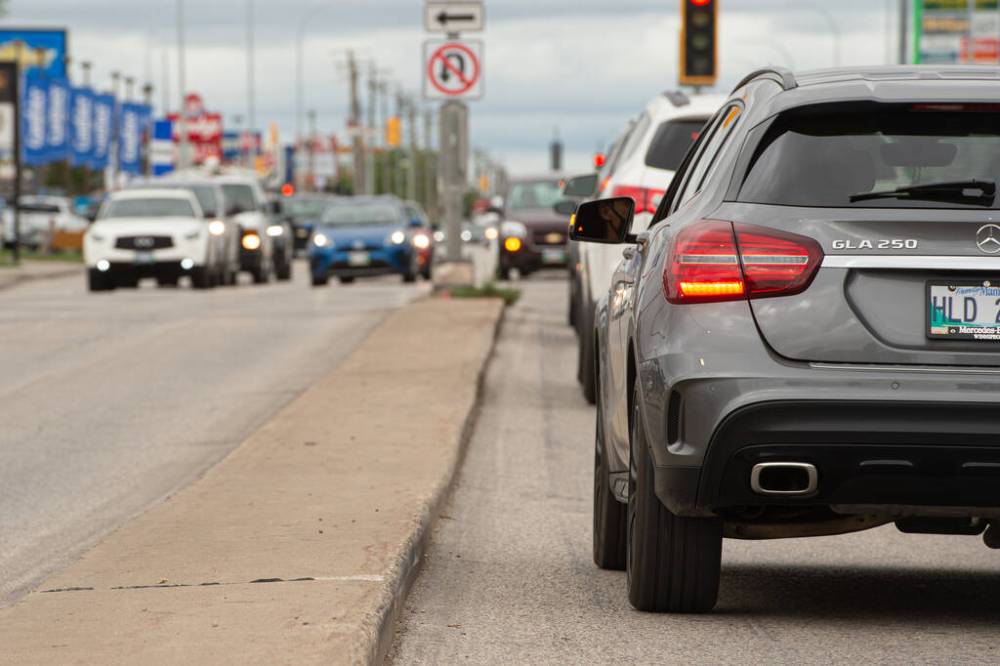
Traffic waits at a red light on McPhillips Street in Winnipeg. Cities built around a single transportation option, like private vehicles, are more vulnerable to disruption, Christopher J. Greyson-Gaito writes. (Mike Sudoma/Winnipeg Free Press files)
This price shock exposes a deeper vulnerability in Canadian cities: their dependence on cars. Around 80 per cent of commuters rely on private vehicles — 95 per cent of which are powered by internal combustion engines, driving demand for roughly 43 million cubic metres of gasoline each year.
Transportation accounts for a significant portion of household spending, particularly in car-dependent areas. When fuel prices rise, households have few alternatives and must pay the cost.
Cities built around a single transportation option, like private vehicles, are more vulnerable to disruption. Fuel price spikes make this vulnerability more visible. Furthermore, due to climate-induced extreme events and conflicts, plus future pandemics, oil price rises will not be the only stressors on our urban transportation systems.
Resilient urban mobility can be created by giving people options that ensure they can still move around when a shock affects one form of transportation. It also means providing options that reduce how much energy that transportation requires so that price hikes don’t affect people’s ability to get around. These options include electric vehicles, walking, cycling and public transit.
Developing alternatives
Electric cars would ensure continued transportation during an oil price spike. Cities can encourage greater uptake of electric cars by requiring a certain amount of electric car charging ports in new developments, grants for individual charger installation and zero emission zones.
In Norway, about 98 per cent of all new passenger car registrations are electric cars. This has been achieved through tax incentives at the national level and electric car charging mandates at the municipal level, among other initiatives. But relying solely on energy-intensive EVs does not provide multiple transportation options.
Cities have options to help residents bike and take public transportation in the short-term. One option is to build a grid of separated bicycle lanes. Seville, Spain, in comparison to Halifax, provides important lessons for building out such a grid.
Seville implemented its grid within two years, resulting in a significant increase in cycling trips. In comparison, Halifax has completed about half of its proposed network, with the rest dogged by political indecision.
Similar networks can be created for public transit. Separate bus rapid transit lanes with signal priority would increase ridership and improve the efficiency of bus operating budgets per user by increasing the speed of buses and preventing “bus bunching” — when two or more buses on the same route end up grouped together due to traffic or delays.
Prioritizing walkable cities
In the medium-term, cities can enact zoning reforms that promote walkable and transit-oriented neighbourhoods. A first policy is to remove parking minimums — the zoning laws that require a minimum number of parking spots for all developments. They cause urban sprawl, compelling people to drive.
A second policy is to allow developers to build single entry/exit buildings up to six storeys. Architects and researchers argue that single entry/exit mid-rise buildings are better for providing accessible, family-sized apartments in smaller lots, allowing more gentle density in transit and transportation priority areas.
The concern here for municipal and provincial regulators is of safety and how people can quickly exit buildings in an emergency if the single exit becomes blocked. However, for mid-rise apartment buildings (three to six storeys), proponents argue that safety concerns can be managed by mandating sprinklers and more advanced fire alarms.
Over the long term, cities can systematically update zoning rules to reorient transportation around walking, biking and public transit. Instead of separating residential and commercial zones that compel people to drive, cities can allow low-noise and low-pollution commercial units within residential areas.
Increasing the density of neighbourhoods, especially in downtown areas and along major transit corridors, would allow many more people to live and work in much more walkable areas.
Finally, governments should mandate that a certain percentage of housing units in a residential development must be three- to four-bedroom units. This would create more options for families and encourage them to live in denser neighbourhoods.
With the policy options outlined above and many more, cities can reduce dependence on cars. As a result, our cities will become easier to get around, more walkable and more resilient to future shocks.
» Christopher J. Greyson-Gaito is a postdoctoral researcher in the department of mathematics and statistics at McMaster University. His column first appeared at The Conversation Canada: theconversation.com/ca.