
Province owes explanation
Advertisement
Read this article for free:
or
Already have an account? Log in here »
We need your support!
Local journalism needs your support!
As we navigate through unprecedented times, our journalists are working harder than ever to bring you the latest local updates to keep you safe and informed.
Now, more than ever, we need your support.
Starting at $15.99 plus taxes every four weeks you can access your Brandon Sun online and full access to all content as it appears on our website.
Subscribe Nowor call circulation directly at (204) 727-0527.
Your pledge helps to ensure we provide the news that matters most to your community!
To continue reading, please subscribe:
Add Brandon Sun access to your Free Press subscription for only an additional
$1 for the first 4 weeks*
*Your next subscription payment will increase by $1.00 and you will be charged $20.00 plus GST for four weeks. After four weeks, your payment will increase to $24.00 plus GST every four weeks.
Read unlimited articles for free today:
or
Already have an account? Log in here »
Hey there, time traveller!
This article was published 05/01/2022 (1538 days ago), so information in it may no longer be current.
“This is a rapidly evolving situation. I think we’re going to continue to look at where we’re at and where we might end up being. If things change, they will be announced.”
— Dr. Jazz Atwal, deputy chief provincial public health officer, Tuesday afternoon
“We need to go to code red. We need new, different and better income supports for individuals as well as organizations and businesses as well as mental health supports. Every dollar we put into keeping a business running or making sure that people can pay their bills will ultimately be paid back. It’s an investment in recovery.”
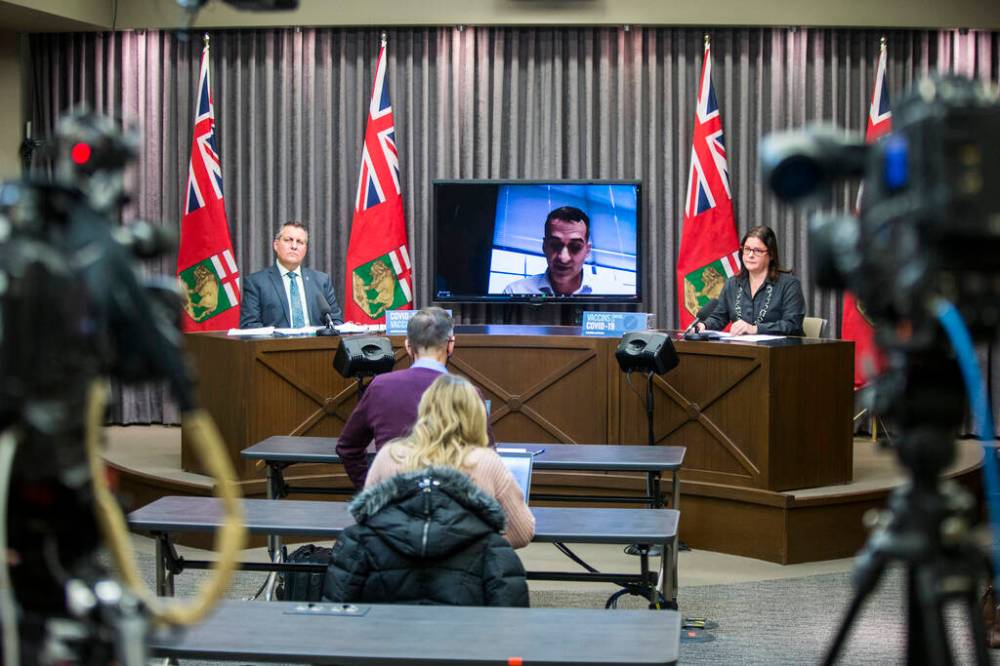
— Manitoba Liberal Leader Dougald Lamont, Tuesday morning
It is a curious situation we find ourselves in here in Manitoba this week. On Tuesday, the province reported 1,757 new cases of COVID-19 — most of these in Winnipeg, and 73 in Prairie Mountain Health — along with two more deaths from the virus.
In fact, since Friday, the province has recorded more than 7,100 new COVID-19 cases, a dramatic surge in number that far outstrips anything we have seen during this pandemic in any wave prior. As of yesterday, Manitoba has recorded 1,400 deaths from the virus, and the provincial government’s COVID-19 dashboard states there are currently 17,076 active cases.
CBC also reported that 251 people are in Manitoba hospitals due to the virus, up from 228 on Monday, with 32 of them in Manitoba ICUs. Note also that as of midnight Tuesday, there were 94 COVID and non-COVID patients in intensive care — the normal pre-COVID baseline capacity is 72 patients.
With this in mind, it’s a worthy question to ask why Manitoba is not in a code red right now. At the end of October 2020, Winnipeg and the districts surrounding Manitoba’s capital were moved to the province’s red (critical) level, the highest stage of the province’s pandemic response system. At that time, Manitoba had a “record high” test positivity rate of 8.6 per cent, with 104 people in hospital due to COVID-19 and only 19 COVID-infected patients filling intensive care beds.
“The numbers today will strike fear in many Manitobans,” Shared Health chief nursing officer Lanette Siragusa told media the day code red measures were announced.
Keep in mind that just yesterday, the province reported that Manitoba had a five-day test positivity rate of 39.5 per cent provincially — even higher than the 37.9 per cent reported only a day earlier.
And yet the province hasn’t activated code red and is not enacting lockdowns.
So why is the government’s response so different in this most recent wave of the virus? There are a few explanations, of course.
Although omicron, the latest variant of COVID-19, is substantially more infectious than previous versions, early evidence suggests it is less severe overall. As the New York Times reported this week, scientists measure the severity of a coronavirus variant “by examining how many people infected by it end up in the hospital.” And while the delta variant was far more severe than earlier iterations, the reverse is true for omicron, with the risk of hospitalization due to omicron about half that of delta, according to a U.K.-based study.
As a society, we’re also better protected than we were in 2020. The vaccines that rolled out in early 2021 have given most Manitobans a strong level of protection, even as booster shots are being promoted by government health officials to keep that protection strong against omicron, delta and any other new variants likely to come by.
At least 71 per cent of eligible Manitobans have been given either two or three doses of vaccine, with a further six per cent of us having had just one dose. Still, that leaves more than 22 per cent of Manitobans without any vaccine protection whatsoever.
And therein lies the danger, and why it still appears that the province is abdicating its responsibility to public health and safety. In spite of the fact that Premier Heather Stefanson told media yesterday that her government has been “proactive,” it really hasn’t.
Since the very beginning, health officials were mostly concerned with the possibility that an explosion of COVID-19 cases would overwhelm Manitoba hospitals, and they pleaded with Manitobans to heed public health orders. And while there were certainly problems in our health system at the start of the pandemic, we were arguably in a far better position than we are now.
There is a drastic nursing shortage in this province, as the two-year battle has prompted exhausted and burnt-out nurses to seek early retirements, quit outright or find work elsewhere in the profession.
Over the holidays, a shortage of nursing staff contributed to several rural Manitoba emergency departments being closed, including eight here in western and southwestern Manitoba.
With the number of hospitalized patients growing in harmony with the exponential growth in omicron cases, there is a real danger of hospitals being overwhelmed. If and when the omicron variant catches up to our health-care system, the province will have no excuse, as we’ve seen this happen before in three previous waves.
So, which “proactive” steps are Stefanson and her team taking? Handing out N95 masks at liquor stores and through MLA constituency offices, while being concerned that they’re undermining business interests by doing so?
Just yesterday, Education Minister Cliff Cullen bought educators and his government another week of grace by delaying the return of students to classrooms until Jan. 17 and imposing remote learning for a full week until that date.
Either the Stefanson government has lost the will to do what is necessary in the face of mounting public anger at yet another go-round on the COVID-19 roller-coaster, or they have information that they’re not disclosing to parents and the public at large.
The mealy-mouthed explanations we were given by Stefanson, Atwal and Cullen yesterday simply don’t cut it.