
Milei empowers Argentina to bar or deport foreigners over hateful remarks about the country
Advertisement
Read this article for free:
or
Already have an account? Log in here »
We need your support!
Local journalism needs your support!
As we navigate through unprecedented times, our journalists are working harder than ever to bring you the latest local updates to keep you safe and informed.
Now, more than ever, we need your support.
Starting at $15.99 plus taxes every four weeks you can access your Brandon Sun online and full access to all content as it appears on our website.
Subscribe Nowor call circulation directly at (204) 727-0527.
Your pledge helps to ensure we provide the news that matters most to your community!
To continue reading, please subscribe:
Add Brandon Sun access to your Free Press subscription for only an additional
$1 for the first 4 weeks*
- Enjoy unlimited reading on brandonsun.com
- Read the Brandon Sun E-Edition, our digital replica newspaper
*Your next Free Press subscription payment will increase by $1.00 and you will be charged $20.95 plus GST for four weeks. After four weeks, your payment will increase to $24.95 plus GST every four weeks.
Read unlimited articles for free today:
or
Already have an account? Log in here »
BUENOS AIRES, Argentina (AP) — After a bruising World Cup defeat gave way to what many Argentines saw as a sweeping wave of hatred against their country, Argentine President Javier Milei on Thursday signed an emergency decree empowering the government to deny entry to or expel foreigners who incite discrimination or violence against Argentines because of their nationality.
Milei’s office cast the decree as a response to weeks of criticism from celebrities, opposing fans and social media users after controversial refereeing decisions fueled speculation that FIFA had tilted the soccer tournament in favor of the Argentina team and superstar Lionel Messi. Detractors directed their anger about occasionally aggressive Argentine fans and the team’s roughhousing on the pitch not only at players but increasingly at Argentine society as a whole.
The measure adds new grounds to Argentina’s immigration law, allowing authorities to bar, deport and revoke visas of people found to have promoted hatred against Argentines in spoken or written statements or who have desecrated national symbols.
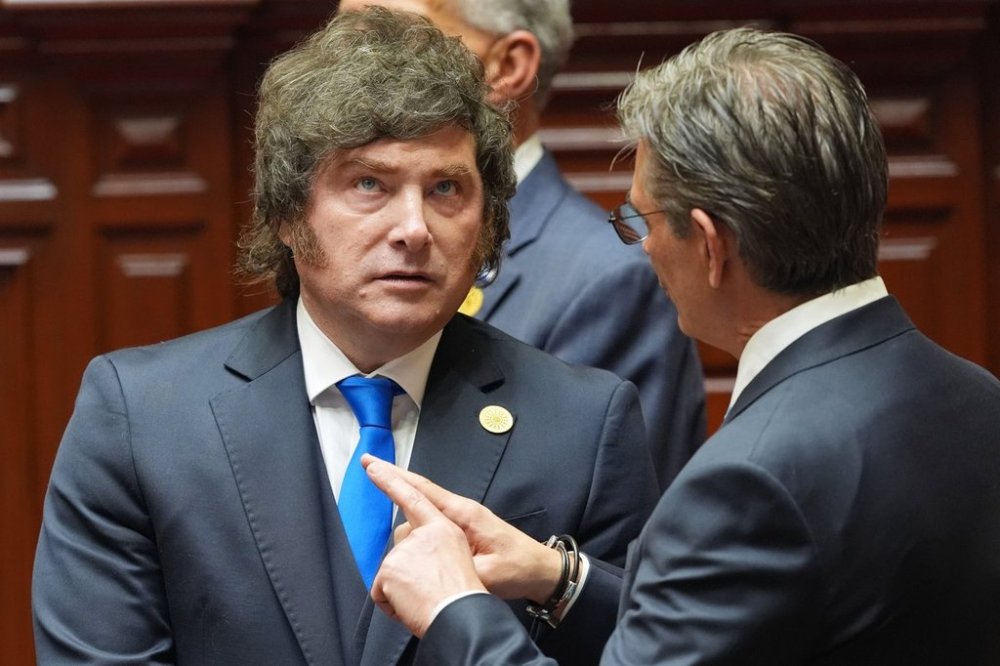
“In light of recent displays of hostility toward the Argentine Republic and Argentines, the national government reaffirms that the defense of the nation, its citizens and its symbols is non-negotiable,” the president’s office said. “Anyone who attacks the Argentine Republic is not welcome in our country.”
It’s a shift for a country that has long prided itself on welcoming immigrants. Argentina’s Constitution explicitly encourages immigration, and for decades the country has offered foreigners broad civil rights and relatively easy access to legal residency, public education and health care.
Milei, however, has introduced tougher immigration measures that have raised the bar for permanent residency and expanded government powers to deport foreigners accused of crimes, often publicizing the moves with rhetoric similar to that of the Trump administration.
The widespread scorn for Argentina has played on long-standing stereotypes, particularly in Latin America, that Argentines view themselves as culturally and economically superior to their neighbors, in part due to the large share of the population descended from European immigrants. The backlash intensified when Argentina players and staff attacked their Spanish opponents in a post-match brawl after the World Cup final. Online petitions to expel Argentina from the World Cup drew hundreds of thousands of signatures.
FIFA, global soccer’s governing body, on Wednesday opened disciplinary proceedings against the Argentine Football Association over the scuffle, as well as over alleged racist abuse and fan misconduct. Players also faced a FIFA investigation into their parading of a banner that asserted Argentina’s claim to the British-controlled Falkland Islands after the team’s semifinal victory over England.
Milei, a close ally of U.S. President Donald Trump, has described the torrent of criticism as a coordinated “anti-Argentina campaign.” He alleged without evidence last week that the left-wing governments of Brazil and Mexico and the U.S. Democratic Party had financed the campaign to undermine his right-wing libertarian administration. That helped trigger a diplomatic crisis with neighboring Brazil, which recalled its ambassador to Argentina over the accusations and Milei’s insults against Brazilian President Luiz Inácio Lula da Silva.
Thursday’s decree says the punishments don’t apply to ideological disagreement or political, academic or civic criticism protected under Argentina’s Constitution.
But it leaves unanswered how officials will distinguish protected speech from prohibited hate speech, whether immigration authorities will review foreigners’ social media activity and how aggressively the new powers will be enforced against tourists and longtime residents.
“Who and how will apply those grounds? How will it be determined that a person has engaged in such ambiguous assumptions as a ‘hate message’ toward the country or our population?” asked Maximiliano Ferraro, an opposition lawmaker, criticizing the decree as an unnecessary political gimmick.
“While the government wraps itself in Argentina’s sky-blue-and-white national colors for publicity, many of the policies it promotes are little more than exclusionary nationalist theater.”