
Indiana governor vetoes transgender girls sports ban
Advertisement
Read this article for free:
or
Already have an account? Log in here »
We need your support!
Local journalism needs your support!
As we navigate through unprecedented times, our journalists are working harder than ever to bring you the latest local updates to keep you safe and informed.
Now, more than ever, we need your support.
Starting at $15.99 plus taxes every four weeks you can access your Brandon Sun online and full access to all content as it appears on our website.
Subscribe Nowor call circulation directly at (204) 727-0527.
Your pledge helps to ensure we provide the news that matters most to your community!
To continue reading, please subscribe:
Add Brandon Sun access to your Free Press subscription for only an additional
$1 for the first 4 weeks*
*Your next subscription payment will increase by $1.00 and you will be charged $20.00 plus GST for four weeks. After four weeks, your payment will increase to $24.00 plus GST every four weeks.
Read unlimited articles for free today:
or
Already have an account? Log in here »
Hey there, time traveller!
This article was published 21/03/2022 (1455 days ago), so information in it may no longer be current.
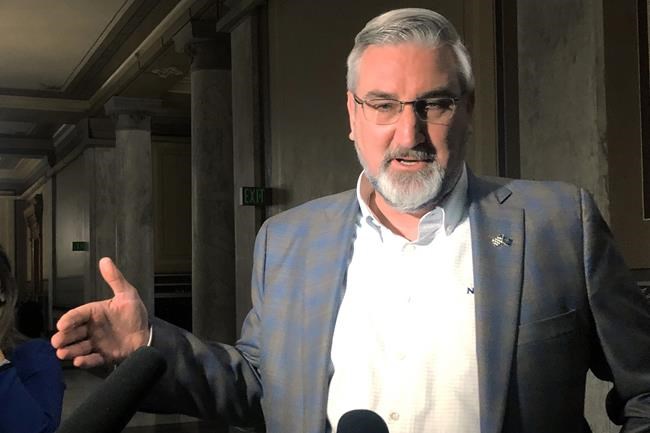
INDIANAPOLIS (AP) — Indiana’s governor on Monday vetoed a bill banning transgender females from participating in girls school sports while signing another eliminating the state’s permit requirement to carry handguns in public.
Republican Gov. Eric Holcomb’s decisions come after both measures faced intense opposition before being approved by the GOP-dominated legislature that embraced what have become a pair of conservative causes across the country.
The governor stayed on the sidelines as legislators debated both issues and made his decisions just before his Tuesday deadline to act.
Opponents of the transgender sports bill argued it was a bigoted response to a problem that doesn’t exist, with the American Civil Liberties Union of Indiana saying it planned a lawsuit against what it called “hateful legislation.”
Republican sponsors of the bill said it was needed to protect the integrity of female sports and opportunities for girls to gain college athletic scholarship but pointed out no instances in the state of girls being outperformed by transgender athletes.
Holcomb signaled support for the bill last month but said in his veto letter Tuesday that the legislation “falls short” of providing a consistent statewide policy for what he called “fairness in K-12 sports.”
Holcomb also pointed to the Indiana High School Athletic Association, which has a policy covering transgender students wanting to play sports that match their gender identity and has said it has had no transgender girls finalize a request to play on girls team.
“The presumption of the policy laid out in HEA 1041 is that there is an existing problem in K-12 sports in Indiana that requires further state government intervention,” Holcomb said in his letter. “It implies that the goals of consistency and fairness in competitive female sports are not currently being met. After thorough review, I find no evidence to support either claim even if I support the effort overall.”
Indiana lawmakers can override the governor’s veto with simple majorities in both the House and Senate. A veto override vote could happen as soon as May 24, which legislative leaders have scheduled as a tentative one-day meeting.
The Indiana law would prohibit K-12 students who were born male but who identify as female from participating in a sport or on an athletic team that is designated for women or girls. But it wouldn’t prevent students who identify as female or transgender men from playing on men’s sports teams.
Eleven other Republican-led states have adopted such laws that political observers describe as a classic “wedge issue” to motivate conservative supporters after the governors in Iowa and South Dakota signed their bans in recent weeks.
In signing the handgun permit requirement repeal, Holcomb went against the vocal opposition of his state police superintendent to the further loosening of the state’s lenient firearms laws.
The permit repeal, called “constitutional carry” by gun-rights supporters in reference to the Second Amendment, was criticized by major law enforcement groups who argued eliminating the permit system would endanger officers by stripping them of a screening tool for quickly identifying dangerous people who shouldn’t have guns.
Twenty-one other states already allow residents to carry handguns without permit — and Ohio’s Republican governor signed a similar bill last week.
Indiana State Police Superintendent Doug Carter joined leaders of the state’s Fraternal Order of Police, police chiefs association and county prosecutors association in speaking out against the change.
Carter, wearing his state police uniform, stood in the back of the Senate chamber as the bill was being debated. He said after the vote that approval of the measure “does not support law enforcement — period.”